
Emergency in the Jordan Valley: Colonists Wound 20, Destroy School in Overnight Raids
A wave of coordinated and violent attacks by Israeli colonists over a 48-hour period has devastated several Bedouin communities east of Tubas in the occupied West Bank, resulting in at least twenty Palestinian injuries and the forcible displacement of approximately 15 families from villages like Tayasir, Al-Maleh, and Khirbet Samra. The assailants not only physically assaulted residents but also engaged in a systematic campaign of terror, stealing livestock, vandalizing homes, and destroying a local school, which community leaders describe as part of a calculated pattern of violence to render life impossible. This latest escalation, occurring just two years after four neighboring communities were completely emptied, is viewed by analysts and international bodies as part of a broader, state-influenced strategy to achieve permanent demographic change in the Jordan Valley through impunity and the slow-motion erasure of Palestinian pastoral life.
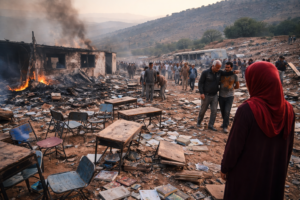
Emergency in the Jordan Valley: Colonists Wound 20, Destroy School in Overnight Raids
This is a breaking news story that demands more than just a replay of the facts. The dry statistics—twenty injured, fifteen families displaced—only hint at the deeper human tragedy unfolding in the occupied West Bank. To truly understand what is happening east of Tubas, we must look beyond the immediate headlines and explore the context, the human cost, and the calculated mechanics of this violence. Below is an original, in-depth feature that transforms the news report into a comprehensive analysis, offering genuine insight into the lives of those under attack and the forces driving them from their ancestral homes.
‘They Came at Night’: The Systematic Erasure of Bedouin Communities East of Tubas
TUBAS, West Bank — For the Bedouin shepherds of the northern Jordan Valley, the sunrise over the arid hills has always signified a time to lead their flocks to pasture. But on the morning of March 9, 2026, the light revealed a landscape of terror. In communities like Tayasir, Khirbet Samra, and the ancient Al-Maleh hot springs, the night had brought not silence, but the clash of violence and the cries of frightened children.
Over a harrowing 48-hour period, a wave of coordinated attacks by Israeli colonists has ripped through the Palestinian herding communities east of Tubas. According to Mahdi Daraghmeh, the head of the Al-Maleh village council, the violence was swift and brutal. Near Tayasir, colonists attacked Palestinians, leaving several injured and requiring hospitalization . In the Al-Maleh hot springs, they didn’t just assault people; they stole the very livelihood of a resident—his livestock—before moving on to vandalize homes and ransack a local school, destroying its contents . In Khirbet Samra, the assault took on a more sinister, psychological character, as armed colonists raided tents under the cover of darkness, terrorizing families, with women and children bearing the brunt of the fear .
This is not random violence. It is a familiar, methodical pattern. The result is devastating: at least twenty Palestinians injured and, most critically, approximately 15 families have been forcibly displaced from their homes, joining a growing exodus of Palestinians from the region . The attack serves as a grim reminder of a recent, painful past. Just two years ago, this same area witnessed the complete ethnic cleansing of about four Palestinian communities, emptied entirely by what the community leaders do not hesitate to call “colonist terrorism” .
A Pattern of Impunity and Displacement
The events of March 8-9 are not an anomaly but a dramatic spike in a relentless campaign. Just a day prior, on March 8, the nearby Bedouin community of Khirbet Yerza was effectively wiped off the map. Eleven Palestinian families there dismantled their own tents and homes, loading them onto trucks not in a move for better opportunity, but as a desperate act of survival. Local official Moataz Bisharat confirmed the families were forced to evacuate after “attacks reached dangerous levels,” describing a siege that included home invasions, physical assaults, and the systematic targeting of their herds—either by theft or killing .
This is the reality for these communities: a slow, grinding war of attrition designed to make life impossible. The data supports this lived experience. According to the Wall and Settlement Resistance Commission, the month of January 2026 alone saw a staggering 1,872 attacks by Israeli forces and settlers across the West Bank . This violence has a direct, causal link to displacement. The United Nations Office for the Coordination of Humanitarian Affairs (OCHA) reported that in January 2026, settler violence drove the highest number of Palestinians from their homes since the Gaza war began in October 2023, with nearly 700 people displaced . A significant portion of this displacement occurred in the Jordan Valley, including the entire herding community of Ras Ein al-Auja, where 130 families left after months of unrelenting harassment .
The Deeper Current: A Goal of ‘Permanent Demographic Change’
What connects the burning of a school in Al-Maleh to the displacement of families in Khirbet Yerza? Many analysts and international bodies see it as part of a larger, state-influenced strategy. The colonists do not operate in a vacuum. They move with a sense of impunity, often under the protection of the Israeli military, which is present during raids . This dynamic has led the United Nations human rights chief, Volker Türk, to issue a stark warning. “Taken together, Israel’s actions appear aimed at making a permanent demographic change in Gaza and the West Bank, raising concerns about ethnic cleansing,” Türk declared before the UN Human Rights Council in late February .
This goal was articulated in stark terms by Israeli Finance Minister Bezalel Smotrich, a settler himself, who vowed to “nullify the cursed Oslo Accords” and “embark on a path toward sovereignty, while encouraging emigration from both Gaza and Judea and Samaria” . Fathi Nimer, a researcher with the Palestinian think tank Al-Shabaka, distilled this ideology down to a brutal phrase used to describe Israeli settlement tactics: “They want maximum land and minimum Arabs” .
The Jordan Valley, with its strategic importance and fertile land, is ground zero for this vision. The attacks on the Bedouin are particularly effective because their communities are small, isolated, and largely unprotected. By targeting their schools, stealing their goats, and terrorizing their children at night, the colonists create an environment of such profound insecurity that leaving becomes the only rational choice. As one Palestinian villager from the south Hebron hills, Nasser, described after a similar attack, “In the night, home is supposed to be the safest place, but actually there is no safety at all” .
Echoes of the Past, A Plea for the Present
Standing amidst the wreckage of the Al-Maleh school, or on the wind-swept plains where the tents of Khirbet Yerza once stood, one hears the echoes of a history repeating itself. The names of the communities—Tayasir, Al-Maleh, Khirbet Samra—may be unfamiliar to the outside world, but for Palestinians, they are markers on a map of survival. They are the last stands of a pastoral way of life that has existed here for centuries.
The international community, focused on the devastating war in Gaza, has been accused of ignoring the slow-motion crisis in the West Bank. “All eyes are focused on Gaza when it comes to Palestine, while we have an ongoing ethnic cleansing in the West Bank and nobody’s paying attention,” said Allegra Pacheco of the West Bank Protection Consortium .
As the 15 displaced families from this latest wave of violence seek shelter elsewhere, and as the injured recover in Tubas hospitals, the question remains: who will ensure that Khirbet Samra does not become another ghost community, joining the four that were emptied two years ago? The colonists came at night, and when the sun rose, another piece of Palestine had vanished.
You must be logged in to post a comment.