
Elon Musk’s H-1B Visa Critique: Navigating the Thin Line Between Talent Access and System Gaming
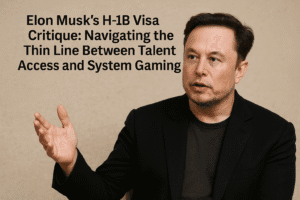
Elon Musk’s H-1B Visa Critique: Navigating the Thin Line Between Talent Access and System Gaming
The Dual Edges of America’s High-Skilled Immigration System
The H-1B visa program, long considered the cornerstone of America’s ability to attract global talent, stands at a critical crossroads amid proposed policy changes and mounting criticism about its implementation. Recently, Tesla CEO Elon Musk added his influential voice to this complex conversation during a wide-ranging interview on Zerodha co-founder Nikhil Kamath’s “People by WTF” podcast, offering a perspective that neither fully endorses nor completely condembs the controversial program. While acknowledging systemic exploitation by certain outsourcing companies, Musk simultaneously warned that dismantling the program entirely would be “very bad” for American innovation and competitiveness—a nuanced position that reflects the program’s complicated reality .
This analysis examines the multifaceted dimensions of the H-1B debate, exploring the historical context behind current vulnerabilities, the economic implications of proposed policy changes, and potential pathways toward a more equitable system that preserves America’s access to global talent while addressing legitimate concerns about abuse and domestic workforce protection.
Musk’s Nuanced Position: Criticism Without Condemnation
During his conversation with Kamath, Musk articulated a carefully balanced perspective on high-skilled immigration, acknowledging both the program’s value and its flaws. “America has benefitted immensely from talented Indians that have come to America,” Musk stated, pushing back against growing anti-immigration sentiments . His comments affirmed Kamath’s observation that the United States has historically attracted “really smart people” from around the world, though the Indian entrepreneur noted an apparent shift in recent years, recounting his own anxiety while passing through U.S. immigration: “I was worried whether I would be stopped” .
Where Musk’s commentary became particularly insightful was in his specific critique of program implementation. “There’s been some misuse of the H-1B Program… some outsourcing companies have kind of gamed the system,” he observed . This acknowledgment of structural vulnerabilities aligns with mounting evidence that certain firms have exploited loopholes to gain unfair advantages in the visa lottery system. Yet despite these concerns, Musk explicitly rejected calls from some conservative groups to eliminate the program entirely: “I’m not in the school of thought that we should shut down the H-1B Program… that would actually be very bad” .
Beyond his H-1B specific comments, Musk contextualized the immigration debate within broader political divisions, noting that “the left wants to basically have open borders,” while “on the right, you’ve got at least a perception that somehow their jobs are being taken by talented people from other countries” . He particularly criticized the Biden administration’s border policies as “a total free-for-all with no border controls,” while maintaining that in his business experience, “we have a lot of difficulty finding enough talented people to get these difficult tasks done. And so more talented people would be good” .
Historical Context: How Systemic Vulnerabilities Emerged
To understand Musk’s critique of system “gaming,” one must examine the historical development of the H-1B program, which originated with the Immigration Act of 1990 signed by President George H.W. Bush . Originally designed to address perceived labor shortages in specialized fields, the program’s structural flaws were embedded from its inception through intense corporate lobbying efforts.
Newly uncovered documents from 1990 House and Senate Immigration Subcommittees reveal how major American multinationals, acting through lobbying groups such as the American Council for International Personnel (ACIP) and the Business-Immigration Coalition (BIC), successfully shaped the program to prioritize employer interests over worker protections . A key figure in this process was Harris Nathan Miller, who represented business interests throughout the legislative process and later became president of the Information Technology Association of America (ITAA), where he continued advocating for program expansion .
Several critical concessions were made during the program’s formation that created vulnerabilities later exploited by outsourcing firms:
- Weakened Labor Attestation: The original bill required employers to attest to “positive recruitment” of American workers and specific actions taken to find domestic candidates. The final version replaced this with a simpler Labor Conditions Application (LCA) that only required employers to attest they were paying prevailing wage .
- Accelerated Processing: The 1991 Miscellaneous and Technical Immigration and Naturalization Amendments required the Secretary of Labor to approve LCAs within seven days, reviewing them only for “completeness and obvious inaccuracies,” effectively eliminating meaningful oversight .
- Dual Intent Provision: The program allowed workers to seek permanent residency while on temporary visas, contrary to the original “temporary intent” requirement that mandated workers return home after visa expiration .
These design flaws created an environment where large outsourcing firms could submit massive numbers of applications for relatively lower-wage positions, effectively crowding out other employers and applicants from the limited visa pool.
The $100,000 Fee Proposal: Economic Implications and Market Responses
The Trump administration’s recent proposal to impose a $100,000 fee on new H-1B applications represents the most dramatic potential change to the program in decades . announced on September 19, 2025, this policy would fundamentally reshape the economic calculus of hiring skilled foreign workers, particularly affecting certain sectors and business models.
Table: H-1B Visa Distribution by Sector and Potential Fee Impact
| Sector | Percentage of H-1B Workers | Median Wage | Vulnerability to Fee |
| IT Services | 54% | $92,600 | High |
| Universities/Research | 6% | $64,610 | Very High |
| Software Publishing | 12% | $115,000 | Medium |
| Financial Services | 8% | $130,000 | Low-Medium |
| Advanced Manufacturing | 7% | $105,000 | Medium |
Research from the Federal Reserve Bank of Richmond suggests the policy would likely reduce the total number of college-educated immigrants in the U.S., with IT sector companies and universities among the most affected organizations . The economic analysis indicates that firms would only find it worthwhile to pay the $100,000 fee for positions earning above approximately $225,000 annually—a threshold that excludes most current H-1B holders .
The distributional consequences of this policy change would be significant. While major tech companies like Amazon, Microsoft, Meta, and Google—which typically pay higher wages and have H-1B denial rates below 1%—might continue participating in the program, outsourcing firms with historically higher denial rates would likely be priced out . Perhaps most concerning is the potential impact on universities and research institutions, where median H-1B wages are just $64,610—far below the economic threshold that would justify the new fee . This threatens to disrupt the pipeline of academic research talent and potentially undermine America’s long-term innovation capacity.
Notably, research shows that restrictions often lead to unintended consequences, including operations offshoring. When U.S. firms face difficulties hiring H-1Bs, they increasingly shift operations abroad, particularly to India and Canada . This phenomenon suggests that restrictive policies may not protect American jobs but simply relocate them outside U.S. borders.
The Genuine Economic Value of H-1B Visa Holders
Despite the legitimate concerns about program gaming, evidence suggests that H-1B visa holders contribute significantly to American economic dynamism and innovation. Rather than displacing native workers, research indicates that skilled immigration often complements domestic workforce capabilities and stimulates job creation.
A 2024 working paper examining the H-1B lottery system found that companies winning the lottery expand employment and revenues and are more likely to survive in subsequent years . Crucially, the research found “no evidence that hiring H-1B workers displaces native college-educated workers” . Instead, the biggest beneficiaries appear to be small, high-productivity firms, which not only grow faster but also hire more native graduates after bringing in immigrant talent—suggesting complementarity rather than competition between domestic and foreign workers.
Table: Economic Benefits of H-1B Visa Program
| Benefit Category | Mechanism | Impact |
| Firm Growth | Access to specialized skills | Higher revenue, employment, and survival rates |
| Native Worker Opportunities | Complementarity effects | Increased hiring of native graduates at expanding firms |
| Innovation | Research and development contributions | Patents, startups, and technological breakthroughs |
| Global Competitiveness | Specialized talent access | Enhanced ability to compete in international markets |
| Consumer Benefits | Production cost reductions | Lower prices and increased purchasing power |
The economic contributions extend beyond immediate employment effects. At the macroeconomic level, estimates suggest that a permanent 10% reduction in college-educated immigrants—most of whom come through the H-1B program—would lower annual welfare for U.S. natives by approximately $2.9 billion . These gains operate through two primary channels: H-1B workers often perform tasks that complement those of native workers, raising overall demand, and by lowering production costs, immigrant labor reduces prices, boosting the purchasing power of U.S. consumers .
Beyond Musk: The Broader Immigration Policy Context
Musk’s comments reflect broader tensions in American immigration policy that extend beyond the H-1B program specifically. His criticism of “open borders” progressives and job protection conservatives highlights the political polarization that has complicated comprehensive immigration reform . This ideological divide has created a policy environment where extreme positions often dominate discourse, leaving little space for nuanced solutions that both control borders and facilitate legal immigration pathways for needed talent.
The data reveals substantial public benefits from well-managed high-skilled immigration. According to the American Immigration Council, “unemployment rates are relatively low in occupations that employ large numbers of H-1B workers” , contradicting narratives about widespread displacement of American workers. Similarly, H-1B visa holders themselves frequently create new businesses, expanding the U.S. labor market rather than constricting it .
The fundamental challenge lies in balancing several competing objectives: maintaining U.S. access to critical global talent, protecting domestic workers from genuine displacement or wage suppression, preventing system exploitation by bad actors, and preserving America’s character as a nation of immigrants while maintaining orderly border processes.
Pathways Forward: Principles for Balanced Reform
Musk’s commentary—critiquing system gaming while defending the program’s fundamental value—suggests the need for targeted reforms rather than wholesale elimination. Several principles could guide such reform efforts:
- Differentiate Between Users: Policy should distinguish between companies using H-1Bs to access genuinely specialized skills unavailable domestically and those using the program primarily for cost arbitration. Fee structures, lottery weights, or approval criteria could be calibrated to prioritize employers offering higher wages or demonstrating substantial domestic recruitment efforts.
- Preserve Access for Critical Institutions: Universities, research organizations, and nonprofit institutions play unique roles in the innovation ecosystem. Their continued access to global talent—perhaps through modified fee structures or separate visa categories—remains essential for maintaining America’s scientific leadership.
- Address Legitimate Gaming: The system’s vulnerability to exploitation by outsourcing companies submitting massive application volumes could be addressed through per-company application caps, higher fees for bulk filers, or modified lottery systems that reduce the advantages of scale.
- Strengthen Enforcement: Enhanced oversight and enforcement of existing program requirements—including prevailing wage regulations and domestic recruitment mandates—could address abuses without reducing legal immigration pathways.
- Complement Rather Than Replace: Policies should emphasize skilled immigration as a complement to rather than replacement for domestic workforce development, potentially pairing H-1B reforms with expanded investments in STEM education and vocational training.
Conclusion: Beyond Binary Choices
Elon Musk’s nuanced perspective on the H-1B program reflects a broader truth about skilled immigration: it resists simplistic binary frameworks. The program is simultaneously valuable and vulnerable, essential for American competitiveness yet requiring thoughtful reform. As Musk noted, the United States has “long benefitted from talented Indians” and other global professionals , yet this reality coexists with legitimate concerns about system integrity and domestic worker protection.
The coming years will likely see continued debate and potential transformation of America’s high-skilled immigration system. The proposed $100,000 fee—while dramatic—represents just one possible approach to rebalancing program objectives. Whatever policy direction emerges, the ultimate test will be whether it preserves America’s ability to attract the world’s best talent while addressing the legitimate concerns about program integrity that Musk and others have raised.
In this sense, the H-1B debate serves as a microcosm of larger questions about America’s place in a globalized economy: how to remain open to the world’s talent while protecting national interests, how to embrace globalization’s benefits while mitigating its disruptions, and how to evolve institutions designed for a previous era to meet contemporary challenges. The path forward lies not in isolationism or unconstrained openness, but in the thoughtful calibration that Musk’s comments implicitly endorse—recognizing both the program’s value and its vulnerabilities, and building solutions that preserve the former while addressing the latter.
You must be logged in to post a comment.