
Drawing the Line: How Indian Courts Are Redefining the Boundaries of State, Rights, and Judicial Power
The recent flurry of rulings from Indian courts collectively underscores the judiciary’s critical role in meticulously defining the boundaries of state power, individual rights, and its own authority. From the Delhi High Court clarifying that bar associations are private bodies beyond writ jurisdiction, to the Supreme Court staying a blanket highway liquor ban to respect precedent and nuance, these decisions reveal a system engaged in constant boundary-setting.
The courts are simultaneously restraining themselves from overreach into private disputes, scrutinizing executive actions for proportionality, protecting citizens from procedural arbitrariness, and untangling conflicting legislative mandates. This judicial activity, spanning issues from religious festivals to corporate liability, demonstrates not just the resolution of isolated disputes, but the ongoing and diligent work of sculpting the contours of India’s legal landscape by balancing authority, autonomy, and constitutional fairness.
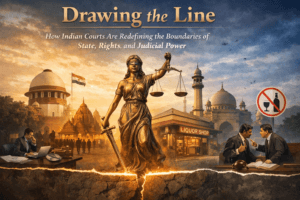
Drawing the Line: How Indian Courts Are Redefining the Boundaries of State, Rights, and Judicial Power
In a single day across courtrooms in Delhi, Kerala, and Karnataka, a series of judicial pronouncements painted a fascinating portrait of Indian jurisprudence in action. These rulings, while arising from disparate facts—a lawyer’s chamber dispute, a religious festival, a corporate investigation, a political scam, a tenancy law, and a highway liquor ban—collectively grapple with a fundamental question: Where does the state’s authority end, and where do the domains of private bodies, individual rights, and judicial restraint begin? This legal tapestry reveals a judiciary meticulously drawing lines, balancing power, and defining the very architecture of governance and justice.
The Private Realm: Bar Associations and the Limits of Writ Jurisdiction
The Delhi High Court’s crisp ruling in Sangita Rai v New Delhi Bar Association serves as a masterclass in constitutional limitation. By unequivocally declaring a bar association a private body outside the definition of “State” under Article 12, the court reinforced a critical boundary. The writ of mandamus under Article 226, a powerful tool for enforcing public duties, cannot be wielded against private entities pursuing their internal, member-centric interests.
The Human Insight: This isn’t a mere technicality. It protects the autonomy of professional and civil society organizations from being micromanaged by constitutional courts. The court essentially advised the aggrieved lawyer to seek redress through the Bar Council—the designated self-regulatory professional body—or civil and criminal remedies. This underscores a vital principle: the Constitution’s extraordinary writ jurisdiction is not a substitute for all other legal avenues. It ensures the judiciary’s immense power is reserved for checking state overreach, not settling every private dispute.
State Power vs. Religious Practice: The Calculus of Regulation
Simultaneously, in Kerala, the High Court’s interim proceedings in the Thirunavaya Mahamagh Mahotsavam case present a contrasting scenario—the state’s regulatory arm in potential tension with religious expression. The village officer’s stop memo, citing a law designed to prevent riverbank encroachment and sand mining, threatened a major pilgrimage revival. The petitioners argued this was a misuse of power, as the law’s intent wasn’t to halt religious gatherings where no sand mining occurred.
The Human Insight: This case sits at the classic intersection of state duty (to protect the environment and public safety) and the fundamental right to religious practice. The court’s call for the government’s response indicates a need to scrutinize the proportionality of the action. Was halting all preparations a justified, narrow measure, or a blunt overreach? The outcome will hinge on whether the state can demonstrate a real, tangible threat from the temporary bridges, balancing its regulatory mandate with the citizens’ right to celebrate faith.
Procedure as Protection: Delayed Actions and Hereditary Liability
The Karnataka High Court’s stay on FEMA proceedings against Malavika Hegde highlights the judiciary’s role as a guardian of procedural fairness and reasonableness. The core arguments—inordinate delay (12 years after the transactions) and the question of liability extending to a legal heir for alleged personal contraventions—strike at the heart of equitable justice.
The Human Insight: Law is not just about substantive guilt or innocence; it’s about the fairness of the process. A 12-year delay in initiating proceedings can prejudice defense, erode evidence, and render the action itself punitive. Similarly, the question of whether a widow can be held liable for her deceased husband’s alleged corporate actions touches on deep legal and moral principles of personal culpability. The court’s intervention signals that agencies must act within a reasonable timeframe and cannot expand liability arbitrarily, ensuring laws are applied with humane consideration.
The Courtroom as an Arena: Decorum and the Zeal of Advocacy
The heated exchange between Kapil Sibal and ASG SV Raju in the Delhi High Court, while undeniably dramatic, reveals the intense pressure-cooker environment of high-stakes litigation. Accusations of misleading the court between senior counsels are serious. Sibal’s retort, “You are not the judge,” is a stark reminder of the distinct roles within the courtroom: the advocate argues, the judge adjudicates.
The Human Insight: Such clashes, though uncomfortable, are sometimes the byproduct of a robust adversarial system where passionate advocacy meets rigorous counter-argument. The judge’s role in calming tensions and focusing on the legal issues is paramount. This incident underscores that the pursuit of justice, even when fiercely contested, must ultimately operate within a framework of mutual, if sometimes strained, professional respect, lest it devolve into mere theater.
Legal Overlap and the Search for Harmony: The Waqf Act Challenge
The challenge to the new Waqf Act’s provisions in Delhi demonstrates the complex layering of laws in a modern state. The petitioners argue that the Act, by allowing the Waqf Tribunal to decide eviction matters, overrides the specific protections of the Delhi Rent Control Act. This creates a conflict between a special religious endowment law and a general socio-economic tenancy law.
The Human Insight: Legislatures often enact laws for specific sectors, but they cannot operate in a vacuum. When a new law threatens to nullify the protections of an older, welfare-oriented legislation, it creates a crisis for citizens caught in the middle. The court’s notice acknowledges this genuine clash. The constitutional test will be whether this overlapping jurisdiction is a justified special provision for managing waqf properties efficiently or an arbitrary violation of the right to equality and property of tenants.
Judicial Hierarchy and Policy Nuance: The Liquor Ban Stay
Finally, the Supreme Court’s stay of the Rajasthan High Court’s blanket order on highway liquor shops is a lesson in judicial hierarchy and nuanced policy application. While applauding the High Court’s genuine concern for road safety, the Supreme Court pointed to its own precedent—which exempts shops within municipal limits.
The Human Insight: This illustrates the doctrine of stare decisis (precedent) in action. High Courts are bound by the letter and spirit of Supreme Court rulings. The Supreme Court recognized that the High Court’s well-intentioned zeal led to an order that ignored this settled nuance. The anecdote shared by the Solicitor General about the beggar near the liquor shop, while humorous, subtly pointed to the complex reality of enforcement and indirect advertising. The Supreme Court’s role here is to ensure uniformity in law while inviting the state to find smarter, more nuanced policy solutions for the future, rather than endorsing a sweeping judicial fix.
The Unifying Thread: A Judiciary Defining Its Own Domain
Together, these cases show an Indian judiciary engaged in continuous self-definition and boundary-setting. It is:
- Restraining itself from overreach into private disputes (Bar Association).
- Scrutinizing the executive to ensure proportionality and lawful authority (Kerala Festival).
- Protecting citizens from procedural arbitrariness and delayed state action (FEMA case).
- Managing its own arena to preserve decorum and the integrity of process (Courtroom exchange).
- Untangling legislative knots to protect citizens from conflicting laws (Waqf Act).
- Enforcing its own hierarchy to maintain consistency in national jurisprudence (Liquor ban).
This is not a judiciary acting in unison on a single policy, but one thoughtfully applying constitutional principles across the vast spectrum of Indian life. The real insight is that the health of a democracy is reflected not in one monumental ruling, but in the daily, diligent work of drawing these lines—between state and citizen, public and private, power and right, zeal and order. In doing so, the courts are not just resolving disputes; they are actively sculpting the contours of India’s evolving legal and social landscape.
You must be logged in to post a comment.