
Dixon Tech Crashes 3% After HKC JV Approval: Why Are Investors Selling?
Despite receiving long-awaited government approval for its strategic display manufacturing joint venture with China’s HKC Overseas—a move that enables deep backward integration and captures higher value in the electronics supply chain—Dixon Technologies’ share price dropped nearly 3%, illustrating a classic “buy the rumour, sell the news” market reaction where short-term traders booked profits after the initial 7% rally on the clearance. While the approval removes a major regulatory overhang and positions Dixon for significant margin expansion by FY28, near-term headwinds such as surging DRAM prices squeezing smartphone demand, high valuation multiples, and a pause in immediate catalysts are driving the current volatility, forcing investors to weigh the company’s transformative long-term potential against the immediate earnings pressures.
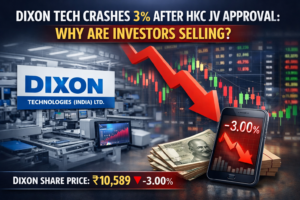
Dixon Tech Crashes 3% After HKC JV Approval: Why Are Investors Selling?
Excellent news story to work with. The divergence between the “good news” of the JV approval and the “bad news” of the stock price drop provides a perfect hook for a deeper, more insightful analysis. Readers don’t just want to know what happened; they want to understand why.
This article will dissect the market’s seemingly illogical reaction, explore the strategic importance of the HKC joint venture, and weigh the bullish long-term potential against the very real short-term headwinds. The goal is to provide a balanced, data-driven perspective that helps investors make sense of the noise.
Dixon’s Display JV Gets Green Signal, But Why Are Investors Hitting The Panic Button?
Dixon Technologies (India) Ltd received a long-awaited gift from the government this week: approval for its display manufacturing joint venture with China’s HKC Overseas. Normally, such a strategic nod—especially one caught in regulatory crosshairs for months—would be a cause for celebration. Yet, in a classic case of “buy the rumour, sell the news,” Dixon’s share price dropped nearly 3% on Wednesday, leaving retail investors scratching their heads .
As of March 11, 2026, the stock was trading at ₹10,589 on the NSE, down from its intraday high of ₹11,050. While the headline numbers suggest a negative market reaction, the reality beneath the surface is far more nuanced. For long-term investors, this isn’t just a story about a one-day price fall; it is a masterclass in how markets digest complex geopolitical approvals, margin pressures, and the arduous journey of backward integration.
Here is the original story first published on GoodReturns:
GoodReturns Dixon Tech Share Price Today Drops After Government Approval for HKC Joint Venture; Know Why Stock is Falling
Shares of Dixon Technologies Ltd declined on Wednesday even after the company secured government approval for a proposed display manufacturing joint venture with HKC Overseas Limited…
Let’s break down the real story behind the stock’s movement and what this JV actually means for the future of electronics manufacturing in India.
The Great Paradox: Why Did the Stock Fall on Good News?
To understand Wednesday’s price action, we have to look at the market’s memory over the preceding week. When the Ministry of Electronics and Information Technology (MeitY) first cleared the HKC proposal, the street reacted with euphoria. On March 9, Dixon shares soared over 7%, reclaiming the psychologically important ₹10,500 level .
However, the glow of that rally faded quickly as investors turned their attention from “the approval” to “the fine print” and the prevailing macroeconomic conditions affecting the broader market.
- The Valuation Reality CheckDespite a 40% correction from its 52-week high of ₹18,471 (touched in September 2025), Dixon is not a cheap stock. Brokerage firm Jefferies recently flagged that the stock still trades at a Price-to-Earnings (P/E) ratio of around 47x . While growth stocks command premiums, the current valuation leaves very little room for error. When a stock is priced for perfection, even a slight headwind—or in this case, the absence of immediate positive catalysts—can trigger profit-taking.
- The “De-risking” EventParadoxically, once the JV approval was announced, the immediate catalyst for a rally was gone. This is what traders call a “de-risking” event. For months, the uncertainty surrounding Press Note 3 (PN3) approvals had been an overhang on the stock. Now that the uncertainty is resolved, some short-term traders who bet on the approval exiting their positions to book profits.
- The Ghost of DRAM Prices and PLIWhile the display JV is a long-term positive, the near-term earnings outlook for Dixon remains clouded. Jefferies pointed out that global smartphone shipments—a key revenue driver for Dixon—could fall by 31% in calendar year 2026 . This is largely due to a massive surge in DRAM (memory) prices, which have shot up by 70% in Q1 2026 due to AI-driven demand. Since DRAM constitutes a significant chunk of raw material costs, this margin squeeze is spooking investors more than the JV benefits, which will only start accruing in FY28 .
Decoding the HKC Joint Venture: More Than Just Another Factory
So, if the near-term is hazy, why are long-term analysts like Nomura, Emkay, and IIFL still bullish? The answer lies in what this specific JV represents: a quantum leap in the value chain.
The Structure of the Deal Dixon Technologies signed a share subscription and shareholders’ agreement with HKC Overseas Limited (an affiliate of HKC Corporation) back in August 2025 . The approval received this week allows HKC to invest in Dixon’s wholly-owned subsidiary, Dixon Display Technologies Private Limited (DDTPL) .
- Shareholding Pattern: Dixon will hold 74%, while HKC will acquire a 26% stake.
- Regulatory Clearance: Because HKC is a Chinese affiliate, the investment required approval under Press Note 3 (2020), which regulates FDI from countries sharing a land border with India .
What Will They Manufacture? The JV is not just another assembly line. It is aimed at manufacturing high-value display modules, including:
- Thin-Film Transistor LCDs (TFT-LCD)
- Liquid Crystal Modules
- Advanced display components
These modules will cater to a massive range of products: smartphones, notebooks, televisions, automotive displays, and industrial equipment .
The Numbers Game Display modules account for roughly 10-12% of the Bill of Materials (BoM) for a smartphone . By localizing this, Dixon isn’t just assembling phones; it is owning a chunk of the intellectual property and value addition. According to Nomura, the display business alone could add about 50-100 basis points to Dixon’s overall margins by FY28 .
The Investment Ramp-up Dixon is expected to invest around ₹1,100-1,200 crore in this project. Phase 1 aims for an annual capacity of 24 million smartphone displays and 2 million laptop displays. Trial production is likely by June-July 2026, with commercial production scaling up in the second half of FY27 .
A Policy Shift: The “China Plus One” Gets a Green Channel
One of the most underappreciated aspects of this story is the signal it sends about India’s evolving stance on Chinese investments. Post the Galwan clashes in 2020, Press Note 3 effectively froze FDI from China, requiring specific government clearances. This created a massive bottleneck for electronics companies that rely on Chinese technology partners for high-end components.
The 60-Day Window Market experts like Renu Baid Pugalia of IIFL Capital highlight that the approval for Dixon-HKC comes at a time when the government is amending the PN3 framework. New proposals are now likely to be cleared within a structured 60-day timeline .
This is a game-changer. It means that Dixon’s other stalled venture—the proposed JV with Vivo—now has a clear path to approval. Pugalia notes that factories for these projects are almost ready. Once the Vivo JV clears, Dixon’s mobile volumes, which have been stagnant due to inventory issues, are poised for a sharp revival .
The Analyst Verdict: Divided by Time Horizons
The divergence in analyst ratings on Dixon perfectly captures the stock’s current dilemma.
The Near-Term Pessimists (Jefferies) Jefferies maintains a “Hold” rating with a target price of ₹11,350. Their caution stems from the high base effect of valuation and the immediate threat of rising DRAM prices impacting smartphone demand. They argue that while the JV is good, it doesn’t solve the demand slump happening right now .
The Long-Term Bulls (Nomura, Emkay, Motilal Oswal)
- Nomura has a “Buy” with a target of ₹14,678, valuing the stock on FY28 earnings. They see the HKC partnership as a validation of Dixon’s ability to execute complex backward integration .
- Emkay Global is even more bullish with a target of ₹15,200. They believe the clearance of the HKC JV improves the odds for the Vivo JV approval, which could add significantly to the order book. They estimate a 48% EPS CAGR between FY25 and FY28 .
- Motilal Oswal retained a “Buy” with a target of ₹16,700 (post a 46% stock correction), arguing that the current price already bakes in the uncertainties of the mobile business .
Why Dixon is Betting Big on “Backward Integration”
To understand Dixon’s strategy, you have to look at their margins. As a pure-play Electronics Manufacturing Services (EMS) provider, Dixon’s EBITDA margin hovers around a slim 4% . Assembly is a high-volume, low-margin game.
However, components are a high-margin game.
- Camera Modules: Dixon is already ramping up camera module production.
- Display Modules (HKC JV): This captures the 10-12% value of the screen.
- Power Equipment: Experts suggest that similar JV structures could soon be applied to power equipment like GIS (Gas Insulated Switchgear), opening a new frontier for Dixon beyond consumer electronics .
By integrating backwards—making the parts rather than just putting them together—Dixon aims to capture the profits that were previously exported to China, Taiwan, or Korea. This aligns perfectly with the government’s deeper vision of a self-reliant electronics ecosystem.
The Road Ahead: Patience is a Virtue
For the average investor watching the red numbers on March 11, it is easy to feel anxious. But the Dixon story is a test of patience.
The HKC JV is a structural upgrade for the company, not a quarterly earnings booster. The financial impact of this display plant will only start flowing in from FY28 onwards . Between now and then, the company must navigate:
- High memory prices suppressing demand for budget smartphones.
- PLI scheme uncertainty (the mobile PLI is expiring, and the extension is still unclear).
- The actual setup and operationalization of the Noida display plant.
However, for those with a 2-3 year horizon, the setup is compelling. Dixon is transforming from an “assembler” to a “manufacturer” in the truest sense. The government approval for the HKC JV isn’t just a regulatory tick-mark; it is a signal that India is ready to let global tech flow in, provided it results in local manufacturing and job creation.
The Final Takeaway Don’t read Wednesday’s 3% drop as a rejection of the HKC deal. Read it as the market recalibrating its expectations. The low-hanging fruit of the “approval rally” is gone. Now comes the hard part—execution. If Dixon can successfully ramp up display production and secure the Vivo JV, the current price of ₹10,500 may well be looked back upon as a significant entry point in the company’s journey up the electronics value chain.
You must be logged in to post a comment.