
Disrupting the Discounts: When Activism Intersects with Holiday Shopping Rituals
Disrupting the Discounts: When Activism Intersects with Holiday Shopping Rituals
Beyond the Sales: The Strategic Stage of Boxing Day Protests
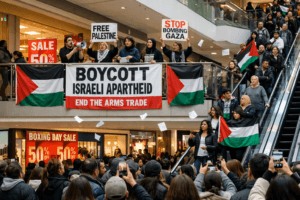
The day after Christmas in much of the Commonwealth is traditionally reserved for two things: rest from familial obligations and the relentless pursuit of discounted goods. Boxing Day sales have become a secular holiday ritual, a spectacle of consumerism where malls transform into temples of commerce. This year, however, the corridors of Westfield Stratford City in London and Toronto’s Eaton Centre witnessed a different kind of spectacle. Anti-Israel activists, aligning themselves with groups like Prayers for Gaza and the Palestinian Youth Movement, strategically chose this high-traffic day to stage disruptive protests, hanging Palestinian flags, dropping pamphlets, and chanting demands for arms embargoes and the release of jailed activists.
This convergence of high-stakes geopolitical advocacy with one of the retail calendar’s most sacred days is not a random act of disruption. It represents a calculated evolution in protest strategy, prompting us to examine not just the “what,” but the “why here, why now?” The choice of Boxing Day reveals a deep understanding of modern society’s pressure points: our rituals, our economies, and our attention spans.
The Anatomy of a Disruption: Tactics, Demands, and Public Reaction
In London, activists associated with Prayers for Gaza targeted Westfield Stratford City, a symbolic heart of contemporary consumer culture. Their actions were visually and audibly disruptive. By hanging banners from banisters and dropping fliers from upper floors—calling for a boycott of Israeli goods—they turned the mall’s vertical architecture into a canvas for their message. The confrontation with security, captured and disseminated on social media, added a layer of conflict that guaranteed further digital reach. Their demands were specific: sever UK defense industry ties with Israel, ban settlement goods, expel Elbit Systems, and release 24 imprisoned Palestine Action activists, some of whom had been on a publicized hunger strike.
Simultaneously, in Toronto, the Palestinian Youth Movement framed their Eaton Centre protest as a direct challenge to national policy. A PYM representative explicitly tied the act of shopping to government action, stating protesters acted because while “people are spending money,” Canada was “sending weapon components to Israel.” Their call for a “full, two-way arms embargo” and the closing of “US export loopholes” aimed to connect the distant reality of conflict to the domestic policies of a Western nation.
The immediate reaction, beyond the security scuffles, likely ranged from sympathy to annoyance among shoppers. This friction is precisely the point. The protest is not designed for seamless integration; it is designed to interrupt, to force a cognitive shift from the mindset of consumption to one of conflict and conscience.
Boxing Day as a Strategic Stage: Why Malls? Why Now?
The selection of Boxing Day and major urban malls is a masterclass in symbolic targeting.
- Captive Audience: On Boxing Day, malls are densely packed with a cross-section of society, far beyond the usual political rally attendees. The protest message bypasses echo chambers and lands, however jarringly, in the path of everyday citizens.
- The Irony of Contrast: The juxtaposition is stark. The protest places images of conflict and calls for arms embargoes directly alongside seasonal sales, new gadgets, and luxury goods. This contrast highlights what activists see as the moral complacency of Western consumerism amidst international crisis.
- Economic Symbolism: Targeting major retail hubs hits at the economic engine. The implied threat is not just to awareness but to commerce itself—disrupt the shopping experience, and you disrupt the smooth functioning of an economy whose government policies you oppose. The call to boycott Israeli goods, issued on the year’s biggest shopping day, is a direct attempt to translate political sentiment into economic impact.
- Media Calculus: Dramatic actions in iconic, normally apolitical spaces are far more likely to generate local and international news coverage than a protest in a designated square. The visual of Palestinian flags draped over escalators in Westfield is potent and shareable.
The Ripple Effects: Between Awareness and Alienation
This form of activism operates in a complex space between raising awareness and risking alienation. Its proponents argue that polite, out-of-the-way protests are easily ignored by a public absorbed in daily life and a media cycle hungry for conflict. Disruption is therefore a necessary tool to break through the noise, forcing an otherwise disengaged public to confront an issue during a moment of leisure and consumption.
However, critics—including some who may be sympathetic to the cause—argue that inconveniencing and confronting ordinary people can backfire. The shopper frustrated by a disrupted family outing may harden their heart against the message, perceiving the activists as aggressors rather than advocates. This creates a strategic tightrope: the need for visibility versus the risk of creating negative associations.
Furthermore, these actions spotlight a growing trend of targeting corporate and economic links to the conflict, moving beyond traditional government-focused diplomacy. By demanding the expulsion of a specific company like Elbit Systems or a consumer boycott, activists are attempting to apply pressure through supply chains and shareholder value, a form of economic warfare waged by civilians.
The Broader Canvas: A Shifting Landscape of Dissent
The Boxing Day mall protests are not an isolated phenomenon but part of a visible shift in how diaspora communities and activists engage with protracted international conflicts. They reflect a sense of urgency and frustration with conventional political channels, leading to more confrontational, direct-action models. From glueing oneself to artwork to blocking highways, the strategy of strategic disruption has migrated from environmental activism to human rights advocacy.
This also speaks to the localization of global conflict. For activists in London and Toronto, the war is not just in Gaza; it is in the boardrooms of defense contractors with UK subsidiaries, in the parliamentary votes on arms exports, and in the consumer choices made in their local malls. The protest makes the global intimately, uncomfortably local.
Conclusion: Interruption as Interrogation
The true impact of these Boxing Day disruptions will be measured not in immediate policy shifts—governments rarely change course due to a single protest—but in the subtle vibrations they send through the public consciousness. They succeed if they transform a brief news item into a dinner table conversation, if they cause one shopper to pause and research the origin of a product, or if they add a grain of pressure to a corporate or political decision-maker.
Ultimately, these activists used the mall not just as a venue, but as a metaphor. They interrupted the act of shopping to ask a deeper question: In a world of interconnected economies and conflicts, can any act of consumption ever be truly neutral? By turning a temple of consumption into a forum for protest, they forced an uncomfortable interrogation of where our rituals end and our responsibilities begin. Whether one agrees with their methods or their message, their action underscores a defining feature of modern life: in our globalized world, there are no longer any spaces, not even a holiday sale, where the politics of elsewhere do not eventually come knocking.
You must be logged in to post a comment.