
DirectH2’s India Move: A Strategic Leap for Decentralized Green Hydrogen
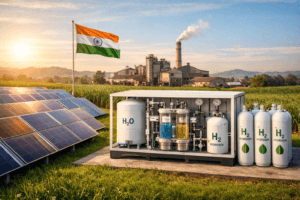
DirectH2, a Dallas-based startup, is bringing its breakthrough modular solar-to-hydrogen technology to India through a strategic partnership with Shree Tuljabhavani Sugar Private Limited (STSPL). The company’s core innovation, based on Rice University research, integrates solar absorption and water electrolysis into a single panel, aiming to produce low-cost green hydrogen directly at the point of use without relying on expensive grid infrastructure. This decentralized approach aligns perfectly with India’s National Green Hydrogen Mission, offering a scalable solution for industrial and agricultural applications. The collaboration, led by CEO Vivek Dhas and leveraging STSPL’s resources as a land provider, off-taker, and investor, represents a significant step toward commercializing a technology that could reshape clean energy production in markets with high solar potential and distributed energy needs.
DirectH2’s India Move: A Strategic Leap for Decentralized Green Hydrogen
The recent announcement that Dallas-based DirectH2 has signed a letter of intent with India’s Shree Tuljabhavani Sugar Private Limited (STSPL) is more than a standard business expansion. It represents a strategic convergence of cutting-edge U.S. energy innovation and India’s ambitious green energy goals. For DirectH2, this partnership is the first major step toward commercializing a potentially transformative technology: modular, solar-to-green hydrogen panels. For India, it is a tangible advancement of its National Green Hydrogen Mission, offering a decentralized model for clean fuel production.
This collaboration could reshape how hydrogen is produced and used, moving it from large, centralized industrial plants to the very sites where it is needed.
The Core Innovation: Turning Sunlight Directly into Hydrogen
At the heart of DirectH2’s venture is a breakthrough scientific achievement from the laboratory of Dr. Aditya Mohite at Rice University. In 2023, his team unveiled a photoelectrochemical cell that achieved a record 20.8% solar-to-hydrogen conversion efficiency.
This device is revolutionary because it integrates two key components into a single unit:
- A next-generation solar absorber made from halide perovskite semiconductors, known for high efficiency and lower cost compared to traditional silicon.
- An electrocatalyst that uses the harvested solar electricity to split water (H₂O) into hydrogen (H₂) and oxygen (O₂).
The major hurdle overcome by Mohite’s team was instability. Perovskites typically degrade rapidly when exposed to water. The research team’s key insight was a two-layer anticorrosion barrier that protects the semiconductor while still allowing the essential flow of electrons needed for the chemical reaction. This integrated design eliminates the need for separate solar panels, electrolyzers, and the complex wiring and power electronics that connect them.
Why India? A Market Primed for Disruption
India’s National Green Hydrogen Mission, launched in 2023, aims to make the country a global hub for the production and export of green hydrogen. DirectH2’s modular, decentralized technology aligns perfectly with several of India’s key challenges and opportunities:
- Grid Independence: Many potential industrial and agricultural users in India face unreliable grid power. DirectH2’s panels operate independently, producing fuel directly from sunlight without drawing expensive or inconsistent grid electricity.
- Land and Infrastructure: Building massive new pipelines for hydrogen transport is prohibitively expensive. Point-of-use production bypasses this need entirely.
- Agricultural and Industrial Symbiosis: Partnering with STSPL is a masterstroke in this regard. The company is not just a funder or land provider; it is an ideal first customer and ecosystem partner. STSPL’s existing operations—from sugar crushing and ethanol distillation to cogeneration power and compressed biogas (CBG)—create a ready-made demand for clean fuel and a culture of energy innovation.
A Comparison of Hydrogen Production Models
| Feature | Conventional Centralized Model | DirectH2’s Modular, Integrated Model |
| Production Site | Large, centralized facility | At or near the point of use |
| Infrastructure Need | Extensive grid connections or dedicated renewables farm; possible H₂ pipeline network | Minimal; requires only sunlight and water feed |
| Scalability | Large-scale from outset; scaling requires major new capital projects | Granular; can start small and add panels incrementally |
| Primary Cost Drivers | Electricity price, electrolyzer capex, transportation | Panel manufacturing cost, balance of system |
| Ideal Use Case | Large industrial clusters, export-oriented production | Distributed industrial users, fleet refueling, remote power |
The Teams Behind the Technology
The partnership’s potential is amplified by the unique backgrounds of the leaders involved.
- Dr. Vivek V. Dhas (CEO): A native of Maharashtra, India, Dhas brings deep connections to the region and a seasoned understanding of commercializing advanced energy tech from his prior roles at Hunt Perovskite Technologies and CubicPV. His dual role as CEO of DirectH2 and Venture Technology Officer at HL Energy Ventures ensures tight alignment with the investor’s vision.
- Dr. Aditya Mohite (CSO): As the inventor of the core technology and a professor at Rice University, Mohite provides the scientific authority and ensures the company’s work remains at the technological frontier. His research group, as shown on its website, continues to push boundaries in perovskite science and green hydrogen.
- HL Energy Ventures (Investor): This venture capital firm is a spinout from the Hunt Energy empire, a family with a decades-long legacy in the energy sector. Their backing provides more than capital; it offers industry credibility, operational expertise, and a network crucial for navigating the energy landscape.
- STSPL (Partner): Under founder Bhavna Bordikar, STSPL has grown from a sugar producer into a diversified agro-energy company. Their commitment to provide land, be an offtaker for hydrogen, and act as an early investor creates a powerful, aligned foundation for pilot projects and future scaling in India.
The Road Ahead: Challenges and the Path to Commercial Reality
While the promise is significant, the path from laboratory record to commercial product is challenging. DirectH2 must now translate a proven prototype into durable, manufacturable, and cost-effective panels. The company’s seed funding, closed in early 2025, was earmarked for exactly this purpose: to expand the team, refine the technology, and establish key partnerships. The STSPL deal is the first major fruit of that strategy.
The company’s stated goal is to produce green hydrogen below $1 per kilogram without subsidies. Achieving this would be a watershed moment, making green hydrogen cost-competitive with fossil fuel-based alternatives. The integrated panel design is the key to this economics, as it aims to drastically reduce balance-of-system costs—all the auxiliary components that make up the majority of current solar-hydrogen system expenses.
A Model for Transnational Clean Energy Collaboration
The DirectH2-STSPL partnership offers a compelling template for future U.S.-India climate technology collaboration. It moves beyond simple equipment export or licensing. Instead, it features:
- Technology Transfer: Rooted in U.S. university IP but adapted for the specific needs and opportunities of the Indian market.
- Local Leadership: Led by Indian diaspora entrepreneurs with deep local knowledge and networks.
- Strategic Partnership: Based on a symbiotic relationship with a local industrial anchor that provides market access, land, and early adoption.
If successful, this model could accelerate India’s energy transition by providing a scalable, distributed solution for decarbonizing hard-to-electrify sectors like heavy transport, industrial heat, and off-grid power. For the global clean hydrogen economy, it demonstrates a viable alternative to the capital-intensive, centralized production model, potentially unlocking a faster and more democratized path to a low-carbon future. The eyes of the energy world will be on Maharashtra as this ambitious partnership works to turn revolutionary science into commercial reality.
You must be logged in to post a comment.