
Diplomatic Breakthrough: How High-Level Talks Secured 80,000 Tonnes of LPG for India Amidst Gulf Tensions
India is set to receive approximately 80,000 tonnes of liquefied petroleum gas (LPG) via two vessels transiting the Strait of Hormuz, a breakthrough secured through intensive high-level diplomacy after Prime Minister Narendra Modi personally engaged with Iranian President Masoud Pezeshkian and External Affairs Minister S. Jaishankar held multiple conversations with his Iranian counterpart amid escalating US-Israel-Iran tensions. The shipments, with the first expected within days and the second by Saturday, represent a significant diplomatic victory for India, as Iranian officials explicitly assured safe passage citing India as a “friend” with shared regional interests, demonstrating how New Delhi’s strategic autonomy and decades-old relationships allowed it to protect its energy security—critical for millions of households dependent on cooking fuel—even as the region faces one of its most volatile periods in recent history.
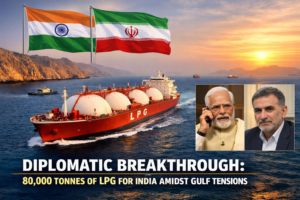
Diplomatic Breakthrough: How High-Level Talks Secured 80,000 Tonnes of LPG for India Amidst Gulf Tensions
The Quiet Victory of Indian Diplomacy in the Strait of Hormuz
In the treacherous waters where global energy security intersects with geopolitical conflict, India has just demonstrated that diplomacy can sometimes accomplish what naval power cannot. As tensions continue to simmer across West Asia, two vessels carrying approximately 80,000 tonnes of liquefied petroleum gas are making their way toward Indian shores—their passage through the strategically vital Strait of Hormuz secured not by warships or military escorts, but through the quiet persistence of diplomatic engagement at the highest levels.
The first of these vessels, carrying roughly 40,000 tonnes of the critical cooking fuel that millions of Indian households depend upon, is expected to arrive within the next 48 to 72 hours. A second ship, carrying an equivalent amount, is scheduled to transit the narrow waterway by Saturday. These aren’t just routine shipments—they represent a diplomatic lifeline carefully woven together during one of the most volatile periods the region has witnessed in recent decades.
Beyond Headlines: What 80,000 Tonnes Actually Means for India
To understand the significance of these shipments, one must look beyond the numbers and consider what 80,000 tonnes of LPG represents in human terms. This quantity of cooking fuel can serve approximately 4 to 5 million households for a month, depending on consumption patterns. For the Public Distribution System, for the subsidized cylinder schemes aimed at empowering rural women, for the street food vendor in Mumbai and the tea stall in Lucknow—this LPG is not merely a commodity traded on international exchanges. It is the difference between cooking with clean fuel and returning to biomass, between respiratory health and chronic illness, between convenience and struggle.
India’s dependence on imported LPG has grown substantially over the past decade as the Pradhan Mantri Ujjwala Yojana and subsequent schemes have transformed the cooking habits of millions. Today, any disruption in supply doesn’t just show up in government statistics—it shows up in the daily lives of ordinary citizens. This context explains why Prime Minister Narendra Modi personally picked up the phone to call Iranian President Masoud Pezeshkian, and why External Affairs Minister S. Jaishankar has maintained an almost continuous dialogue with his Iranian counterpart, Seyed Abbas Araghchi.
The Diplomatic Choreography Behind the Cargoes
What makes this development particularly noteworthy is the timing and the context. The US-Israel offensive on Iran that began on February 28 fundamentally altered the security calculus of the entire region. Within days, the Strait of Hormuz—that narrow chokepoint through which approximately one-fifth of the world’s oil supply passes—became not just a geographical feature but a potential flashpoint.
The Indian diplomatic machine responded with unusual agility. Between Thursday and Friday alone, Jaishankar and Araghchi spoke multiple times, bringing their total conversations since the conflict began to four. This wasn’t ceremonial diplomacy—it was crisis management conducted in real-time, with tangible outcomes hanging in the balance.
When PM Modi described his conversation with the Iranian President as addressing “the serious situation in the region” and expressing “deep concern over the escalation of tensions and the loss of civilian lives as well as damage to civilian infrastructure,” he was speaking both for the record and for the specific purpose of securing India’s energy lifelines. The language of diplomacy often obscures as much as it reveals, but in this case, the connection between humanitarian concern and practical outcomes was remarkably direct.
Iran’s Reassurance: “India is Our Friend”
Perhaps the most revealing moment in this entire episode came when Iran’s Ambassador to India, Mohammad Fathali, was asked directly whether India could expect safe passage through the strait. His response was striking in its simplicity and its implications: “Yes, because India is our friend. You will see it within two or three hours.”
In the world of international relations, such straightforward affirmations of friendship are rare. They represent not just diplomatic nicety but the accumulated weight of decades of India-Iran relations—relations that have weathered sanctions, international pressure, and regional realignments. When Fathali added that “Iran and India share common interests in the region,” he was articulating a fundamental truth that transcends any single conflict: India and Iran are civilizational neighbors whose destinies are intertwined whether through formal agreements or through the simple geography that places them on opposite shores of the same strategic waterway.
Abdul Majid Hakeem Ilahi, Representative of Iran’s Supreme Leader in India, went further in contextualizing the issue. While confirming that discussions had occurred regarding Indian ships transiting the Strait of Hormuz, he subtly broadened the conversation to address the root cause of the crisis. “The complete solution is that leaders of the world have to come together,” he suggested, urging global diplomacy to convince the Trump administration and to pressure what he termed “the Zionist regime” to end hostilities.
His words carried both a reassurance and a reminder: “We didn’t create this war, we didn’t initiate this war, we didn’t start this war… We are ready to share our blood on the earth, but we are not ready to sell our dignity.”
The Strategic Stakes for India
For India, the stakes in this conflict extend far beyond the immediate question of LPG shipments. The Strait of Hormuz is not merely a passage for cooking fuel—it is the artery through which India’s energy security flows. Crude oil, LNG, and other critical commodities all traverse these waters. When news emerged earlier that 28 Indian vessels carrying LNG, LPG, and crude had been stranded near Hormuz, the vulnerability of India’s supply chains became starkly apparent.
The crude oil price surge of over 40 percent in the fifteen days since the conflict began tells its own story. Every dollar increase in oil prices affects India’s current account deficit, its inflation calculations, its fiscal planning, and ultimately, the economic well-being of its citizens. In this context, ensuring the safe passage of vessels through Hormuz isn’t just a shipping issue—it’s a macroeconomic imperative.
India’s response to the crisis reveals a maturing approach to international relations. Rather than choosing sides in a conflict that doesn’t directly involve it, New Delhi has chosen to leverage its relationships with all parties to protect its core interests. The same government that has deepened strategic ties with Israel and the United States over the years has now demonstrated that those relationships don’t preclude active engagement with Iran when Indian interests demand it.
Historical Precedents and Future Implications
This isn’t the first time India has navigated the treacherous waters of West Asian diplomacy to secure its energy supplies. During the 2019 tensions following attacks on tankers in the Gulf of Oman, India had to similarly engage with multiple stakeholders to ensure the safety of its vessels and crew. What’s different this time is the scale of the conflict and the direct involvement of major powers.
The fact that a foreign-flagged tanker recently delivered crude oil to Mumbai via the Strait of Hormuz, despite the ongoing hostilities, suggests that India’s diplomatic efforts are yielding results beyond just these two LPG shipments. There appears to be an understanding—tacit or explicit—that Indian energy supplies should remain off-limits in this conflict.
This has significant implications for how India positions itself in future regional crises. By demonstrating that it can protect its supply chains through diplomacy rather than military means, India is carving out a unique space for itself in the international order. It’s not seeking to become a naval power capable of escorting its own vessels through contested waters—at least not yet. Instead, it’s building a network of relationships and a reputation for constructive engagement that makes other powers willing to accommodate its interests.
The Human Dimension of Energy Security
Behind the geopolitics and the diplomatic maneuvering, it’s worth remembering what these shipments ultimately represent. In homes across India, particularly in rural areas where the transition to LPG has been most transformative, the availability of cooking fuel determines daily routines. The woman who no longer has to spend hours collecting firewood, the child who can study without coughing from smoke inhalation, the family that can cook regardless of weather conditions—all of them are connected, however indirectly, to the safe passage of vessels through a distant strait.
This human dimension is what gives energy security its urgency. It’s why governments worry about supply disruptions not just in terms of macroeconomic indicators but in terms of real-world consequences. When PM Modi expressed concern over civilian lives and infrastructure in his conversation with the Iranian President, he was speaking to a principle that applies equally to the civilians in conflict zones and to the civilians at home whose access to essential services depends on stable supply chains.
The Road Ahead: Challenges and Opportunities
While the immediate crisis has been averted with these two shipments, the underlying tensions remain unresolved. The US-Israel offensive against Iran shows no signs of ending soon, and the risk of escalation—including the possibility of Iran attempting to close or disrupt the Strait of Hormuz—continues to hang over the region.
For India, this means maintaining constant diplomatic engagement. The four conversations between Jaishankar and Araghchi may need to become forty before this crisis is fully resolved. The channel of communication opened by PM Modi’s call may need to be used repeatedly. And India may need to position itself as a potential mediator or facilitator of dialogue, leveraging its relationships with all parties to help de-escalate tensions.
There are opportunities here as well. India’s ability to maintain normal commercial relations with Iran despite sanctions and conflicts demonstrates the value of strategic autonomy. It shows that close ties with the United States need not come at the cost of engagement with Iran, and that friendship with Israel doesn’t preclude sympathy for Palestinian concerns. This balancing act—difficult as it is to maintain—positions India uniquely among major powers.
Conclusion: Diplomacy as the First Line of Defense
The arrival of these two LPG cargoes in Indian ports over the coming days will be a routine event in logistical terms. Ships dock, cargo is unloaded, and the fuel enters distribution networks that operate with quiet efficiency across the country. But behind this routine lies an extraordinary achievement of Indian diplomacy.
At a time when the region is on edge, when naval forces are on high alert, and when every vessel transiting the Strait of Hormuz could potentially become a target or a bargaining chip, India has secured safe passage for its supplies through the simple but powerful mechanism of diplomatic engagement. It has reminded the world that in an age of drones and missiles, of sanctions and counter-sanctions, there is still space for conversation, for friendship, and for the recognition of shared interests.
The 80,000 tonnes of LPG heading toward India represent more than just cooking fuel. They represent a diplomatic triumph, a demonstration of strategic autonomy, and a reassurance to millions of Indian households that their government can protect their interests even in the most challenging circumstances. As the region continues to navigate through turbulent waters, India’s experience with these shipments offers a template for how to protect national interests without being drawn into conflicts that are not of its making.
In the end, the Strait of Hormuz will remain a chokepoint, tensions will persist, and the risk of disruption will never fully disappear. But India has shown that when diplomacy is pursued with persistence and skill, even the most dangerous waters can be navigated safely. The two vessels making their way toward India are not just carrying LPG—they are carrying the proof that India’s voice in the world matters, that its friendships have substance, and that its commitment to the welfare of its citizens extends to the farthest reaches of global commerce.
You must be logged in to post a comment.