
Digital Summons & Diplomatic Walls: The US SEC’s Unprecedented Move Against Adani and What It Reveals About Global Power Shifts
For over 14 months, the US Securities and Exchange Commission’s (SEC) attempts to serve legal summonses to Gautam Adani and his nephew Sagar Adani—following civil and criminal fraud charges related to a $750 million bond offering—have been systematically blocked by India’s Ministry of Law and Justice, which first cited missing physical seals and then contested the SEC’s very authority under the Hague Convention.
This diplomatic stalemate has now prompted the SEC to abandon treaty channels and ask a US federal court to approve service via email and through the Adanis’ high-profile US lawyers, marking an unprecedented shift toward digital legal action to bypass what it views as sovereign obstruction. The clash underscores escalating tensions between US regulatory reach and a protective Indian government, revealing a high-stakes geopolitical struggle where legal procedure becomes a frontline for defending national corporate champions and testing the limits of cross-border accountability in the digital age.
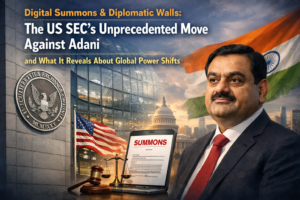
Digital Summons & Diplomatic Walls: The US SEC’s Unprecedented Move Against Adani and What It Reveals About Global Power Shifts
For over a year, a quiet but intense diplomatic and legal duel has unfolded between Washington and New Delhi, centered on one of the world’s most powerful businessmen: Gautam Adani. The United States Securities and Exchange Commission (SEC), thwarted in its attempts to formally serve legal documents through official channels, has now taken the extraordinary step of asking a federal court to bypass sovereign protocols entirely. The requested method? Email and service via US lawyers. This isn’t merely a procedural skirmish; it’s a window into the escalating friction between a rising India, protective of its corporate champions, and a US regulatory body determined to enforce its rules extraterritorially. The story of the blocked summons reveals layers of geopolitical maneuvering, legal innovation, and a high-stakes test of regulatory reach in a multipolar world.
The Stalemate: A Treaty in Paralysis
At the heart of the deadlock is the Hague Service Convention, a multilateral treaty designed to simplify the cross-border delivery of legal documents. For 14 months, the SEC pursued this channel, submitting its request to India’s Ministry of Law and Justice—the designated “Central Authority.” What followed was a masterclass in bureaucratic obstruction, framed within a veneer of procedural nitpicking.
India’s first rejection in April 2025 was on the grounds of missing physical seals and ink signatures on the documents—requirements the SEC swiftly noted are archaic and not mandated by the Convention itself. The agency pointed out its decades of successful, seal-less service to countries worldwide, and even to India itself as recently as December 2024. The message was clear: the objection was a novelty, not a standard.
The second rejection, in November 2025, escalated the conflict. India’s Law Ministry invoked an obscure internal SEC regulation (17 C.F.R. § 202.5(b)) to argue that the SEC lacked the authority to even issue such summonses under the Hague framework. The SEC’s retort in court filings was sharp: this was a “baseless” conflation of procedural rules with substantive authority, an argument with “no basis in the Convention.” Effectively, India had moved from questioning the paperwork to questioning the SEC’s very right to ask.
This shift is significant. It transcends bureaucratic delay and enters the realm of strategic defiance. By challenging the SEC’s authority, India’s government is not just protecting a citizen from a lawsuit; it is contesting the jurisdictional overreach of a foreign regulator into what it perceives as a domestic matter, or at least, a matter it wishes to manage on its own terms.
The Allegations: A $750 Million Shadow
The reason for this high-wire act lies in the gravity of the SEC’s allegations. Filed in November 2024, the civil complaint paints a picture of systemic fraud. It alleges that Gautam Adani and his nephew Sagar Adani orchestrated a bribery scheme involving hundreds of millions of dollars in payments or promises to Indian government officials. This conduct, the SEC claims, rendered the anti-corruption disclosures in a $750 million bond offering by Adani Green Energy—which raised $175 million from US investors—“materially false or misleading.”
Parallel criminal charges for securities fraud conspiracy and wire fraud add a severe dimension. For the Adani Group, a conglomerate synonymous with India’s infrastructure ambitions and whose fortunes are often seen as intertwined with national prestige, these charges strike at the heart of its global credibility and access to international capital.
The Group’s dismissal of the charges as “baseless” was immediate. Yet, the prolonged battle over mere service of notice indicates a legal strategy focused on delay and procedural warfare—a common tactic in complex litigation. Every month the summons goes unserved is a month the formal legal process is stalled.
The Digital End-Run: What Service by Email Signifies
Faced with a sovereign wall, the SEC has turned to innovation, petitioning the US District Court in New York for permission to use “alternative means” under Rule 4(f)(3). Their proposal is twofold: serve the documents to the high-profile US law firms representing the Adanis (Kirkland & Ellis, Quinn Emanuel, and Hecker Fink), and send them to the defendants’ known corporate email addresses.
The SEC’s argument is pragmatic: the Adanis have undeniable “actual notice” of the case. They’ve hired top-tier American counsel, made public statements referencing the charges, and the investigation itself was no secret. The corporate email addresses are proven, active channels for business. Service, therefore, should fulfill its core purpose—informing the defendant—without being held hostage by state-level interference.
This move is a potential watershed. If granted, it sets a precedent that when a foreign state obstructs treaty mechanisms, US courts can empower regulators to leapfrog diplomatic channels using digital tools. It democratizes service but also weaponizes it, potentially lowering the barrier for future actions against internationally mobile elites who enjoy protective home governments.
The Geopolitical Undercurrents: Modi’s India and “National Champions”
To view this solely as a legal dispute is to miss the forest for the trees. The 14-month blockage occurred under the Modi government, which has consistently championed Indian business giants as vehicles for national growth and symbols of Indian self-reliance (Atmanirbhar Bharat). Gautam Adani, in particular, has seen his empire’s expansion align closely with national priorities in energy, ports, and logistics.
The government’s resistance can be interpreted as a robust defense of a national champion against perceived extraterritorial overreach, akin to past US-EU clashes over sanctions or the US-China battles over Huawei. It signals to global markets and other Indian corporates that New Delhi will push back forcefully against foreign legal actions it deems unjust or intrusive. This assertiveness is a hallmark of contemporary Indian foreign policy.
However, there’s a delicate balance. India also deeply values its economic and strategic partnership with the US. Prolonged, overt obstruction in a serious fraud case risks collateral damage, potentially affecting investor confidence or inviting reciprocal legal stubbornness. The Law Ministry’s letters, therefore, are carefully couched in procedural language, providing a defensible, if transparent, rationale for delay rather than an outright political refusal.
The Road Ahead: Sovereignty vs. Accountability
Judge Nicholas G. Garaufis’s decision on the SEC’s motion will be closely watched. Granting it would be a victory for regulatory agility and a blow to the tactic of diplomatic shielding. It would assert that in the digital age, physical sovereignty cannot create a black hole for legal accountability, especially when plaintiffs can demonstrate the defendant’s clear awareness.
Denying it, or seeking further diplomatic consultation, would be a nod to state sovereignty and traditional comity, but might also be seen as allowing obstruction to succeed.
For readers, this saga is more than a billionaire’s legal troubles. It is a case study in:
- The New Legal Battlefield: How digital service and alternative means are reshaping cross-border litigation against powerful entities.
- The Limits of Global Governance: How treaties like the Hague Convention can be rendered inert when political will opposes them.
- Corporate-State Symbiosis: The extent to which rising economic powers will go to insulate their flagship corporations from foreign judicial scrutiny.
- Investor Implications: A stark reminder that investing in global firms involves not just market risk, but complex geopolitical and regulatory jurisdictional risk.
The SEC’s attempt to serve a summons via email is a small, technical action. But it carries the weight of a much larger question: in an interconnected yet fractious world, when a nation-state stands as a gatekeeper, can international law and accountability find a digital backdoor? The answer will redefine the rules of engagement for regulators, corporations, and governments for years to come. The Adani case is no longer just about allegations of fraud; it’s about the very mechanisms through which global justice is—or isn’t—allowed to proceed.
You must be logged in to post a comment.