
Digital Rules and Farm Debates: Why the US is Struggling to Close Major Trade Deals
U.S. Trade Representative Jamieson Greer’s criticism of stalled negotiations with India and the European Union, now extending into 2026, highlights a fundamental shift in trade conflicts from tariffs to deeper clashes over domestic policy and digital sovereignty. With India, the impasse centers on politically sensitive U.S. demands for greater access to its agricultural market and for India to curb imports of discounted Russian oil, issues that threaten India’s domestic stability and energy strategy.
Meanwhile, the dispute with the EU is a philosophical battle over the bloc’s aggressive digital regulations, which the U.S. views as discriminatory measures unfairly targeting American tech giants under the banner of “tech sovereignty.” The economic costs are mounting, particularly for India, which faces significant export declines and job losses in sectors hit by U.S. tariffs, pushing both it and the EU to accelerate alternative trade partnerships and revealing a global economy increasingly fragmenting into competing regulatory and geopolitical blocs.
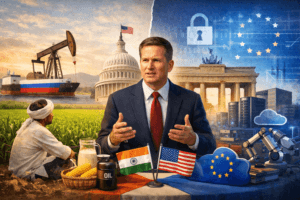
Digital Rules and Farm Debates: Why the US is Struggling to Close Major Trade Deals
For the US, a trade deal with India or the EU isn’t just about tariffs—it’s about whose regulatory vision will dominate the 21st-century global economy.
As 2025 draws to a close, the optimistic trade promises made at the beginning of the year have given way to a reality of protracted negotiations and economic pressure. U.S. Trade Representative Jamieson Greer has openly criticized both the European Union and India for practices he considers unfair, signaling that these contentious talks will extend into 2026. While the U.S. has successfully concluded deals with partners from Malaysia to Switzerland, its negotiations with two of the world’s largest economic blocs have hit significant roadblocks. These stalled talks reveal a deeper conflict between competing visions of trade, sovereignty, and economic power in a fragmenting global landscape.
The Sticking Points: Agriculture and Digital Sovereignty
The core disagreements with India and the EU could not be more different in substance, yet both reflect deep-seated political and economic priorities that each side is unwilling to compromise.
India: The Political Minefield of Agriculture
Trade negotiations between the U.S. and India, which began with high hopes earlier this year, have become mired in one of India’s most sensitive domestic issues: agricultural reform.
- American Demands: The U.S. is pushing for greater market access for its agricultural products, specifically genetically modified (GM) crops and dairy exports. American negotiators also want India to significantly cut back on its imports of discounted Russian oil, which Washington argues funds the war in Ukraine.
- Indian Resistance: For India, opening its agricultural market is politically perilous. The country’s massive farm lobby wields significant influence, and major state elections are due in key agricultural regions like West Bengal, Tamil Nadu, and Kerala in 2026, followed by Uttar Pradesh in 2027. As former U.S. trade official Mark Linscott noted, the U.S. needs a “big gesture” from India, such as a major purchase of American fuel ethanol, to move the political needle.
- The Oil Conundrum: India has officially refused to dictate where private refiners source their oil, citing the need to provide affordable energy to 1.4 billion people. Reports indicate Indian refiners resumed buying deeply discounted Russian oil from non-sanctioned entities in November, directly challenging U.S. foreign policy goals.
The EU: A Clash of Regulatory Philosophies
The dispute with the European Union is less about traditional tariffs and more about competing visions for the digital future. Greer has accused the EU of creating discriminatory regulations that “magically… only happen to capture US companies”.
- The New Digital Rulebook: At the heart of the tension is the EU Data Act, which took effect in September 2025. This regulation compels manufacturers of connected devices (like IoT sensors or smart machinery) to share the data they generate with users and third parties, often for free. For U.S. cloud and software service providers, it imposes new obligations to make it easier for customers to switch providers, directly challenging established business models.
- The “Digital Sovereignty” Mandate: The EU defends these rules as essential for its **”tech sovereignty”**—the ability to act autonomously in the digital realm. This philosophy was cemented in the November 2025 Berlin Declaration, where EU states committed to reducing dependency on foreign technologies and asserting control over their digital infrastructure. As one analysis notes, for the EU, digital sovereignty is inseparable from the protection of core European values and fundamental rights.
- An Unresolved Framework: While the U.S. and EU announced a broad “Framework Agreement” in August 2025, it left the most contentious digital issues unresolved. The EU’s sweeping digital regulations, which apply extraterritorially to U.S. companies, remain a major point of friction.
The Economic Toll: Numbers Behind the Stalemate
The failure to reach agreements is not just a diplomatic stalemate; it has real and measurable economic consequences, particularly for India.
Impact of U.S. Tariffs on Indian Exports & Employment (May-Oct 2025)
| Sector | Export Decline | Estimated Job Losses | Key Factors |
| Gems & Jewellery | 30% (in October) | 135,000 | High tariff exposure; loss of U.S. market share. |
| Textiles & Garments | Significant drop | 150,000 | Missed Christmas season; summer orders at risk. |
| General Merchandise | 37% overall (May-Oct) | Not specified | 50% tariff rate making Indian goods uncompetitive. |
Table based on data from Indian trade analyses.
Despite a surprising 19.4% year-on-year jump in total exports for November 2025, driven by strong performance in tariff-exempt sectors like engineering goods and pharmaceuticals, the pain in targeted industries is acute. Analysts warn the lack of a deal creates crippling uncertainty, causing U.S. importers to permanently shift sourcing to countries like Vietnam, Bangladesh, and Sri Lanka, which have secured lower-tariff deals with the U.S..
The macroeconomic impact is also significant. Financial firms estimate that the 50% tariffs could shave 0.5 to 0.6 percentage points off India’s GDP growth. Furthermore, the uncertainty is making global investors wary of betting on India as a manufacturing hub, potentially undermining its “Make in India” and “Viksit Bharat” (Developed India) ambitions.
Strategic Pivots: Seeking Alternatives in a Divided World
With talks stalled, both India and the EU are not sitting idle. They are actively pursuing alternative partnerships to reduce their dependence on the U.S. market and counter American pressure.
India’s FTA Diplomacy: India is accelerating its network of free trade agreements (FTAs) as a strategic cushion against U.S. tariffs. Recent months have seen a flurry of activity:
- A deal with Oman, signed in December 2025, grants Indian goods zero-duty access on over 98% of Oman’s tariff lines.
- The hard-won agreement with the United Kingdom, concluded in May 2025.
- Advanced negotiations are ongoing with the European Union, New Zealand, and Chile.
This diversification strategy aims to open new export corridors and integrate India more deeply into alternative global supply chains.
The EU’s Geopolitical Balancing Act: Similarly, the EU is trying to prove it can be a “geoeconomic force” outside the orbit of the U.S. and China. Its key test is the long-delayed trade pact with the Mercosur bloc (Argentina, Brazil, Paraguay, Uruguay). After 25 years of negotiation, the deal was stalled again in late 2025 by European farming protests and last-minute political demands, particularly from Italy. Success would create an integrated market of 780 million consumers, giving Europe access to critical agricultural resources and a counterbalance to U.S. and Chinese economic power. Failure, as one policy fellow warned, “would be a blunder of epic proportions for Europe’s ambitions”.
Looking Ahead to 2026: More Than Just Trade
As negotiations drag into the new year, it is clear that these are not typical disputes over tariff percentages. The U.S.-India impasse is a clash between geopolitical strategy and domestic politics, where America’s foreign policy goal of isolating Russia conflicts with India’s economic need for affordable energy and its political need to protect farmers.
The U.S.-EU conflict represents a deeper philosophical divide over the future of technology. The U.S. champions a market-driven, innovation-first model, while the EU is building a rights-based, regulatorily dense digital ecosystem. The EU’s drive for “digital sovereignty” is, in part, a direct response to the overwhelming market power of U.S. tech giants and concerns over extraterritorial U.S. laws like the CLOUD Act.
Ultimately, the resolution of these talks—or their continued stalemate—will signal more than just new trade terms. It will reveal whether the world’s largest democracies can reconcile their visions for a fair global economic order or if the fragmentation of the global economy into competing blocs is now an irreversible reality. The economic costs are already being counted in lost jobs and growth; the geopolitical costs of continued discord may be far greater.
You must be logged in to post a comment.