
Digital Free Speech vs. State Power: Why the Supreme Court Refused to Stall a Landmark IT Rules Verdict
The Supreme Court has refused to stay a 2024 Bombay High Court judgment that struck down as “unconstitutional” the central government’s 2023 amendments to the IT Rules, which sought to establish a government-run Fact Check Unit to identify and regulate “fake” or “false” content about the government on social media. While agreeing to hear the government’s appeal, the apex court’s three-judge bench issued notices to the original petitioners—including Kunal Kamra and the Editors Guild of India—and declined to reinstate the rules, effectively upholding the high court’s finding that the amendments created a “chilling effect” on free speech by making the state the arbiter of truth about itself and coercing platforms into over-censorship. The Chief Justice of India noted it would be preferable to decide the entire constitutional issue definitively rather than through an interim stay, marking a significant, albeit interim, victory for digital rights and free expression advocates.
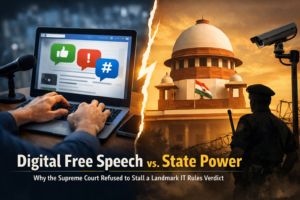
Digital Free Speech vs. State Power: Why the Supreme Court Refused to Stall a Landmark IT Rules Verdict
In a significant development that has reignited the debate over the regulation of digital speech in India, the Supreme Court on Tuesday agreed to scrutinize the central government’s challenge to a Bombay High Court judgment. However, in a move that speaks volumes about the constitutional weight of the case, the apex court firmly refused to stay the high court’s operation, which had struck down key amendments to the Information Technology Rules as “unconstitutional.”
The decision by a three-judge bench, led by Chief Justice of India Surya Kant, effectively means that for now, the legal landscape regarding the regulation of online content about the government remains as defined by the Bombay High Court. The government’s attempt to immediately revive its 2023 amendments, which aimed to create a mechanism for flagging “fake” and “false” content against the government, has been put on hold.
This article delves into the heart of this legal and ideological clash, exploring what the amendments sought to do, why the Bombay High Court found them so problematic, and what the Supreme Court’s refusal to grant a stay means for free speech, social media platforms, and the future of digital governance in India.
The Contested Amendments: A “Fact Check Unit” Under Scrutiny
To understand the gravity of the Supreme Court’s refusal, one must first revisit the contentious changes introduced by the Union government on April 6, 2023. These were amendments to the existing Information Technology (Intermediary Guidelines and Digital Media Ethics Code) Rules, 2021.
The core of the controversy was the establishment of a Fact Check Unit (FCU) . Under the amended rules, this government-mandated body was empowered to act as the arbiter of truth concerning all content related to the “business of the Central Government.”
Here’s how the mechanism was designed to work:
- The FCU would monitor online content and identify any information it deemed to be “fake,” “false,” or “misleading” about the government.
- Once flagged, the onus would shift to social media intermediaries (like X, Facebook, YouTube, and Instagram).
- These platforms would then be legally obligated to act. They had two choices: either remove the flagged content entirely, or append a disclaimer to it, clearly marking it as “fake” or “misleading.”
- Crucially, if a platform chose the second option—allowing the content to stay up but with a disclaimer—it would risk losing its “safe harbour” protection. This protection, enshrined in Section 79 of the Information Technology Act, 2000, is the bedrock of the internet. It shields intermediaries from legal liability for content posted by third parties, provided they act as neutral conduits and follow due process when notified to take down illegal content.
The underlying message from the government was clear: misinformation targeting the state is a unique threat that requires a dedicated, state-backed mechanism to identify and neutralize. Solicitor General Tushar Mehta, representing the Centre before the Supreme Court, attempted to soften this stance, arguing that the government’s intention was not to “block content completely” but to regulate misinformation.
The Bombay High Court’s Stinging Rebuke: A “Chilling Effect” on Speech
The government’s rationale, however, failed to convince the Bombay High Court. On September 26, 2024, a division bench of the court delivered a powerful and detailed judgment that struck down the amendments. The court didn’t just find procedural flaws; it declared the rules unconstitutional for violating the fundamental right to free speech and expression under Article 19(1)(a) of the Constitution.
The high court’s reasoning was multifaceted and went to the very core of democratic principles:
- State as the Judge in Its Own Cause: The most potent argument against the FCU was that it made the government the sole arbiter of what is true or false about itself. The court observed that vesting such power in a body directly controlled by the executive creates an inherent bias. In a democracy, criticism of the government is not just a right but a necessity. Allowing the state to unilaterally label dissent or uncomfortable facts as “fake” creates a dangerous precedent, effectively silencing legitimate opposition and satire. As one of the petitioners, stand-up comedian Kunal Kamra, has consistently argued, satire and political commentary often rely on exaggeration and irony, which a government fact-check unit might be institutionally incapable of understanding or appreciating.
- The “Chilling Effect” on Intermediaries: The high court recognized that the rules would have a devastating “chilling effect” on free speech, but not just on individual users. By threatening to strip intermediaries of their safe harbour protection if they failed to comply, the rules would force platforms into a corner. To avoid the immense legal and financial risk of hosting content that the government might later deem “fake,” platforms would be left with little choice but to over-comply. This means they would likely err on the side of taking down any content that even remotely touched upon the government, regardless of its truth or satirical value. This privatized censorship, driven by a fear of liability, is far more potent and insidious than direct state censorship.
- Vagueness and Overbreadth: The term “fake, false, or misleading” was never clearly defined in the rules. What constitutes “misleading” is highly subjective. A statement taken out of context, a parody account, or a historical comparison could all be deemed “misleading” by a government official, even if the core information is accurate. This vagueness gives the FCU immense discretionary power, which can be wielded arbitrarily. Constitutional law demands that laws restricting fundamental rights must be clear, precise, and narrowly tailored. The Bombay High Court found that these amendments failed on all counts.
- Prior Restraint: The mechanism effectively operates as a system of prior restraint. Content does not have to be published and then proven false in a court of law. Instead, it can be flagged and subjected to a disclaimer or removal before any judicial determination of its falsity. Prior restraint is viewed with extreme disfavor in constitutional jurisprudence, as it stifles speech at its source.
By striking down the rules, the Bombay High Court sent a strong message that the fight against misinformation, while important, cannot be waged at the cost of the Constitution. It affirmed that the solution to “bad” speech is not state-mandated censorship, but “more” speech—criticism, counter-speech, and a vigilant public.
Why the Supreme Court’s Refusal to Stay is a Tactical Victory
When the government moved the Supreme Court, its primary, immediate goal was to get a stay on the high court’s judgment. A stay would have temporarily revived the FCU rules while the larger appeal was pending. The Supreme Court’s refusal to grant that stay is therefore a major setback for the government and a significant, albeit interim, victory for the petitioners, which include Kunal Kamra, the Editors Guild of India, and the Association of Indian Magazines.
The Chief Justice of India’s observation—that it would be “better if the entire issue were finally decided”—is telling. It signals that the court views the constitutional questions raised as too important to be dealt with through an interim order. The CJI’s remark suggests a desire to provide a definitive, long-term legal framework rather than a temporary patch.
By refusing the stay, the Supreme Court has effectively preserved the status quo as defined by the Bombay High Court. This means:
- The government’s Fact Check Unit, as envisioned in the 2023 rules, cannot function.
- Social media platforms are not bound by the now-struck-down obligations to act on the FCU’s flags.
- The legal protection for online speech, particularly political speech and commentary, remains broader.
This doesn’t mean the government’s appeal is dead. The Supreme Court has issued notices to the original petitioners, meaning it will hear the case on its merits. However, the refusal to grant a stay indicates that the government faces an uphill battle in convincing the apex court that the high court was wrong. The bench will now carefully examine the constitutional validity of the rules, and the fact that they are not operational during this examination is a crucial reprieve for digital rights advocates.
The Broader Implications: A Fight for the Soul of the Internet
This legal battle is about much more than just one set of rules. It is a proxy war for the future of the internet in India.
For Content Creators and Satirists: The outcome will determine the breathing space available to those who critique power. From YouTubers and stand-up comedians to political cartoonists and ordinary social media users, the ability to mock, question, and scrutinize the government without fear of a state-backed “fake” label hangs in the balance. Kunal Kamra’s presence as a lead petitioner is symbolic; it represents the voice of dissent that the state finds most inconvenient.
For the Media: The Editors Guild and the Association of Indian Magazines have a direct stake. A government fact-check unit with the power to label news reports as “fake” would have a chilling effect on investigative journalism. It could be used to discredit reporting that is merely inconvenient for the government, even if it is factually accurate. The ability of the press to act as a watchdog depends on its freedom from such state-sanctioned intimidation.
For Democracy Itself: The case forces a reckoning with a fundamental question: In a digital age flooded with misinformation, who decides what is true? The government’s answer was “we do.” The Bombay High Court’s answer is that in a democracy, truth is discovered through an open and often messy public debate, not through a government diktat. The Supreme Court will now have to weigh these competing visions.
The government’s argument about needing to curb misinformation is not without merit. The digital ecosystem is rife with falsehoods that can incite violence and undermine public trust. However, the constitutional challenge is about the means chosen to achieve that end. The Bombay High Court found the means—a centralized, government-controlled arbiter with the power to compel platforms to act—to be fundamentally at odds with a free society.
As the Supreme Court prepares to hear the final arguments, all eyes will be on the nine-pointed star. Its ultimate decision will not only decide the fate of the Fact Check Unit but will also draw the boundaries of free speech in India’s digital public square for years to come. The refusal to grant a stay is a promising sign for those who believe that sunlight, not censorship, is the best disinfectant—and that in a democracy, the government must be robustly criticized, not robustly protected from criticism.
You must be logged in to post a comment.