
Digital Curfew in the Silicon Valley of India: Karnataka’s Bold Ban on Social Media for Under-16s
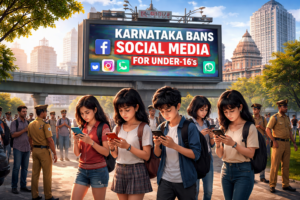
Digital Curfew in the Silicon Valley of India: Karnataka’s Bold Ban on Social Media for Under-16s
In the bustling, tech-saturated metropolis of Bengaluru, where the aroma of filter coffee blends with the hum of server farms powering global corporations, a quiet revolution has begun. It’s not another startup disrupting the fintech space or a breakthrough in artificial intelligence. Instead, it’s a piece of legislation that seeks to disrupt the daily digital diet of millions of children.
On Friday, the state government of Karnataka, home to India’s renowned “Silicon Valley,” announced a landmark ban on social media for children under the age of 16. This bold move, tucked into the state’s annual budget speech by Chief Minister Siddaramaiah, marks a pivotal moment for India, the world’s second-largest smartphone market and the biggest user base for Meta’s Facebook, Instagram, and WhatsApp.
The declaration—”With the objective of preventing adverse effects of increasing mobile usage on children, usage of social media will be banned for children under the age of 16″—is deceptively simple. Its implications, however, are as complex and far-reaching as the fiber-optic cables that connect Bengaluru to the world. This isn’t just a local policy; it’s a high-stakes experiment in one of the globe’s most vibrant digital ecosystems, one that parents, educators, tech giants, and other Indian states are now watching with bated breath.
The Genesis of a Ban: From Screen Time to Scrutiny
The decision didn’t materialize in a vacuum. It is the most significant domino to fall in India following a global shift in how governments perceive the relationship between children and the internet. Australia became the first country to enact a similar ban in December 2025, sending shockwaves through the boardrooms of Silicon Valley and the corridors of power worldwide. Nations like Britain, Denmark, and Greece are actively studying similar measures.
In India, the conversation has been simmering for years. It boiled over in January when India’s Chief Economic Advisor publicly urged the central government to draft policies on age-based access limits to tackle what he termed “digital addiction.” His remarks drew widespread support from parents and child rights groups, who have long been fighting a lonely battle against the algorithmic pull of infinite scrolls on young minds.
Karnataka, with its unique position as the country’s technology nerve center, has now taken the lead. It’s a poetic irony: the state that hosts the Indian headquarters for tech behemoths like Microsoft, Google, and Amazon is now the first to erect a legal wall between its children and the very products those companies create.
The Rationale: Beyond the Addiction Narrative
While the government cites “adverse effects of increasing mobile usage,” the reality for families here is far more nuanced. It’s not just about the hours lost to Reels or shorts; it’s about the quality of childhood itself.
“It’s a mental health crisis that we are not equipped to handle,” says Dr. Ananya Sharma, a Bengaluru-based child psychologist who has seen a sharp rise in anxiety and body-image issues among pre-teens and teenagers over the last five years. “I have 13-year-olds who speak in terms of likes and shares, who derive their self-worth from the number of followers they have. They are comparing their real, messy lives with the curated, filtered perfection they see online. This ban is a blunt instrument, but it’s a recognition that the status quo was failing our children.”
For parents, the ban offers a lifeline of legitimacy. For years, setting screen-time limits has been a daily battleground in homes across Karnataka. Children have become adept at navigating parental controls, and the social pressure to be on platforms like Instagram is immense.
“It’s exhausting being the ‘no’ parent all the time,” confides Rajesh Kumar, a father of a 14-year-old daughter in Bengaluru’s Whitefield neighborhood. “My daughter says everyone in her class is on Instagram, and if she’s not, she’s out of the loop. Now, I can tell her it’s not just a house rule; it’s the law. It takes the pressure off me and, in a strange way, off her too. It becomes a collective responsibility.”
The Implementation Quagmire: Can You Really Ban a 15-Year-Old from the Internet?
The announcement, while celebrated by many, has been met with a wave of skepticism from tech policy experts and activists. The most pressing question is: How?
Karnataka’s 67.6 million people include a significant population under 15, all of whom are now legally barred from platforms like Instagram, Snapchat, and Facebook. Yet, the mechanics of enforcement remain shrouded in mystery. The Chief Minister did not provide a timeline or a framework, leaving a vacuum filled with more questions than answers.
The primary challenge is one of verification. Australia’s federal ban is currently grappling with the same issue, exploring age-estimation technologies and biometrics—solutions that raise significant privacy concerns. In India, where the digital identity infrastructure (Aadhaar) is already deeply integrated into daily life, the government could theoretically link social media accounts to biometric IDs. However, this prospect sends chills down the spines of digital rights advocates.
“This is a massive overreach waiting to happen,” warns Nikhil Menon, a digital rights activist based in New Delhi. “The intention might be good, but mandatory Aadhaar-linking for social media would create a surveillance architecture that threatens the privacy of every citizen, not just children. It would be a cure far worse than the disease.”
Children, as digital natives, are also experts at circumventing rules. The use of fake identification documents or simply borrowing a parent’s phone are workarounds that are nearly impossible to police at scale. If a 15-year-old logs into Instagram on their father’s second SIM, is the father liable? Is the platform? The lack of clarity is a major vulnerability in the policy’s potential effectiveness.
The Ripple Effect: A Pan-India Movement in the Making?
Karnataka may be the first, but it likely won’t be the last. The Reuters report highlights that neighboring Goa is already weighing a similar ban, and a lawmaker in Andhra Pradesh has proposed a bill. This suggests a snowball effect is building momentum.
For the rest of India, Karnataka serves as a testing ground. If the state can navigate the treacherous waters of implementation—balancing child safety with privacy rights, and enforcement with practicality—it could provide a blueprint for national legislation. Conversely, if the ban proves unenforceable and descends into chaos, it will serve as a cautionary tale.
The political will is clearly there. In a country with a billion internet users, the “youth vote” is critical, but so are the concerns of their parents. Politicians are tapping into a deep well of parental anxiety, positioning themselves as protectors of the next generation against the unchecked power of global tech corporations.
The Tech Industry’s Silent Dilemma
For Meta, which counts India as its largest market by users, the Karnataka ban presents a significant regulatory and business challenge. While the company has not yet issued a formal response to this specific development, the broader industry has historically pushed back against age-based bans, arguing for “age-appropriate experiences” and better parental controls rather than outright prohibition.
The stakes are enormous. With less than a quarter of Karnataka’s population under 15, the immediate financial hit might be manageable for these ad-driven platforms. However, the precedent is terrifying for them. If India’s tech state leads the charge, and others follow, it could significantly shrink their future user base in a market that is crucial for global growth.
Some industry insiders suggest a quiet pivot is already underway. “The companies saw this coming after Australia,” says a product manager at a major social media firm, speaking on condition of anonymity. “Internally, there are discussions about building more robust, privacy-preserving age-verification tools. But it’s a nightmare. They have to satisfy governments while not alienating users with intrusive data collection. It’s a tightrope walk.”
A Search for Alternatives: Education Over Enforcement?
Amidst the legal and political maneuvering, the voices calling for a more holistic approach are growing louder. Critics of the ban argue that an outright prohibition infantilizes teenagers and fails to equip them with the critical thinking skills needed to navigate the digital world when they do turn 16.
“We don’t ban driving; we require lessons, tests, and licenses,” argues educationist Veena Prasad. “The same should apply to the internet. A ban is a wall, but walls can be climbed or gone around. What we need is to build bridges—bridges of understanding, digital literacy, and critical thinking. We need to teach children how to spot a deepfake, how to handle a cyberbully, and how to curate a feed that enriches them rather than diminishes them.”
This perspective calls for a multi-pronged strategy that includes mandatory digital literacy in school curricula, dedicated support systems for parents who are often less tech-savvy than their children, and a demand for more ethical design from tech platforms—features that default to safety rather than maximizing screen time.
The View from the Ground: What Do the Kids Think?
In the parks and cafes of Bengaluru, away from the legislative assembly, the subjects of this ban are forming their own opinions. They are, after all, the first generation to grow up with a smartphone in their hand.
“It’s unfair,” protests 15-year-old Arjun, a ninth-grade student. “Social media is how we talk. It’s where we share homework help, where we follow our interests in music or art. Taking it away completely is like cutting us off from our friends. It feels like the government doesn’t trust us.”
His friend, Priya, is more ambivalent. “Sometimes I wish it wasn’t there. There’s so much pressure to post, to look good. But to have it banned? I don’t know. We’ll just find ways around it. We always do.”
Their perspective highlights the central paradox of the ban: it is an adult solution to a deeply complex, human problem. It acknowledges the dangers of the digital deep end but proposes to solve it by removing the pool entirely, rather than teaching children how to swim.
Conclusion: A Watershed Moment for India’s Digital Future
Karnataka’s social media ban for under-16s is more than a headline; it is a watershed moment. It signifies a fundamental shift in the social contract between the state, big tech, and families. It represents a collective sigh of relief from exhausted parents and a gauntlet thrown down to platforms that have long prioritized engagement over well-being.
As the state government moves from announcement to action, the world will be watching. The success or failure of this initiative will depend not just on the laws passed in Bengaluru, but on the conversations happening in its classrooms, living rooms, and courtrooms.
Will it create a generation of healthier, more resilient teenagers, free from the pressures of the like button? Or will it drive children to unregulated corners of the dark web and create a new wave of resistance against state surveillance?
The answer, likely, lies somewhere in the messy, human middle. The ban is a necessary conversation starter, a powerful acknowledgment that the age of unfettered, unprotected internet access for children must end. But it is only the first word in what promises to be a long and defining dialogue for India’s digital future. The real work—of teaching, guiding, and building a safer digital world—has only just begun.
You must be logged in to post a comment.