
Demolition of UNRWA Headquarters: An Unprecedented Escalation Against International Law
In a strongly worded joint statement, the foreign ministers of eleven nations—Belgium, Canada, Denmark, France, Iceland, Ireland, Japan, Norway, Portugal, Spain, and the United Kingdom—have condemned Israel’s unprecedented demolition of the UNRWA headquarters in occupied East Jerusalem on January 20, 2026, calling it an unacceptable attack by a UN member state against a UN agency that undermines its operations. The ministers urged Israel to abide by its international obligations under the UN Charter and the 1946 General Convention to protect UN premises, to halt all demolitions, and to reverse its legislative campaign—enacted in 2024 and 2025—that bans contact with and effectively prevents UNRWA’s presence in Israel and Jerusalem. They reiterated full support for UNRWA’s indispensable humanitarian mission, welcomed its ongoing reform efforts, and called on Israel to take urgent steps to facilitate the expanded and unimpeded delivery of aid throughout Gaza, where conditions remain dire despite some increase in supplies.
Demolition of UNRWA Headquarters: An Unprecedented Escalation Against International Law
An Israeli demolition of a United Nations agency headquarters in occupied East Jerusalem has triggered one of the broadest and strongest international condemnations of recent years, marking a critical moment in the relationship between Israel and the international system. This incident represents more than a property dispute; it is a direct challenge to the inviolability of UN premises and the rules-based global order.
The Unprecedented Attack
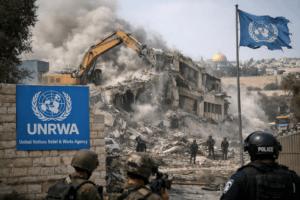
On 20 January 2026, Israeli forces accompanied by bulldozers moved into a UN compound in occupied East Jerusalem and began demolishing the headquarters of the United Nations Relief and Works Agency for Palestine Refugees (UNRWA). UNRWA Commissioner-General Philippe Lazzarini described it as “an unprecedented attack against a United Nations agency & its premises”.
This event is unprecedented for a key reason: while tensions between member states and UN agencies occur, the physical demolition of an agency headquarters by a member state breaks a fundamental norm enshrined in the 1946 UN General Convention on Privileges and Immunities. This convention obliges all member states to protect and respect the inviolability of UN premises.
The Systematic Campaign Against UNRWA
The demolition is not an isolated incident but rather the most visible escalation in a calculated, months-long campaign by Israel to dismantle UNRWA’s operational capacity. This campaign has progressed through legislative, administrative, and now physical means.
Timeline of Escalating Actions Against UNRWA (2024-2026):
| Date | Action | Consequence |
| October 2024 | Israeli Knesset passes initial legislation | Bans contact between Israeli entities and UNRWA |
| December 2025 | Legislation strengthened with amendments | Prohibits UNRWA presence in Israel and Jerusalem |
| October 2025 | ICJ ruling on UNRWA | Court orders Israel to lift restrictions on UNRWA |
| 20 January 2026 | Demolition of East Jerusalem headquarters | Physical destruction of UN premises |
The legislation passed by the Knesset represents a deliberate legal strategy to cripple UNRWA. It forbids any contact between Israeli state entities and UNRWA officials and prohibits any UNRWA presence within Israel and Jerusalem, including cutting off basic utilities like electricity, water, and gas to properties registered under UNRWA. This creates an impossible operational environment for the agency.
Violation of Multiple International Obligations
The joint statement from eleven nations identifies several specific international legal frameworks that Israel’s actions violate:
- UN Charter and General Convention (1946): These foundational documents establish the privileges and immunities of UN agencies, including the inviolability of their premises.
- International Court of Justice Ruling (October 2025): In a significant ruling, the ICJ explicitly stated that “Israel is under an obligation to agree to and facilitate relief schemes provided by the United Nations and its entities, including UNRWA”. The demolition directly contradicts this binding legal order.
- Humanitarian Law Obligations: As the occupying power in Gaza, Israel has a duty under international humanitarian law to ensure the basic needs of the civilian population are met. UNRWA is the primary mechanism for delivering this aid.
The Coalition of Condemnation: Geopolitical Significance
The composition of the nations issuing the joint condemnation is geopolitically noteworthy. The coalition includes:
- Traditional U.S. Allies: Canada, Japan, and the United Kingdom.
- Key European Nations: Belgium, Denmark, France, Ireland, Norway, Portugal, and Spain.
- Nordic States: Iceland and Norway.
This diverse group, spanning North America, Europe, and Asia, represents a broad consensus that extends beyond traditional divides in Middle East politics. Their unified stance underscores that Israel’s actions are viewed not merely as a bilateral dispute with Palestinians but as an assault on multilateral institutions that uphold international law globally.
UNRWA’s Reform Efforts Amidst Attacks
A crucial dimension often missing from the discourse is UNRWA’s ongoing institutional reforms. The joint statement explicitly welcomes “UNRWA’s commitment to reform and implementation of the recommendations of the Colonna Report”.
An independent annual report from October 2025 details substantial progress. UNRWA has fully implemented 20 of the report’s 50 recommendations (40%) with the remaining 30 actively underway. These reforms focus on strengthening neutrality safeguards, governance, and accountability systems. Donors have mobilized approximately $12 million specifically to support this implementation.
This context is vital: the demolition and legislative attacks are targeting an agency that is actively and transparently reforming itself in response to legitimate concerns, supported by many of the same nations condemning Israel’s actions.
Dire Humanitarian Consequences in Gaza
The practical consequence of restricting UNRWA is a worsening humanitarian catastrophe in Gaza. The agency provides healthcare and education to millions of Palestinians across the region and is described in the joint statement as “indispensable”.
Despite a nominal increase in aid, conditions in Gaza remain “dire” with supplies “inadequate for the needs of the population”. Humanitarian leaders consistently note that UNRWA, with its extensive infrastructure and personnel, is best equipped to distribute aid in the war-ravaged enclave. The 11 foreign ministers called for urgent steps, including:
- Safe, unimpeded delivery of aid throughout Gaza and the West Bank.
- Lifting restrictive registration requirements for international NGOs.
- Reopening all crossing points, including Rafah in both directions.
- Removing restrictions on “dual-use” items essential for humanitarian recovery.
A Critical Juncture for International Order
The demolition of the UNRWA headquarters represents a dangerous precedent. When a member state can physically dismantle a UN agency’s premises without facing immediate and severe consequences, it weakens the protections all UN agencies rely on to operate in conflict zones worldwide.
The strong, coordinated response from a cross-regional coalition of states suggests recognition of this broader threat. They are defending not just UNRWA, but the principle that multilateral institutions must be able to operate under the protection of international law, especially where civilians are most vulnerable.
The path forward requires Israel to halt demolitions, abide by its international obligations, and reverse its legislative campaign against UNRWA. The international community, meanwhile, faces the test of whether its condemnation will translate into effective diplomatic pressure to uphold the rules-based system that this unprecedented act has challenged. The security of humanitarian operations globally may depend on the outcome.
You must be logged in to post a comment.