
Delhi’s Winter Siege: When Fog and Foul Air Bring the Capital to a Choked Standstill
Delhi and the National Capital Region are grappling with a severe dual crisis of dense winter fog and dangerously polluted air, leading to significant disruption and health risks. An IMD ‘orange’ alert warns of persistent fog, which has drastically reduced visibility and caused the cancellation of nearly 100 flights, stranding travelers and crippling air operations. Concurrently, air quality has plummeted to ‘Very Poor’ and ‘Severe’ levels across the NCR, creating a toxic smog that poses serious respiratory and cardiovascular threats to residents. This annual siege, exacerbated by meteorological conditions like temperature inversion that trap pollutants, underscores a profound and recurring urban environmental emergency that extends beyond travel chaos to impact public health, livelihoods, and the overall quality of life, highlighting the urgent need for sustained, systemic action beyond temporary advisories.
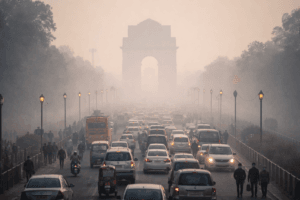
Delhi’s Winter Siege: When Fog and Foul Air Bring the Capital to a Choked Standstill
For the residents of Delhi and the National Capital Region, the final days of the year are not just a countdown to celebrations, but a battle against an annual, suffocating adversary. As 2025 draws to a close, the city finds itself locked in a familiar yet intensifying grip of dense winter fog and dangerously polluted air—a dual crisis that disrupts lives, halts travel, and poses severe health risks. The recent headlines of nearly 100 cancelled flights and an ‘orange’ alert from the India Meteorological Department (IMD) are not mere weather reports; they are symptoms of a deeper, more persistent urban and environmental challenge.
The Unseen Wall: Fog and the Fractured Rhythm of Life
The India Meteorological Department’s ‘orange’ alert for dense fog is a formal warning of a phenomenon that transforms the city’s landscape. Visibility drops to mere meters, turning familiar landmarks into ghostly silhouettes and the daily commute into a hazardous crawl. This isn’t the picturesque mist of hill stations; it’s a thick, grimy blanket that smothers the city, laden with pollutants that exacerbate its toxicity.
The most immediate and visible impact is on transportation. The advisory from the Airport Authority of India (AAI) and subsequent updates from Delhi Airport reveal a cascade of disruption:
- Flight Chaos: With 60 arrivals and 58 departures cancelled and 16 diversions reported, the human cost is immense. Travel plans for year-end reunions, holidays, and crucial business meetings lie in tatters. Airlines like IndiGo and Air India preemptively warn passengers, highlighting the widespread nature of the fog, affecting not just Delhi but airports across Northern India like Amritsar, Chandigarh, and Kolkata.
- Ground Realities: Beyond the airports, the crisis unfolds on highways and streets. Reduced visibility leads to massive traffic snarls, increased accident risks, and crippled public transport schedules. The economic ripple effect—from delayed goods logistics to lost work hours—is substantial but often unquantified.
This fog is a complex meteorological event, typically caused by the cooling of the land at night under clear skies, leading to condensation in the moist air near the surface. However, in Delhi’s case, high levels of particulate matter provide abundant nuclei for fog droplets to form, creating a denser, more persistent, and polluted mix known as ‘smog’.
The Silent Killer: Decoding the ‘Poor’ to ‘Severe’ AQI Tapestry
While the fog captures headlines, the silent, insidious partner in this crisis is the air quality. The data from the Central Pollution Control Board (CPCB) paints a grim picture of the NCR:
- Noida gasping at 410 (‘Severe’)
- Delhi at 384 (‘Very Poor’)
- Ghaziabad at 393 (‘Very Poor’)
- Gurugram at 318 (‘Very Poor’)
- Faridabad at 253 (‘Poor’)
An AQI above 400 (‘Severe’) signifies that the air pollution can affect healthy people and seriously impact those with existing diseases. It translates to a cocktail of PM2.5 and PM10 particles, nitrogen dioxide, carbon monoxide, and ozone that penetrate deep into the lungs and bloodstream.
The winter exacerbates this due to temperature inversion: a layer of warm air traps cooler air—and all the pollutants—close to the ground, preventing dispersion. This, combined with seasonal factors like stubble burning in neighboring states (though its contribution varies), vehicular emissions, construction dust, and industrial pollution, creates a toxic atmospheric lid over the basin.
The Human Cost: Beyond Cancellations and Numbers
The real story lies beyond the statistics. It’s in the:
- Health Emergency: Hospitals see a surge in patients with aggravated asthma, bronchitis, chronic obstructive pulmonary disease (COPD), and cardiovascular issues. The elderly and children are particularly vulnerable. Long-term exposure is linked to reduced lung capacity, increased risk of stroke, and even cognitive decline.
- Disrupted Livelihoods: For gig workers, delivery personnel, street vendors, and daily wage laborers, working outdoors in these conditions is a severe health risk they cannot afford to avoid. The nationwide strike call by gig workers on New Year’s Eve, as mentioned in related reports, underscores the growing awareness and protest against working in hazardous conditions.
- Psychological Toll: The relentless grey haze, the need to constantly check AQI apps before stepping out, the confinement indoors, and the anxiety over children’s health contribute to a collective sense of claustrophobia and helplessness, often termed “climate anxiety.”
Navigating the Crisis: Short-Term Alerts and Long-Term Imperatives
In the immediate term, the IMD’s alerts are crucial. An ‘orange’ alert urges authorities and citizens to “be prepared.” This means:
- For Travelers: Heeding airline advisories, allowing extensive extra time for journeys, and using verified official channels for updates.
- For Residents: Limiting prolonged outdoor exposure, especially during early morning and late evening hours when pollution peaks. Using N95/99 masks effectively, employing air purifiers at home, and staying hydrated are essential personal precautions.
- For Authorities: Enforcing graded response action plans (GRAP) measures, regulating traffic flow to prevent congestion, and ensuring visibility aids on highways.
However, reactive measures are a band-aid on a arterial wound. The recurring nature of this crisis demands systemic, year-round action:
- Accelerated Transition to Clean Energy: A non-negotiable shift from fossil fuels in transportation (electric vehicles, robust public transit), industry, and power generation.
- Integrated Regional Action: Airshed management recognizing that pollution doesn’t respect borders. Coordination between NCR states on crop residue management, industrial standards, and shared monitoring is vital.
- Green Infrastructure: Massive urban afforestation drives, protecting wetlands, and creating green corridors can act as natural air filters.
- Innovation & Transparency: Initiatives like the Delhi government’s proposed collaboration with IIT Kanpur for AI-driven pollution control are steps in the right direction. Data transparency and public awareness are key to building sustained pressure for action.
Conclusion: A Clarion Call from the Haze
As Delhi shivers and chokes under the winter siege, the fog and foul air are a stark, annual reminder. They are a manifestation of choices made and challenges unmet. The cancelled flights and ‘severe’ AQI readings are not just weather events; they are a report card on urban planning, environmental policy, and public health priorities.
The path forward requires treating this not as an inevitable seasonal curse, but as a solvable, albeit complex, problem. It demands a shift from crisis management to crisis prevention, where clear winter skies become the norm, not a fleeting memory. Until then, the dense fog serves as a poignant, if grim, metaphor—obscuring not just our vision, but also our path to a sustainable and healthy future for the capital and its people. Celebrating a new year should symbolize hope and fresh beginnings, not a desperate wait for the winds to change.
You must be logged in to post a comment.