
Delhi’s Winter Siege: Decoding the Fog, the Chill, and the Faint Whispers of Change
Delhi remains gripped by a persistent winter siege characterized by dense, pollutant-laden fog that severely reduces visibility and compounds public health risks due to very poor air quality, with the IMD’s Yellow Alert highlighting ongoing hazards for commuters and residents alike. While gentle northwesterly winds signal the beginning of a gradual shift, suggesting the intense cold and fog will slowly erode rather than abruptly end, the immediate forecast indicates only a slight moderation with moderate fog and temperatures ranging from 9°C to 22°C, meaning the capital must endure a few more days of obscured mornings before a sustained transition to clearer, warmer spring conditions takes hold.
Delhi’s Winter Siege: Decoding the Fog, the Chill, and the Faint Whispers of Change
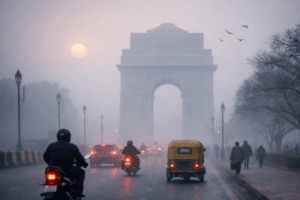
For the residents of Delhi, the morning of February 4th wasn’t just a start to the day; it was a ritual of navigating a world softened and obscured. A thick, persistent blanket of dense fog once again descended upon the capital, transforming familiar landmarks into ghostly silhouettes and turning the daily commute into an exercise in patience and hazard. The India Meteorological Department’s (IMD) Yellow Alert was more than a bulletin; it was the official confirmation of a prolonged atmospheric stalemate that has come to define Delhi’s winter narrative. But as a subtle shift in the wind whispers through the haze, a question hangs in the damp air: Is this the winter’s final, firm grip, or are we witnessing the first, tentative steps towards a reluctant spring?
The Anatomy of the Blanket: More Than Just Mist
To call it mere “fog” is to undersell its complexity. What envelops Delhi is a specific meteorological phenomenon, often a blend of radiation fog and advection fog. On clear, cold winter nights, the earth rapidly loses heat (radiation cooling). When the air near the saturated ground chills past its dew point, it condenses into fog. This is compounded by advection—the horizontal movement of moist air from the relatively warmer Yamuna and surrounding agricultural fields of Punjab and Haryana over Delhi’s cooler land surface.
However, Delhi’s fog is uniquely potent because of an unwelcome additive: pollution. It’s more accurately termed “smog” (smoke + fog). As particulate matter (PM2.5, PM10) from vehicles, industry, and seasonal stubble burning mixes with the moisture, it provides countless nuclei for water droplets to form. This creates a denser, more persistent, and far more hazardous fog. The droplet-laden air scatters light intensely, reducing visibility sometimes to less than 50 meters, but it also becomes a toxic brew that residents are forced to breathe. The transition from “fog” to “smog” is the critical point where a natural weather event becomes a public health crisis.
A Day in the Life: The Human Cost of Low Visibility
The IMD forecast for February 4th—moderate to dense fog with partly cloudy skies and temperatures between 9°C and 23°C—reads clinically. On the ground, this translates into a tangible slowdown of human life.
- The Commuter’s Ordeal: Major arteries like the Delhi-Noida Direct Flyway, NH-48, and the Ring Road become corridors of caution. Tail lights glow like faint, hovering embers in the gloom. Flights are delayed, trains run behind schedule, and the constant, anxious honking forms a muffled soundtrack. Each journey requires a recalibration of time, adding an extra “fog buffer” hour to the daily routine.
- The Health Toll: Beyond the obvious respiratory aggravation from the poor AQI (which spiked back to ‘Very Poor’ levels above 300 after a brief post-rain respite), the fog has a psychological weight. The persistent grey, the absence of the sun for days on end, contributes to a seasonal affective disorder-like fatigue. The chill, with minimums hovering 2-3 degrees below normal, seeps into bones, making homes feel perpetually cold and damp.
- The Economic Ripple: From delayed logistics and supply chains to last-minute cancellations of outdoor work, the fog imposes a subtle economic tax. Street vendors see fewer customers, morning walkers abandon parks, and the city operates below its frenetic optimum.
The Winds of Change: A Meteorological Glimmer of Hope
Embedded in the forecast is the key to the puzzle: “Northwesterly winds are expected to blow at a speed of around 8 kmph.” This is the detail weather watchers seize upon. These winds, dry and originating from the continental interiors, are the traditional scavengers of North Indian winter.
They work in two ways:
- Dispersion: They physically push and scatter the stagnant layer of fog and pollutants.
- Drying: They introduce drier air, lowering the relative humidity and making it harder for fog to form.
The question is one of intensity and persistence. An 8 kmph wind is a gentle nudge, not a sweep. It suggests a gradual erosion rather than a sudden clearance. As one senior meteorologist explained, “Northwesterlies mark the beginning of the transition. They chip away at the moisture field. If they sustain and pick up speed over the next 48-72 hours, we could see a significant improvement in visibility and a slight rise in daytime temperatures.”
The Historical Context: Is This Winter Unusual?
Was February 2nd, with a maximum of 17.5°C (5 degrees below normal), an anomaly? Statistically, dense fog episodes in January and early February are a staple of Delhi’s climate. However, their duration and intensity are increasingly linked to the cocktail of moisture and pollution. The role of Western Disturbances (WDs) is also crucial. The recent active WD brought rain and snow to the hills, but its aftermath flooded the plains with moisture—prime fodder for fog. A “good” WD that brings widespread rain can wash away pollutants, but a “weak” one only adds moisture to the air, exacerbating the smog.
The forecast for February 5th—temperatures between 9°C and 22°C with moderate fog—indicates a holding pattern. The winter is not ready to release its grip entirely, but it is no longer intensifying. We are at the meteorological plateau, just before the descent into spring.
The Inseparable Twin: Fog and the AQI Rollercoaster
The brief improvement in air quality following the February 1st rain was a fleeting relief. As predicted, the AQI deteriorated again, with hotspots like Jahangirpuri (354) and Anand Vihar breaching the ‘Severe’ category. This is the fog’s vicious partnership with pollution. Calm winds and low temperatures create a thermal inversion—a layer of warm air acting like a lid over the cooler, pollutant-filled air near the ground, preventing vertical dispersion. The fog then traps these pollutants even more effectively. Until a strong, dry wind system breaks this inversion, the air quality will remain trapped in the ‘Very Poor’ to ‘Severe’ range, making every deep breath a calculated risk.
Looking Ahead: A Gradual Thaw, Not a Sudden Shift
So, will winds push winter out? The answer is nuanced. They have begun the process. The northwesterlies are the first draft of the eventual shift towards the drier, warmer pre-summer wind patterns. However, Delhi’s winter retreats in fits and starts. We can expect:
- A gradual lifting of fog: Dense fog will likely become moderate, then shallow, over the next week, especially if wind speeds increase.
- A slow climb in temperatures: Daytime maximums will more consistently reach the low-to-mid 20s, while night-time minimums may rise above 10°C, softening the sharpest edge of the chill.
- The persistence of morning haze: Even as dense fog recedes, a characteristic morning haze, laden with pollutants, may linger until more robust wind patterns establish themselves.
For Delhi’s residents, the advice remains to brace for a few more mornings of limited visibility and chilly starts. But there is a meteorological promise in the air—a subtle, dry wind that carries, if not immediate warmth, then the certainty of change. The siege will lift, not with a dramatic bang, but with a slow, stubborn scatter, revealing the city once again under the strengthening late-winter sun. The key is to stay vigilant through this final phase, protecting health while reading the signs in the wind—the quiet heralds of the season’s turn.
You must be logged in to post a comment.