
Delhi’s Winter Paradox: Why Clearer Skies Are Masking a Deepening Air Quality Crisis
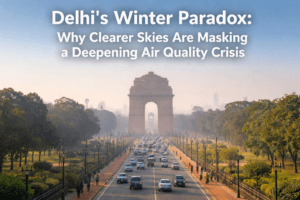
Delhi’s Winter Paradox: Why Clearer Skies Are Masking a Deepening Air Quality Crisis
In the final days of 2025, Delhi’s residents are experiencing a jarring atmospheric contradiction. While the dense fog that has choked visibility for days is beginning to lift, revealing clearer skies, a more insidious enemy persists: the air itself remains dangerously toxic. With the Air Quality Index (AQI) stubbornly lodged in the ‘very poor’ category—registering 342 on a recent morning and soaring to 374 in the ITO area—the capital is trapped in a winter paradox. This situation is not an isolated bad day but a symptom of a complex and entrenched environmental challenge facing India’s north, where meteorological conditions and human activity conspire to create a recurring public health emergency.
The Cruel Illusion of Winter Skies
Delhi’s weather in late December presents a cruel illusion. A superficial glance upwards shows clearer skies, a welcome change from the oppressive, near-zero visibility of dense fog. However, this visual improvement is deceptive. The fog’s retreat often leaves behind what experts term a “thick layer of toxic smog”. This smog is a hazardous cocktail of particulate matter (PM2.5 and PM10), nitrogen oxides, sulfur dioxide, and other pollutants, now trapped by a different set of atmospheric conditions.
The recent spell of severe weather has been widespread. Northern Haryana and Punjab became the epicenter of a dense fog cluster that spread across north India, severely disrupting life. Cities like Ambala faced orange alerts from the India Meteorological Department (IMD), while Ayodhya and Kanpur in Uttar Pradesh grappled with intensified cold waves. The IMD has extended a dense fog alert for the entire region until at least December 27, predicting continued cold day conditions where maximum temperatures struggle to rise.
Table: Delhi’s Recent Air Quality and Weather Snapshot
| Metric | Status/Measurement | Context & Impact |
| Average AQI (Dec 24 AM) | 342 (Very Poor) | Down from a ‘severe’ level of 412 the previous evening. |
| AQI at ITO Area | 374 (Very Poor) | Shows severe localized pollution hotspots within the city. |
| Visibility at Palam | Dropped to 100m | Classified as “dense fog,” severely disrupting air and road travel. |
| Flight Disruptions | Over 150 flights delayed | Direct consequence of low visibility and safety protocols. |
| Temperature Range | Max: 16-18°C; Min: 8-11°C | “Cold day” conditions, where daytime temps remain well below normal. |
The Meteorological Trap: Why Pollutants Won’t Disperse
The primary reason for this pollution lock-in is meteorological stagnation. As explained by the Commission for Air Quality Management (CAQM), the region is experiencing unfavorable conditions marked by low wind speeds—sometimes becoming calm—and an increase in moisture in the lower atmosphere. This combination is a perfect recipe for winter smog.
Normally, winds help disperse and sweep away pollutants. When these winds vanish, a phenomenon known as a temperature inversion often occurs. A layer of warm air acts like a lid, trapping cold, polluted air close to the ground. With no vertical or horizontal movement, emissions from vehicles, industry, and other sources accumulate relentlessly. The CAQM noted that a “feeble Western Disturbance” approaching northwest India contributed significantly to this calm, trapping weather pattern. It’s a stark reminder that during Delhi’s winters, a drop in emissions alone is often insufficient; the atmosphere’s capacity to self-clean effectively shuts down.
Beyond Emergency Measures: Delhi’s Multi-Pronged Environmental Push
Faced with this annual crisis, authorities are implementing a two-track strategy: immediate emergency action and longer-term structural investment.
The emergency response is governed by the Graded Response Action Plan (GRAP). With AQI levels breaching severe thresholds, Stage-IV measures—the most stringent—were invoked. These include:
- A ban on most diesel trucks (BS-IV and below) entering the city.
- A halt on all public and private construction and demolition activity.
- A shift to hybrid (online-offline) learning modes for schools from Class VI upwards.
Concurrently, the Delhi government has approved a series of ambitious, long-term environmental decisions. The most prominent is the allocation of ₹100 crore for the rejuvenation of water bodies. Delhi has approximately 1,000 such bodies, 160 of which fall directly under the government’s jurisdiction. Environment Minister Manjinder Singh Sirsa stated this initiative aims for a “decisive reduction in sources of air and water pollution”. Healthy, percolating water bodies can help settle dust, moderate local microclimates, and restore groundwater, contributing to overall ecological resilience.
This water body project is part of a broader environmental package that includes:
- Establishing Delhi’s first E-Waste Park in Holambi Kalan, designed on a 100% circular, zero-waste, and zero-pollution model.
- Consolidating public transport by bringing all bus operations under the Delhi Transport Corporation (DTC) for better efficiency and route rationalization.
- Continuing the “No PUCC, No Fuel” campaign year-round to ensure vehicles maintain valid Pollution Under Control Certificates.
The National Context: A Systemic Challenge
Delhi’s struggle is a magnified version of a crisis engulfing much of the Indo-Gangetic Plain. The 2025 progress report on India’s National Clean Air Programme (NCAP) reveals the scale of the challenge. The report shows that in 2024:
- Delhi ranked as the third-most polluted city in India for annual average PM10 concentrations and second for PM2.5.
- All 28 monitored cities in the National Capital Region (NCR) exceeded the national ambient air quality standards for PM10.
- In the broader Indo-Gangetic Plain, 74 out of 76 monitored cities exceeded the PM10 standard.
These figures underscore a critical point: air pollution is a regional, transboundary problem. An “airshed” approach—where states collaborate on a unified plan—has been recommended but remains difficult to implement. Furthermore, while ₹11,211 crore has been released for NCAP, fund utilization has been suboptimal at 68%, with a skewed allocation heavily favoring road dust management over addressing industrial or domestic fuel sources.
Health, Livelihood, and the Path Forward
The human cost of this persistent ‘very poor’ air is immense. Health advisories consistently warn children, the elderly, and those with respiratory or cardiovascular diseases to avoid outdoor activities. Prolonged exposure to PM2.5 pollution is linked to asthma, lung cancer, heart disease, and strokes. The economic cost includes healthcare burdens, lost productivity, and disrupted commerce and travel, as seen with the hundreds of delayed flights.
The path forward requires moving beyond seeing pollution as only a winter emergency. It demands:
- Sustained, Year-Round Action: Policies like strict PUCC enforcement and sustainable waste management must be permanent, not seasonal.
- Evidence-Based Investment: Funding should be guided by completed source apportionment studies, which only 50 of 131 NCAP cities have done.
- A Shift in Priority: Experts urge NCAP to prioritize the more health-damaging PM2.5 over PM10 in its target-setting.
- Embracing Natural Solutions: Initiatives like water body rejuvenation represent a necessary shift toward enhancing ecological infrastructure to complement regulatory measures.
Delhi’s clearer winter skies are a poignant symbol of a misunderstood battle. The real fight is not just against visible fog but against an invisible, toxic mixture that a stagnant atmosphere locks into place. Solving it requires recognizing that the winter air quality crisis is a year-long problem of emissions, manifesting most violently when the wind stops blowing. The true measure of progress will come not on a single clearer day, but when ‘very poor’ AQI readings become a true anomaly, not a winter norm.
You must be logged in to post a comment.