
Delhi’s Winter 2025: A Late Arrival, Global Context, and What to Truly Expect
Delhi’s characteristic winter chill, or “Dilli ki sardi,” is experiencing a notable delay this year, with experts forecasting that typical cold conditions will only arrive after December 20-21, influenced by the awaited arrival of active Western Disturbances that usher in cold air. While a weak La Niña climate pattern may contribute to slightly more frequent cold waves in January and February, overall, the season is not expected to be an extreme outlier, as its potential intensity is tempered by the broader context of record global warming, which is shifting seasonal timelines and creating a warmer baseline climate, despite the likelihood of normal winter spells and dense fog during the peak months.
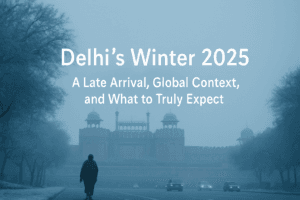
Delhi’s Winter 2025: A Late Arrival, Global Context, and What to Truly Expect
With mid-December upon us, Delhi’s residents are asking a familiar, seasonal question: Where is the winter chill? The “Dilli ki sardi,” famous for its sharp bite and dense fog, is running significantly late this year. While weather experts agree that colder days are on the horizon, their forecasts reveal a complex interplay of local weather systems, a weak global climate phenomenon, and the undeniable backdrop of a warming planet. This season is shaping up to be a case study in how global patterns manifest in local weather, balancing predictions of harsh cold with the reality of record global heat.
The Forecast: A Timeline for Winter’s Arrival
According to expert analysis, Delhi’s characteristic winter is not cancelled, merely postponed. GP Sharma, President of Skymet Weather Services, provides a clear timeline: the region can expect “wintry conditions” to begin by the end of the third week or the start of the fourth week of December. He specifies that the “typical winter” will set in anytime after December 20 or 21.
This delay is not without precedent. Sharma notes that last year, typical winters also started “a little late,” after mid-December, before establishing a steady, cold pattern in January and February. For those anticipating intense cold spells, the window is later still. Sharma indicates that while colder conditions will arrive late December, extreme cold waves typically occur after mid-January.
Why the Delay? The Critical Role of Western Disturbances
The primary culprit for the mild December is a lack of active Western Disturbances (WDs). These are low-pressure systems that originate over the Mediterranean Sea and travel eastward, bringing vital rainfall to the Himalayas and, crucially for the plains, ushering in cold, dry northwesterly winds.
- Current Absence: Dr. Naresh Kumar, a senior scientist at the India Meteorological Department (IMD), confirms that no active WD has influenced the region this season, preventing the cold wave from reaching Delhi-NCR.
- Immediate Outlook: The IMD forecasts a weak WD around December 13, but it is expected to bring only light rain to parts of Jammu and Kashmir and will not lower temperatures in Delhi. In fact, it may cause a slight temperature rise.
- The Turning Point: Sharma from Skymet expects more impactful WDs only after December 19, which will finally begin to affect both the mountains and the plains, triggering the awaited temperature drop.
In the absence of these systems, Delhi has recorded above-normal temperatures. On December 11, the minimum temperature was 8.6°C, which is 0.6°C above average, and notably warmer than the 4.9°C recorded on the same date last year. The IMD predicts minimums may even rise by 2-4°C in the coming week.
The La Niña Factor: A Weak Influence in a Warm World
Much has been said about La Niña’s potential to deliver a harsh winter. La Niña, characterized by cooler-than-average sea surface temperatures in the central-eastern Pacific Ocean, can influence global weather patterns.
- Official Assessments: Both the IMD and the World Meteorological Organization (WMO) classify the current La Niña as weak and likely to be short-lived. The WMO gives only a 55% probability of it persisting through the December-February period.
- Expert Calibration: GP Sharma concurs, stating this is the second consecutive year of a “very brief and weak” La Niña event. He links it, along with broader climate changes, to a “shifting of seasons beyond the timeline”.
- Contrasting Predictions: This assessment contrasts with some media reports that have predicted La Niña could trigger the “coldest winter in years” for North India, with frequent cold waves and dense fog. The IMD, however, has sought to dispel rumours of an extremely harsh winter, anticipating a normal winter season instead.
The Bigger Picture: A Record-Warm Planet
To understand Delhi’s weather fully, one must zoom out to the global scale. The local delay in winter is occurring against a backdrop of extraordinary planetary heat.
November 2025 was Earth’s third-warmest November on record, continuing a streak where every month for half a year has ranked third-warmest. Crucially, this heat is persisting without an El Niño event, which had fueled the record warmth of 2023 and 2024.
The trend is stark:
- The January-November 2025 period is the 2nd-warmest on record globally.
- The average global temperature for 2023–2025 is expected to exceed 1.5°C above pre-industrial levels, marking the first three-year average to do so.
- On a continental level, Asia had its 9th-warmest November on record.
This context is vital. While local phenomena like WDs and La Niña dictate short-term weather patterns, the baseline state of the climate is warmer. This can modulate extremes, making severe cold spells less frequent or shorter-lived even when they occur.
What Can Delhi-NCR Actually Expect This Winter?
Synthesizing the expert forecasts and data, here’s a balanced outlook for the 2025-26 winter season:
| Aspect | Likely Outlook | Key Influences & Notes |
| Onset of Winter | Delayed, commencing late Dec (post Dec 20/21). | Dependent on arrival of active Western Disturbances. |
| Cold Wave Frequency | Near normal to slightly above. ~5-8 days in the season. | Weak La Niña may contribute to slightly more frequent spells. |
| Peak Cold Period | Mid-January through February. | Extreme cold waves most probable in this window. |
| Overall Severity | Not an outlier; harsh spells typical of winter, but not exceptionally severe. | Weak La Niña and global warming backdrop temper extreme cold potential. |
| Additional Factors | Potential for dense fog, especially in Jan-Feb. | Could combine with pollution, raising health and travel concerns. |
Preparing for the Season Ahead
For residents, the forecast suggests a winter that arrives late but delivers a fairly typical January and February. Preparation should be standard but thoughtful:
- Layer Up Gradually: The delayed onset means you have more time to unpack winter clothing, but ensure woolens are ready for the late-December dip.
- Focus on January: Plan for the most impactful cold weather after the New Year, when health risks from cold and pollution peaks are highest.
- Stay Informed: Follow updates from authoritative sources like the IMD and trusted private agencies for real-time cold wave and fog alerts.
- Health Advisory: The elderly, young children, and those with respiratory conditions should be particularly cautious as temperatures fall and pollution tends to get trapped.
In conclusion, Delhi’s awaited winter is coming, but it is a season caught between competing forces. It is being nudged by a weak La Niña, held back by absent wind patterns, and fundamentally tempered by a warmer world. The “Dilli ki sardi” will still arrive with its familiar chill, but its character this year is a testament to the complex and interconnected nature of modern climate and weather.
You must be logged in to post a comment.