
Delhi’s Weather Whiplash: A Weekend of Relief, Rumbles, and Renewal
The article provides an in-depth look at Delhi’s impending weather shift, driven by back‑to‑back western disturbances that promise light rain, thunderstorms, and gusty winds on Friday, followed by more widespread showers over the weekend. The sudden cool down—temperatures dropping from a sultry 34.8°C to a pleasant 29–31°C—offers a brief but welcome respite from the building summer heat, while the accompanying winds and rain are expected to temporarily improve the city’s moderate air quality. Beyond the forecast, the piece explores how Delhi adapts to such meteorological swings: commuters brace for disruptions, street vendors cover their wares, and residents find comfort in indoor plans and seasonal treats like pakoras and chai. It also highlights the rain’s significance for agriculture on the capital’s outskirts and notes that this cooling interlude will be short‑lived, with the sun soon reasserting its dominance as summer approaches.
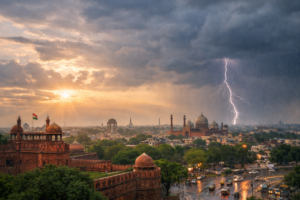
Delhi’s Weather Whiplash: A Weekend of Relief, Rumbles, and Renewal
The air in Delhi on Friday morning carried a peculiar charge. It wasn’t the usual pre-summer stillness that settles over the capital like a heavy blanket, nor was it the oppressive humidity that precedes the monsoon. Instead, there was a crispness, a tangible hint of electricity that made the city feel as if it were holding its breath. After a Thursday that saw the mercury spike to a sweltering 34.8°C—three notches above the seasonal norm—the India Meteorological Department’s (IMD) prediction of a dramatic shift felt less like a forecast and more like a promise.
As the sun struggled to pierce through a veil of high-altitude clouds, Delhiites braced themselves for a day of transition. The weather office had issued a forecast for spells of very light rain or drizzle, accompanied by the kind of dramatic meteorological theatre that only the convergence of seasonal heat and a western disturbance can produce: thunderstorms, lightning, and gusty winds whipping through at speeds of 20–30 kilometers per hour, with gusts reaching up to 40 km/hr.
This is the story of that weather—but more than a simple report of rain and wind, it is a look at how the city lives through these moments of climatic whiplash, and what this particular shift means for the rhythm of life in India’s capital.
The Science of a Sudden Chill
To understand the drama unfolding over Delhi’s skyline, one must look to the west. The protagonist in this meteorological narrative is the “Western Disturbance,” a term that has become a staple in the Indian subcontinent’s weather lexicon, especially during the winter and spring months. These are extratropical storms originating in the Mediterranean region, carrying moisture across the Arabian Sea and into the western Himalayas and northern plains.
The disturbance currently approaching northwest India is the second act in a short play. A weaker system was responsible for the “patchy light rain” and gusty winds forecast for Friday. But it is the next one, predicted to become active from the night of March 28, that has meteorologists raising their eyebrows.
“This isn’t just a drizzle event,” explains a senior meteorologist, speaking on the condition of anonymity to elaborate on the technicalities. “The initial disturbance is a precursor, a softening of the atmospheric canvas. The real event is the second, more vigorous system. It has the potential to pull in more moisture and create the instability needed for widespread, sustained showers.”
This instability is born from the collision of two air masses. On one side is the warm, dry air that has been building over the plains of northern India, creating the 34.8°C heat recorded just a day prior. On the other is the cool, moist air being funneled in by the western disturbance. When they meet, the warm air is forced to rise rapidly, cooling and condensing into the towering cumulonimbus clouds that unleash the theatrics of thunder and lightning. The result, for the 20 million people living in the National Capital Region (NCR), is a forecasted temperature dip to a pleasant 29–31°C on Friday—a welcome drop of nearly six degrees from Thursday’s high.
The City in Waiting
As the morning progressed, the city responded to the impending change with its characteristic blend of chaos and preparation. In the crowded bylanes of Old Delhi, the pace of life seemed to quicken. Vendors who usually sprawl their wares onto the pavement began to tuck them away, covering piles of textiles and trinkets with blue plastic tarps that flapped in the rising wind. The aroma of garam masala and frying samosas from a thousand street-side stalls mingled with the earthy scent of dry dust, a smell that transforms into the unique fragrance of “petrichor” the moment the first raindrops fall.
For the city’s commuters, the day was a gamble. The Delhi Metro, the city’s circulatory system, operated on high alert, with extra staff positioned at key stations to manage potential surges in ridership if the roads became waterlogged. At the ITO and Moolchand flyovers, traffic moved with a nervous energy. Auto-rickshaw drivers, ever the pragmatists, haggled with a little less enthusiasm, many eyeing the sky and deciding to head home early rather than risk getting caught in a hailstorm on the open road.
“It’s a tricky day,” said Ramesh Kumar, a 45-year-old cab driver who has been navigating Delhi’s roads for two decades. “The heat is good for business—people want AC cars. But a storm? That stops everything. You get stuck under a flyover for hours. But you know what? I don’t mind it. This weather, just before the real summer hits, it’s like a gift. A last drink of cool water before the long, dry thirst of May and June.”
A Breath of Fresh (and Slightly Cleaner) Air
There is another, often invisible, layer to this weather event that adds to its value. Alongside the thermal relief, the wind and rain offer a temporary reprieve from the region’s perennial challenge: air quality.
On Thursday, the 24-hour average Air Quality Index (AQI) stood at 186, teetering on the edge of the ‘moderate’ category. For Delhi, an AQI under 200 is considered a tolerable day. But the chemistry of a thunderstorm is a powerful, if temporary, cleanser. The updrafts within a storm cell lift pollutants—dust, particulate matter from vehicles, and construction debris—high into the atmosphere. The rain then acts as a giant scrubber, binding to these particles and pulling them down to the ground.
“Winds of 20-40 km/hr are significant,” said a scientist from a leading environmental think tank in Delhi. “They provide the ventilation that Delhi’s air desperately needs. Instead of pollutants accumulating in a stagnant air mass, they get dispersed. The rain then does the final wash. We often see AQI values drop from ‘poor’ to ‘satisfactory’ or even ‘good’ after a well-developed western disturbance passes through. It’s a natural detox.”
Forecasts predict the AQI will likely remain in the ‘moderate’ band over the next seven days, a testament to the cleansing effect of the incoming weather system. For residents prone to respiratory ailments, this isn’t just a statistic; it’s a chance to open their windows for the first time in weeks without fear.
More Than Just a Weekend Washout
The IMD has raised a yellow alert for Sunday, signaling a “be aware” advisory for light showers and thunderstorms. For many, this might sound like a disruption to weekend plans. For farmers on the outskirts of Delhi and in the neighboring states of Haryana and Uttar Pradesh, however, it’s a different story entirely.
The late-March rain is a critical factor in the Rabi (winter) harvest. Wheat, the staple crop of the region, is currently in its final ripening stage. While rain during this period can be a double-edged sword—potentially causing lodging (the flattening of crops) if accompanied by heavy winds—a gentle, widespread shower is beneficial. It can reduce the need for the last round of irrigation and help the grain fill properly.
For the city’s vast population of gardeners and nature enthusiasts, the rain is a catalyst. The hardy bougainvillea that lines the city’s flyovers, the neem trees shedding their dry leaves, and the carefully tended rose bushes in Lutyens’ Delhi bungalows will all respond to the moisture. It’s the final green push before the heat of summer forces the city into a state of suspended, dusty animation.
How to Navigate the Thunderous Weekend
As the city prepares for the weekend, a shift in mindset is required. The usual urge to flock to crowded outdoor markets or plan a picnic in the Sunder Nursery might need a contingency plan. The IMD has warned of lightning and gusty winds, which pose a genuine risk. Here’s how a discerning Delhiite can navigate the next 48 hours:
- Embrace the Indoors: This is a perfect weekend to explore Delhi’s world-class indoor attractions. The National Museum, the Kiran Nadar Museum of Art, or a long, leisurely lunch at a historic haveli-turned-restaurant in Shahjahanabad offer shelter without compromising on experience.
- Travel Smart: If driving is necessary, be cautious of waterlogging under flyovers, particularly in areas like Minto Bridge, Pul Prahladpur, and the underpasses on the Ring Road. Winds can bring down tree branches; parking under large, old trees is best avoided.
- Tech-Ready: Keep devices charged. Thunderstorms can cause transient power fluctuations. For those working from home, ensuring data backups and a stable mobile internet connection can prevent mid-meeting disruptions.
- A Culinary Shift: The dip in temperature is a culinary invitation. It’s a signal to shift from the summer obsession with cold juices and ice cream back to comfort foods, even if briefly. A hot bowl of kadhi chawal, a plate of piping hot pakoras (which taste exponentially better in the rain), or a chai from the corner thela becomes an essential experience rather than just a beverage.
Looking Ahead: A Brief Respite
The relief, while welcome, is fleeting. The IMD’s data underscores a broader climatic narrative for Delhi. March has become a month of extremes, acting as a volatile battleground between retreating winter systems and advancing summer heat. The forecasted high of 29-31°C on Friday will likely feel cool compared to the days prior, but it is still a reminder that summer is not far off.
By Monday, after the second disturbance has passed, the sun will reassert its dominance. The moisture left behind by the rain will initially lead to high humidity, making the subsequent rise in temperature feel even more oppressive. The brief, cool interlude will become a memory—a meteorological palate cleanser before the main course of the North Indian summer.
For now, however, Delhi stands at a threshold. The thunder is not just a noise; it is a signal of change. The lightning is not just a hazard; it is a momentary illumination of the city’s delicate relationship with its environment. As the first drops begin to fall on Friday afternoon, tapping against windowpanes in South Delhi and creating tiny craters in the dust of the Yamuna floodplains, the city will pause. In that pause is a shared understanding: this is Delhi’s weather at its most dramatic, offering a moment of unity, relief, and renewal before the long, hot road ahead.
You must be logged in to post a comment.