
Delhi’s Unseasonable Warmth: A Pleasant Day or a Piercing Warning?
The seemingly pleasant weather in Delhi, with a maximum temperature of 29.7°C—four notches above average—masks a more complex and concerning reality for its residents, as this unseasonable warmth disrupts daily life, strains resources, and is intrinsically linked to a “poor” Air Quality Index (AQI) of 229 that causes chronic, low-grade health issues for millions. This combination of rising temperatures and persistent pollution represents a new, year-round environmental normal where the joy of a sunny February day is undercut by the hidden costs of respiratory discomfort and the knowledge that these two factors—heat and haze—are deeply connected, forcing the city’s resilient population to adapt to a state of constant, low-level environmental stress.
Delhi’s Unseasonable Warmth: A Pleasant Day or a Piercing Warning?
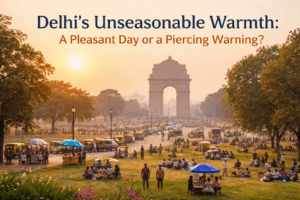
On the surface, the news from the national capital on Sunday was a straightforward weather update. The India Meteorological Department (IMD) recorded the day’s temperature at a pleasant 29.7 degrees Celsius, a full four notches above the seasonal average. The sun was out, the mist of the early morning had burned off by noon, and for many Delhiites, it was a perfect day to shed the winter layers, sit in the park, or enjoy a late afternoon chai at an outdoor stall.
But beneath this veneer of pleasant, almost spring-like weather, lies a more complex and concerning reality for the city of 20 million. The same data that tells us about the warm sun also reveals a minimum temperature that refuses to dip, a humidity level that swings wildly, and an air quality index that has settled into a toxic rhythm. The “poor” AQI of 229, recorded by the Central Pollution Control Board (CPCB) at 4 PM, is a stark reminder that in Delhi, no pleasant day comes without a hidden cost.
This isn’t just a weather report; it’s a snapshot of the new normal for India’s capital—a complex interplay of a changing climate, persistent pollution, and the quiet resilience of its people.
The 30-Degree February: Unpacking the Temperature Anomaly
When the IMD notes that the maximum temperature was 29.7°C, “4.2 notches above the seasonal average,” the numbers can feel abstract. To understand what that means, you have to step outside. For generations, Delhi’s late February has been characterized by a specific kind of beauty—a crispness in the morning air, a gentle, welcome warmth by noon, and a cool, blanket-worthy evening. It’s the transition period, a time to enjoy the city’s famed argemone flowers blooming in vacant lots and the last of the winter vegetables at the local mandi.
A temperature of 30°C, however, is something you expect in late April. It carries the whisper of the scorching summer to come. For the average Delhiite, this isn’t just a matter of comfort; it’s a disruption of rhythm.
For the Common Man: Walking through a market in Lajpat Nagar on Sunday, the evidence was everywhere. Families were buying ice cream, a treat usually reserved for April onwards. Auto-rickshaw wallahs had their cotton towels draped over their shoulders, using them to mop brows earlier in the day than they should have to. “The heat is coming early this year,” said Ramesh, a vegetable vendor, arranging his greens under a makeshift shade. “In February, the saag stays fresh longer. But this heat? It wilts the leaves by noon. We have to adjust everything.”
This early heat has a cascading effect. It increases water consumption, puts an early strain on the power grid as fans and coolers are switched on weeks ahead of schedule, and even affects crop cycles in the surrounding regions, impacting the supply and price of fresh produce entering Delhi’s markets.
The Environmental Context: Meteorologists point to a combination of factors. The lack of active western disturbances—the weather systems that bring winter rain to North India—has left the region dry. Clear skies allow the sun to beat down unimpeded during the day. Furthermore, anti-cyclonic circulations over parts of North India can act as a cap, trapping heat and preventing the dispersion of pollutants, linking the temperature rise directly to the air quality crisis.
Breathing the ‘Poor’ Air: The Invisible Price of a Sunny Day
While the 29.7°C heat is felt on the skin, the AQI of 229 is felt deep in the lungs. The CPCB classifies ‘Poor’ AQI (201-300) as a level that leads to “breathing discomfort to most people on prolonged exposure.” It is the threshold where the air becomes a public health concern, not just for the vulnerable (children, the elderly, those with pre-existing conditions), but for the healthy adult population as well.
Sunday’s reading of 229 places Delhi in a dangerous middle ground. It is not the “Severe” emergency of November, when schools shut and people are advised to stay indoors. It is, in many ways, more insidious. It is the everyday air that millions of people have no choice but to breathe while commuting, working, and living.
The Lived Experience of ‘Poor’ Air: For Jiya, a 24-year-old marketing professional who commutes from Noida to Connaught Place via metro and auto, “poor” air has become an invisible tax on her health. “It’s not the smoggy, visible haze of winter. The sun is shining, so it tricks you into thinking the air is clean. But by the time I get home, my throat is scratchy, and my eyes are red. I’ve had a mild cough for three months now that just won’t go away,” she shared.
This is the reality for millions. Pharmacies across the city report a steady, year-round demand for antihistamines, asthma inhalers, and eye drops, a constant baseline of illness that spikes when the AQI climbs. The “poor” category is where the body never gets a break. It’s a state of chronic, low-grade inflammation for the city’s population.
The “very poor” and “severe” days make headlines. But the “poor” days, like Sunday, are the ones that actually define life in Delhi. They are the days when doctors advise limiting outdoor walks, when schools keep children inside for PE class, and when the simple act of jogging in a park becomes a net negative for your health.
Why a High of 30°C and an AQI of 229 Go Hand-in-Hand
The dual data points from Sunday are not coincidental; they are deeply connected. Delhi’s pollution problem is at its worst in the winter due to a phenomenon called temperature inversion. A layer of warm air acts like a lid, trapping cold air and pollutants close to the ground. As we move towards the end of February, the surface heating increases.
While a hotter surface might seem like it would help disperse pollutants, the situation is more nuanced. The high temperatures themselves can contribute to the formation of secondary pollutants. Furthermore, the calm winds and stable atmospheric conditions that allow the mercury to soar also prevent the wind from sweeping the pollutants away. The heat bakes the existing pollution into a stable, ground-level haze that, while not as visually dramatic as winter smog, is chemically complex and just as harmful.
Looking Ahead: A Glimpse into Monday and Beyond
The IMD’s forecast for Monday offers more of the same—mist in the morning, followed by a high near 30 degrees Celsius, with the minimum settling at a relatively warm 14 degrees Celsius. This forecast of a warm night is particularly significant.
Typically, cool nights offer the body a chance to recover from daytime heat and pollution. When the minimum temperature is also above normal, it indicates a warming trend that is relentless. It puts stress on the body, disrupts sleep, and ensures that the air remains laden with moisture and pollutants for longer.
For the city’s administration, this forecast is a reminder that the “pollution season” is no longer just the winter. It is becoming a year-round challenge. The focus must shift from emergency measures (like GRAP – Graded Response Action Plan) to long-term, sustainable solutions that address the root causes: vehicular emissions, industrial pollution, construction dust, and the burning of biomass.
Conclusion: The New Normal
The news of Delhi’s temperature hitting 29.7°C and its air being “poor” is more than just a daily statistic. It is a narrative of adaptation. It speaks of a city learning to live in a state of constant environmental flux—where the joy of a sunny February afternoon is always tempered by the scratch in the throat and the worry in the back of the mind.
As one resident waiting for a bus at ITO remarked, “You learn to take the good with the bad. The sun feels nice on your face, but you know you’ll be coughing by dinner time. What can you do? This is Delhi.”
And that, perhaps, is the most poignant takeaway. The city and its people are resilient, navigating these challenges with a stoic acceptance. But as the temperatures continue to climb and the air remains heavy, the question looms larger: At what point does resilience turn into resignation? For now, the answer is blowing in the warm, polluted wind.
You must be logged in to post a comment.