
Delhi’s Sudden Winter Return: How a Rare March Weather Twist Is Reshaping the Capital’s Weekend
In an unexpected meteorological twist, Delhi-NCR experienced a dramatic return to winter-like conditions over the weekend, with dense fog, unseasonal rain, and a record-low maximum temperature of 21.7°C on Friday—the lowest in March in six years. This rare cooldown resulted from a perfect storm of moisture-laden winds and an active western disturbance, offering residents a brief respite from the approaching summer, prompting them to swap air conditioners for sweaters, and even improving the Air Quality Index to the “moderate” category. While another spell of rain is forecast for March 23, the India Meteorological Department notes that the chill is temporary, with temperatures expected to rise gradually and conditions returning to normal in the coming days.
Delhi’s Sudden Winter Return: How a Rare March Weather Twist Is Reshaping the Capital’s Weekend
For residents of the national capital, the last few days have felt like a meteorological glitch. Just as the city was bracing for the familiar ascent into summer—with air conditioners humming and the first signs of heat haze appearing on the roads—nature decided to hit the rewind button.
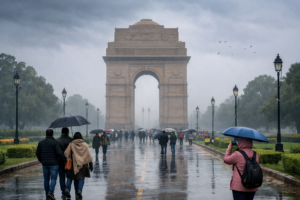
Since late Wednesday, a dramatic shift in weather patterns has transformed Delhi-NCR. The sweltering anticipation of summer has been replaced by a chill that feels more reminiscent of late January than the cusp of April. Dense fog enveloped parts of the city on Saturday morning, following overnight rainfall that left the streets slick and the air tasting of damp earth. Similar conditions were reported in the satellite cities of Ghaziabad and Noida, where a light, ethereal layer of fog hovered over high-rises and industrial corridors, delaying morning commutes and offering a rare, misty aesthetic to the urban landscape.
This isn’t just a passing shower; it is a significant weather anomaly that has broken records, disrupted routines, and offered a final, fleeting taste of winter before the inevitable grip of the hot season begins.
The Perfect Storm: A Confluence of Atmospheric Events
To understand this sudden cooldown, one must look beyond the clouds and into the mechanics of a rare atmospheric confluence. The India Meteorological Department (IMD) has been tracking a complex interplay of weather systems that began around March 18.
The first ingredient was moisture-laden winds. Unlike the dry, scorching winds that typically characterize this time of year, these winds carried significant humidity. Combined with unseasonably high surface temperatures, they created the perfect conditions for the formation of convective clouds—the tall, towering clouds that often precede thunderstorms.
Then came the catalyst: an active Western Disturbance. This weather system, originating in the Mediterranean region, is typically associated with winter rain and snow in North India. However, when it interacts with residual moisture and convective energy in the pre-summer season, the result can be explosive.
As the Western Disturbance approached, it interacted violently with the convective clouds already brewing over the region. The result was widespread, intense rainfall that lashed Delhi-NCR with an intensity usually reserved for the monsoon’s arrival. This meteorological “collision” didn’t just bring rain; it fundamentally altered the thermal dynamics of the region.
The numbers tell the story of this dramatic shift. On Friday, the maximum temperature in Delhi plummeted to a staggering **21.7 degrees Celsius**. To put that in perspective, this was nearly 10 degrees below the normal for this time of year, and a sharp fall from the 26.8 degrees Celsius recorded just a day earlier.
Data from the IMD highlights the rarity of this event. This marked the lowest maximum temperature recorded in the capital during March in six years. The last time the mercury dipped this low in the third month of the year was on March 8, 2020, when the temperature settled at 21.2 degrees Celsius. For a city that often sees its March temperatures cross the 35-degree mark, this was a statistical outlier—a brief, surprising gift of winter.
Human Impact: From ACs to Sweaters
For the people of Delhi, statistics translate into lived experience. The sudden shift has been jarring but not unwelcome.
Just a few days ago, the city was gearing up for summer. Offices were testing their air conditioning units, roadside vendors were setting up their *aam panna* (raw mango drink) stalls, and families were storing away winter quilts. The rain changed all that. Residents scrambled to pull out sweaters and light jackets that had been packed away for months.
The cooling effect was most noticeable during the evenings and early mornings. The usual hustle of the city was muted by the drizzle, and the sound of thunder replaced the blare of traffic in many residential neighborhoods. There was a tangible sense of relief in the air. For a population accustomed to the oppressive heat that often arrives by mid-March, this extension of the cool season felt like a bonus—a chance to enjoy chai and *pakoras* on the balcony without the sweat of summer.
However, the disruption was not without its challenges. The sudden fog on Saturday morning led to reduced visibility, causing delays at the Indira Gandhi International Airport and affecting train services in the northern railway zone. The dampness also posed health concerns for those with respiratory issues, as the combination of humidity and trapped pollutants often creates a different kind of discomfort than dry heat.
What Lies Ahead: A Temporary Respite
As with all weather anomalies in the Indo-Gangetic plain, this one is expected to be temporary. The IMD has forecast another spell of rain on March 23, suggesting that the cool spell might have one final act.
Looking ahead, the temperature is expected to begin its gradual ascent from Saturday onward. The maximum temperature is likely to settle between 26 and 28 degrees Celsius in the coming days—still comfortable, but a clear signal that the heat is preparing to return. The impact of the Western Disturbance is waning, and the atmospheric conditions are slowly returning to the baseline expected for this time of year.
For now, residents are making the most of it. Street vendors selling *bhutta* (roasted corn) have seen a surge in business, as the weather is perfect for the monsoon-like snack. Social media is flooded with photographs of foggy mornings and cloudy skies, with captions expressing gratitude for the “bonus winter.”
Air Quality: A Silver Lining
One of the most significant benefits of this weather system has been its impact on the Air Quality Index (AQI). According to the IMD’s early warning system and real-time monitoring data, the AQI is expected to remain in the ‘moderate’ category.
For Delhi, a city that frequently battles ‘severe’ and ‘hazardous’ air quality levels, particularly in winter, ‘moderate’ is a welcome relief. The rain has acted as a natural cleanser, washing away particulate matter and dust that had accumulated in the atmosphere. The wind speeds associated with the Western Disturbance have also helped disperse pollutants that often get trapped near the surface. This combination of wind and rain has resulted in a rare period of visibility and breathable air, allowing residents to step outside without the lingering worry of toxic air.
A Wider Regional Phenomenon
Delhi is not alone in experiencing this late-March cool down. The IMD reported that rain and thunderstorms lashed several parts of North India on Friday. The cooling effect has been felt across Punjab, Haryana, and western Uttar Pradesh, prolonging what was expected to be an early end to the pleasant weather.
In the national capital region, the impact was particularly pronounced due to the urban heat island effect being temporarily nullified. Usually, Delhi’s concrete landscape traps heat, making nights warmer than in surrounding rural areas. However, with continuous cloud cover and persistent rain, that heat was dissipated, allowing for the sharp drop in temperature that caught many off guard.
Conclusion: A Moment of Equilibrium
As the clouds begin to part and the sun attempts to regain its dominance, this weather event serves as a reminder of the dynamic and often unpredictable nature of the Indian subcontinent’s climate. It is a moment of equilibrium—a brief pause between the cold of winter and the intensity of summer.
For now, residents of Delhi-NCR are savoring the unseasonal cool. Whether it’s enjoying a morning walk in the fog, sipping a hot beverage while listening to the last of the rain, or simply turning off the air conditioner and opening the windows to let the fresh air in, there is a collective appreciation for this unexpected gift from the skies.
But as the IMD predicts, the mercury is set to rise. The quilts might have to be packed away again, this time for good. The air conditioners, currently silent, will soon hum back to life. The fog will lift, and the familiar heat of a North Indian summer will return. Until then, the capital is making the most of a rare and beautiful weather anomaly—a final, chilly whisper before the long, hot roar of summer.
You must be logged in to post a comment.