
Delhi’s Smog Siege: When a City Grinds to a Halt and the Human Cost of Breathing
The dense smog that engulfed Delhi, reducing visibility to near-zero and spiking the Air Quality Index (AQI) to a “severe” 433, triggered a cascading city-wide crisis by trapping pollutants through a meteorological temperature inversion and calm winds.
This environmental emergency directly caused the cancellation of over 100 flights and widespread train delays, as transportation infrastructure struggled with unsafe conditions, while also posing severe public health risks that prompted advisories from authorities and foreign commissions. The event starkly exposed the vulnerability of urban systems to pollution, highlighting an urgent need for moves beyond short-term adaptations like flight protocols and traffic advisories toward sustained, comprehensive strategies addressing agricultural, industrial, and vehicular emissions to prevent recurring seasonal collapses.
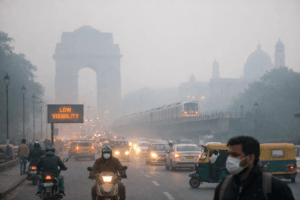
Delhi’s Smog Siege: When a City Grinds to a Halt and the Human Cost of Breathing
Introduction: A City Disappears
On a chilly December morning, Delhi didn’t so much wake up as dissolve into a milky, toxic oblivion. Roads familiar to millions became ghostly outlines, the rhythmic roar of aviation at one of the nation’s busiest airports sputtered into silence, and the simple act of breathing transformed into a calculated health risk. This was not an ordinary fog; it was a “smog event,” a severe meteorological and public health crisis where visibility dropped to near zero and the Air Quality Index (AQI) soared into the “severe” category at 433. The fallout was immediate and systemic: over 100 flights cancelled, train schedules in disarray, and an entire mega-city forced to recalibrate its pace under a relentless grey blanket.
This article delves beyond the headlines of cancellations and delays to explore the complex interplay of nature, policy, and human resilience that defines Delhi’s annual winter struggle. We will examine the science behind the smog, the cascading failures in critical infrastructure, the profound health implications for its 30 million residents, and the broader economic and social ripple effects. This is a story of a modern city in a precarious dance with its environment, and the lessons it holds for urban centers worldwide.
The Perfect Storm: Meteorological and Environmental Conditions
The crisis of December 15th was the result of a convergence of adverse factors, creating conditions ripe for a severe smog episode.
- Temperature Inversion: A key meteorological culprit. Normally, air temperature decreases with altitude, allowing warmer, polluted air near the ground to rise and disperse. During a winter inversion, a layer of warm air acts like a lid, trapping cooler, pollutant-laden air at the surface. This atheric lid prevents vertical mixing and allows contaminants to accumulate to dangerous levels.
- Calm Winds and High Humidity: The presence of very light westerly winds (5-7 kmph), as reported, was insufficient to disperse the accumulating haze. Combined with high ambient humidity, these conditions allowed moisture to bind with fine particulate matter (PM2.5 and PM10), creating a dense, persistent fog-smog mixture that drastically reduced visibility.
- Anthropogenic Contributions: The trapped air mass acted as a receptacle for pollutants from multiple sources: vehicle emissions, industrial output, construction dust, and crucially, post-harvest agricultural burning in neighboring states. While not always the sole driver, this seasonal practice injects massive quantities of smoke that can drift over urban centers, exacerbating an already polluted baseline.
The data points were stark. The Central Pollution Control Board (CPCB) recorded an overall AQI of 452 by 8 AM, deep in the “severe” zone (401-500). At this level, the air affects healthy people and seriously impacts those with existing diseases. Visibility at key monitoring stations like Safdarjung and Palam dropped to 50 meters, with areas like Hindon in Uttar Pradesh reporting zero visibility. This trifecta of toxic chemistry, stagnant meteorology, and human activity set the stage for a full-scale disruption.
Systemic Disruption: Transportation in Paralysis
The most visible and immediate impact of the smog was on transportation, a city’s circulatory system. The collapse was multi-modal.
Aviation: Grounded Skies At the Indira Gandhi International (IGI) Airport, a hub for domestic and international travel, operations were severely curtailed. The term “CAT III conditions,” mentioned in official advisories, became the operational reality. The Category III Instrument Landing System (ILS) is a precision approach aid that allows suitably equipped aircraft and specially trained pilots to land in extremely low visibility (as low as 50 meters for CAT IIIb). However, not all aircraft or pilots are certified for these operations. Furthermore, while landing might be possible, ground movements, take-offs, and the safety margins for sequencing aircraft become immensely challenging.
The result was a cascade of delays and cancellations as airlines and air traffic control worked to maintain safety. Over 100 flights were cancelled, with hundreds more delayed. The ripple effect disrupted schedules across the country, as evidenced by the travel advisory issued by Mumbai’s Chhatrapati Shivaji Maharaj International Airport for passengers traveling to and from affected northern regions. Airlines like IndiGo and Air India proactively urged passengers to check flight statuses, a small but crucial step in managing chaos.
Surface Transport: Navigating a Grey Maze On the ground, the situation was equally perilous. The Gautam Budh Nagar Traffic Police’s proactive advisory to reduce speed limits on the Noida-Greater Noida and Yamuna Expressways (to 75 kmph for light vehicles) was a direct response to the lethal risk of high-speed travel in near-zero visibility. Road safety infrastructure, often overlooked, became a critical line of defense. The National Highways Authority of India (NHAI) highlighted measures like reinstalling reflective road studs, rectifying faded markings, and placing reflective stickers on crash barriers—all essential to guide disoriented drivers.
Rail networks, traditionally more robust in fog than aviation, were not immune. While trains often operate in low visibility, the extreme density of this smog event, combined with the need for extreme caution, led to widespread delays, stranding thousands of passengers and causing logistical headaches for freight.
The Human Dimension: Health, Advisories, and Daily Life
While travel disruptions captured headlines, the more insidious and widespread impact was on public health. An AQI in the “severe” category represents a clear and present danger.
- Health Impacts: Prolonged exposure to such polluted air aggravates respiratory ailments like asthma, bronchitis, and COPD. It increases the risk of cardiovascular events, impairs lung function in children, and can have long-term carcinogenic effects. The fine particulate matter (PM2.5) penetrates deep into the lungs and bloodstream, causing systemic inflammation.
- Official Advisories: The severity of the situation triggered a range of official responses. The most striking was the advisory from the Singapore High Commission, urging its nationals in Delhi-NCR to stay indoors, wear high-quality masks (N95/FFP2) outdoors, and heed local health guidelines. Such diplomatic advisories are reserved for significant health and safety risks and underscore the international perception of the crisis.
- Protecting the Protectors: The Delhi Police‘s rollout of a “winter safety plan” for over 6,000 traffic personnel—distributing high-quality air-filter masks and winter gear—was a poignant detail. It highlighted that those mandated to be on the streets, ensuring order amid the chaos, were among the most vulnerable. Their protection is a microcosm of the broader public health challenge.
For the average citizen, the smog meant altering daily routines: postponing morning walks, keeping children home from outdoor activities, investing in air purifiers, and wearing masks not for pandemic fears, but for basic respiratory defense. The psychological toll of being trapped indoors under a gloomy, toxic sky also contributes to a sense of malaise and anxiety.
Economic and Social Ripple Effects
The cost of a smog event extends far beyond immediate inconvenience. The economic ripple effects are substantial and multifaceted.
- Direct Aviation Losses: Airlines incur massive costs from cancellations and delays—fuel, crew scheduling, maintenance rotations, and passenger compensation. Airport operators lose revenue from retail and services. The total runs into millions of dollars for a single day of major disruption.
- Productivity Dip: Employees missing work due to delayed travel or illness, coupled with the general decline in cognitive performance and well-being linked to poor air quality, leads to a city-wide productivity loss. Supply chains are delayed, meetings are missed, and economic activity slows.
- Healthcare Burden: A surge in respiratory and cardiac emergencies places additional strain on hospitals and clinics, leading to increased healthcare costs for individuals and the system. The long-term burden of chronic diseases fostered by repeated exposure is incalculably high.
- Social Equity: The crisis is not borne equally. While the affluent can retreat to air-purified homes and cars, a vast population of daily wage workers, street vendors, and homeless citizens has no such respite. They must endure the toxic air for their livelihood and survival, facing the greatest health risks. This environmental challenge is deeply intertwined with issues of poverty and social justice.
Looking Ahead: Mitigation, Adaptation, and Resilience
Delhi’s smog siege is not a novel event but a recurring pattern. The question is not just how to manage a crisis, but how to prevent its worst excesses and build systemic resilience.
- Short-Term Adaptation: The measures seen—CAT III operations, speed limits, road reflectors, public advisories—are forms of essential adaptation. Improving the accuracy and granularity of smog forecasting can help airlines, railways, and institutions make proactive decisions rather than reactive scrambles.
- Long-Term Mitigation: Addressing the root causes requires sustained, multi-jurisdictional action. This includes:
- Curbing Stubble Burning: Promoting and incentivizing alternative uses for paddy straw (like bio-energy or in-situ decomposition).
- Year-Round Pollution Control: Stringent enforcement on vehicle emissions (especially moving to Bharat Stage VII norms), shifting to electric public transport, controlling construction and road dust, and regulating industrial emissions.
- Green Infrastructure: Expanding urban forests and green walls can help sequester some pollutants and moderate microclimates.
The path forward demands acknowledging that the smog is a symptom of a deeper environmental management challenge. It requires moving from crisis management to a comprehensive, science-based clean air policy with strict accountability and inter-state cooperation.
Conclusion: A Warning Wrapped in Fog
The image of a paralyzed Delhi, with its skies and streets silenced by smog, is a powerful parable for the Anthropocene era. It demonstrates with brutal clarity how environmental neglect can swiftly undermine economic vitality, public health, and social cohesion. The cancelled flights and delayed trains are more than logistical failures; they are signals of a system under extreme environmental stress.
For the residents of Delhi, each winter now brings a season of anxiety. For the world, Delhi’s struggle offers a critical case study. As urbanization accelerates and climate change alters weather patterns, similar challenges may confront other mega-cities. The lessons learned here—about the necessity of integrated forecasting, robust infrastructure adaptation, equitable public health communication, and, above all, the imperative of tackling pollution at its source—are of global relevance.
The fog will eventually lift, as it always does. But the question that hangs in the hazy air is whether the political and societal will can be mustered to ensure that future winters are less toxic, less disruptive, and less hazardous to the health of a city and its people. The true test will come on the clear days, when the urgency of the smog is a memory, and the hard work of prevention must continue.
You must be logged in to post a comment.