
Delhi’s Smog Lifts Slightly, But North India’s Winter Air Quality Crisis Demands Long-Term Solutions
On December 25th, Delhi experienced a brief respite from its toxic smog as improved wind patterns slightly dispersed pollutants, shifting air quality from “very poor” to “poor” and dramatically increasing visibility; however, this temporary relief contrasted with dense fog and cold waves continuing to grip other North Indian cities like Kanpur and Ayodhya, highlighting the region’s complex and persistent winter crisis driven by meteorological traps, anthropogenic pollution, and geographic factors, which demands sustained, systemic solutions beyond relying on fleeting favorable weather.
Delhi’s Smog Lifts Slightly, But North India’s Winter Air Quality Crisis Demands Long-Term Solutions
A Brief Respite in the Capital Highlights a Deeper, Recurring Challenge
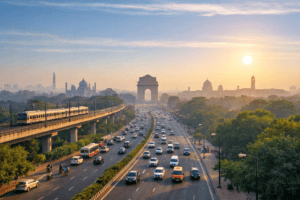
For millions of residents in North India, the morning of December 25th offered a rare and welcome sight: a glimpse of clearer sky. After weeks of choking under a toxic blanket of smog, Delhi recorded an improvement in its Air Quality Index (AQI), dropping from “severe” and “very poor” categories to “poor” in several areas. Visibility at the Indira Gandhi International Airport, which had plummeted to a mere 100 meters just a day earlier, improved dramatically to 2,500 meters. This fleeting relief, coinciding with Christmas morning, felt like a gift to a city weary from respiratory distress and obscured horizons. However, a closer look at the broader regional weather narrative reveals a complex and persistent crisis where temporary relief is not a solution, but a pause in a much longer battle.
The Immediate Shift: What Changed in Delhi?
The slight improvement in Delhi’s air quality wasn’t accidental magic. It was the result of subtle shifts in meteorological conditions. The primary driver was a change in wind patterns and a slight increase in wind speed. For weeks, stagnant air—a hallmark of North Indian winters—had acted like a lid over the Indo-Gangetic Plain, trapping pollutants from vehicle emissions, industrial activity, construction dust, and seasonal agricultural stubble burning. On December 25th, a modest increase in ventilation helped disperse these concentrated pollutants.
The data tells the story: The Central Pollution Control Board (CPCB) recorded an overall AQI of 349 (“very poor”) in the early hours, but specific monitoring stations, like the one at IGI Airport, logged a significantly better 121 (“moderate”). The Air Quality Early Warning System reported an average AQI of 221 (“poor”) by 5:30 AM. While “poor” is still a significant health risk according to global standards, the shift from “severe” (AQI 400+) represents a meaningful, if temporary, reduction in acute exposure for Delhi’s citizens.
The Broader North Indian Canvas: A Tale of Contrasts
Beyond Delhi, the weather picture across North India on December 25th was one of stark contrasts, painting a fuller picture of the region’s winter challenges:
- The Hills: Shimla enjoyed clear, dry skies, a reprieve for tourists and locals alike. However, the IMD forecast hinted at incoming disturbances, predicting isolated rainfall and snowfall in Jammu & Kashmir, Ladakh, Himachal Pradesh, and Uttarakhand between December 27th and 30th. For these regions, the concern shifts from smog to travel disruptions and cold waves.
- The Plains: A Patchwork of Fog and Cold: While Delhi saw improved visibility, other major cities were not as fortunate. Kanpur, Ambala, Ayodhya, and Bahraich woke up to dense, visibility-hampering fog and intense cold waves. In Amritsar, people huddled around communal fires as temperatures dropped to 8°C. This dichotomy underscores a crucial point: the “North India” weather story is not monolithic. The same atmospheric conditions that allow pollutant dispersion in one area can cause fog formation in another, depending on local humidity, temperature, and topography.
- A Silver Lining in Agra: In a positive visual, the iconic Taj Mahal was clearly visible to residents and tourists in Agra, a sight often stolen by the same haze that blankets Delhi, located just 200 kilometers away.
The Human and Systemic Impact Beyond the AQI Number
The numerical AQI reading, while critical, only captures part of the story. The real narrative unfolds in the daily lives of people:
- Health as a Casualty: During “severe” and “very poor” air days, hospitals report a surge in patients with exacerbated asthma, chronic obstructive pulmonary disease (COPD), bronchitis, and eye infections. The most vulnerable—children, the elderly, and those with pre-existing conditions—bear the brunt. The slight improvement offers a crucial breathing space, literally and figuratively, for overburdened healthcare systems.
- Economic and Logistic Disruption: The preceding days of dense fog caused significant travel chaos. On December 24th, over 270 flights were delayed and at least 10 cancelled at Delhi’s airport. Train schedules across the Northern Railway network were similarly disrupted. Every hour of delay translates to economic loss, missed connections, and public frustration. The improved visibility on the 25th provided vital operational normalcy for aviation and rail authorities.
- The Psychological Toll: Living under a perpetual grey-brown dome has a profound psychological impact. The lack of sunlight can contribute to seasonal affective disorder (SAD), while the constant health anxiety and the feeling of being trapped indoors erode overall well-being. A clearer sky, even for a day, provides a significant mental health boost, a reminder of the “normal” world beyond the smog.
Looking Deeper: Why This is a Recurring Narrative
The annual winter air pollution crisis in North India is not a surprise; it’s a predicted outcome of a confluence of factors:
- Meteorological Trap: Winter brings lower temperatures and slower winds. The phenomenon of “temperature inversion” occurs, where a layer of warm air acts as a cap, preventing the upward movement and dispersion of cooler, pollutant-laden air near the surface.
- Anthropogenic Load: The region’s immense baseline pollution from transport, industry, and energy generation creates a constant emission stream. The addition of seasonal stubble burning in Punjab and Haryana, while its contribution is debated in percentage terms, provides a potent seasonal spike that the atmosphere cannot absorb.
- Urban Design and Geography: The Indo-Gangetic Plain is a bowl-shaped topography, flanked by the Himalayas to the north. This natural geography inhibits the easy outflow of air, making the region a “depression” where pollutants accumulate.
The Path Forward: Beyond Waiting for the Wind
Relying on favorable wind patterns is not a policy. The brief improvement on December 25th should serve as a catalyst for reinforced action, not complacency. Sustainable solutions require a multi-pronged, year-round approach:
- Accelerating the Clean Energy Transition: A faster shift to renewable energy for power generation, coupled with electrification of public transport and last-mile delivery vehicles, is non-negotiable.
- Revolutionizing Agriculture: Farmers need economically viable and accessible alternatives to stubble burning. This requires scaling up solutions like happy seeders, decomposers, and creating robust markets for crop residue.
- Rethinking Urban Planning: Cities need to prioritize green buffers, pedestrian-friendly infrastructure, and stringent dust control norms for construction. The focus must shift from managing a crisis to preventing its buildup.
- Regional Collaboration: Air pollution recognizes no political boundaries. A coordinated policy framework among neighboring states is essential, moving beyond blame to shared responsibility and resource pooling.
The clearer skies over Delhi on Christmas morning were a momentary relief, a demonstration of what clean air could feel like. However, the simultaneous fog and cold engulfing other cities, and the forecast of incoming wet weather, remind us that North India’s winter is a complex interplay of natural and human-made elements. The true insight from this weather update is not that the air improved for a day, but that without systemic, unwavering commitment to change, the residents of this region will remain hostages to the wind, waiting each winter for a fleeting glimpse of blue sky. The goal must be to make such days the rule, not the exception.
You must be logged in to post a comment.