
Delhi’s Red Fort Blast: A Capital on Edge, a Nation Seeks Answers Amidst Tragedy
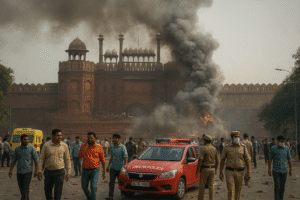
A devastating car explosion near Delhi’s Red Fort Metro Station on Monday evening killed at least nine people and injured several others, plunging the national capital into a state of high alert and triggering nationwide security reinforcements. While the precise cause remains unconfirmed, initial forensic findings—including the absence of a crater or military-grade explosives—have led investigators to probe the possibility that the blast was accidental, perhaps occurring during the transport of explosive material, rather than a deliberate terrorist attack at the location.
The vehicle, which had changed hands multiple times with a last-known owner in Pulwama, Jammu & Kashmir, is the focal point of a multi-agency investigation, even as the tragic incident has left a profound human toll of shattered lives and a nation grappling with renewed security vulnerabilities in its symbolic heart.
Delhi’s Red Fort Blast: A Capital on Edge, a Nation Seeks Answers Amidst Tragedy
A Evening of Carnage: The Moment Calm Shattered in Old Delhi
It was a typical Monday evening in the bustling, historic heart of Old Delhi. The air was thick with the sounds of commerce and commotion—vendors hawking their wares, auto-rickshaws weaving through narrow lanes, and the constant flow of people heading home after a long day. The Red Fort, a silent sentinel to centuries of history, stood as a backdrop to this daily symphony of urban life. Then, at approximately 6:40 PM, a violent explosion tore through the twilight, replacing the familiar cacophony with a single, deafening roar of terror.
The epicenter was a moving car, moments away from Gate No. 1 of the Red Fort Metro Station. The blast was not just heard; it was felt. Witnesses described a scene of sudden, brutal chaos. A fireball erupted, engulfing nearby vehicles. Body parts were seen flying from the shattered car, a horrific image now seared into the memories of those present. The initial shock gave way to a primal instinct for survival, as people scrambled for cover, their screams adding to the dissonance.
In the immediate aftermath, the priority was sheer human preservation. The injured, many with severe burns and shrapnel-like wounds from the flying debris, were rushed to Lok Nayak Hospital. The toll was grim and swiftly mounting: at least nine lives were extinguished, with several others fighting for their lives. Among the victims was 22-year-old Sameer Khan, an auto-rickshaw driver simply waiting for his next passenger, his life irrevocably altered by severe burns. Families, like that of Nazim searching for his missing brother-in-law Mohd Mohsin, an e-rickshaw driver, descended on hospitals, their faces etched with a desperate, terrifying uncertainty.
The High-Alert Ripple Effect: A Nation Fortifies Its Defenses
The blast in the national capital sent shockwaves far beyond the confines of Old Delhi. Within hours, a high alert was declared not just in Delhi, but across major metropolitan centers—Mumbai, Kolkata, Bengaluru. The specter of coordinated attacks, a tragic staple of India’s past, prompted an immediate and visible security clampdown.
In Bengaluru, Police Commissioner Seemant Kumar Singh announced intensified security at public places and transport hubs, with barricades and vehicle checks becoming the new normal. Gujarat’s DGP echoed the sentiment, urging public vigilance. The practical ramifications were felt by everyday citizens nationwide. Akasa Air issued an advisory, asking passengers to arrive at airports three hours early due to enhanced security, a small but significant disruption to the rhythm of modern life.
This nationwide response underscores a hard-learned lesson: an attack on one symbol of India is perceived as an attack on all. The Red Fort is not just a tourist destination; it is the very podium from which the Prime Minister addresses the nation on Independence Day. Its proximity to the blast imbues the event with a profound symbolic weight, making the state’s defensive posture not just operational, but deeply psychological.
Inside the Investigation: Unraveling the Threads of a Tragedy
As the dust settled, the painstaking work of piecing together the “how” and “why” began. A multi-agency probe, involving the Delhi Police, the Forensic Science Laboratory (FSL), the National Investigation Agency (NIA), and the National Security Guard (NSG), descended upon the scene. Union Home Minister Amit Shah, who visited the blast site, was categorical: investigators were examining “all angles” and ruling out nothing.
The early forensic findings, however, painted a puzzling picture. Sources indicated that there was no crater at the blast site, and the injured did not exhibit classic shrapnel wounds. There was also no tell-tale smell of military-grade explosives like RDX. This has led investigators to a critical, albeit tentative, initial hypothesis: this may not have been a sophisticated, targeted terrorist strike in the conventional sense.
One senior officer theorized that the explosion was so powerful it shattered surrounding vehicles, yet the location might not have been the intended target. The vehicle itself, a car that had changed hands multiple times with its last registered owner traced to Pulwama in Jammu and Kashmir—a region with a fraught history of militancy—is the investigation’s central clue. The current line of inquiry suggests the possibility that the explosive material was being transported, and the blast was either accidental or premature. The owner, now being questioned in Gurgaon, claimed he had sold the vehicle, sending investigators scrambling through RTO records to trace a chain of ownership that may hold the key.
The Human Dimension: Beyond the Headlines and Helpline Numbers
Behind the official statements, the traffic advisories, and the helpline numbers (011-23233400 for LNJP Hospital, 112 for police emergencies), lies a landscape of profound human suffering. The story of Amar Kataria, a 35-year-old pharmacist who was simply entering the metro when the blast gave him head injuries, is a stark reminder of the randomness of such tragedies. He was not a target; he was just there.
The challenge for authorities extends beyond identifying the perpetrators to identifying the victims. Sources at LNJP Hospital revealed that two bodies arrived without heads and arms, rendering them unrecognizable. Another victim, deceased, bore third-degree burns on their face, complicating identification. This grim task in the hospital morgue is a silent, heartbreaking parallel to the forensic work at the blast site—both seeking to restore names and narratives to the anonymous.
The condolences poured in from the highest offices—President Droupadi Murmu, Prime Minister Narendra Modi, and Leader of Opposition Rahul Gandhi—all using words like “heartbreaking,” “distressing,” and “profoundly sorrowful.” Their unity in grief is a powerful testament to the national scale of the loss, but it is cold comfort to the families waiting outside hospital emergency wards, their lives irrevocably broken.
A Capital Transformed: Security, Symbolism, and the Path Ahead
The Delhi blast is a brutal reminder of the vulnerabilities that persist in even the most heavily secured urban spaces. The area around the Red Fort and Chandni Chowk is perennially crowded, a dense ecosystem of commerce, commuting, and history. As Sanjay Bhargava of the Chandni Chowk Sarv Vyapar Mandal noted, the incident happening on a weekday perhaps averted a catastrophic stampede, but it highlights the perpetual security nightmare such crowded heritage zones present.
The international community—with the US and UK issuing advisories and their diplomats expressing condolences—is watching closely. The incident tests India’s internal security apparatus and its ability to manage a crisis that immediately captures global attention.
As Delhi, and India, moves forward from this tragedy, the questions will only grow louder. Was this a failed transport of explosives, a botched terror plot, or something else entirely? The answers lie in the meticulous work of the NIA and FSL teams scouring the charred wreckage. For the citizens, the directive is one of heightened vigilance—a return to a state of awareness that many had hoped was a relic of the past.
The blast near the Red Fort is more than a tragic event; it is a somber lesson in the enduring fragility of peace and the relentless need for resilience. The investigation will eventually deliver its final report, but the scars on the city’s psyche, and on the families of the victims, will take far longer to heal.
You must be logged in to post a comment.