
Delhi’s Post-Rain Respite: Unpacking the Science and Sensibility Behind the Capital’s Sharp Temperature Plunge
Delhi’s Post-Rain Respite: Unpacking the Science and Sensibility Behind the Capital’s Sharp Temperature Plunge
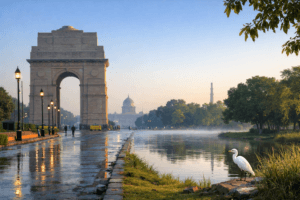
If you stepped outside in Delhi this past weekend, you were met with an unfamiliar companion: a crisp, clean chill. The city, so often shrouded in a stubborn haze, inhaled deeply. The usual metallic tang of pollution was, for a moment, replaced by the petrichor of damp earth. This wasn’t just a slightly cooler day; it was a dramatic atmospheric shift. Following a brief but impactful spell of rain, temperatures in the capital nose-dived, offering residents a fleeting glimpse of a winter that often feels more theoretical than tangible. But what lies beneath this sudden meteorological recalibration? This event is more than a weather footnote; it’s a case study in urban climate dynamics, a lesson in atmospheric physics, and a poignant reminder of the delicate balance that dictates life in one of the world’s most populous megacities.
The Numbers Tell the Story: A Capital in Chill
The data from the India Meteorological Department (IMD) paints a vivid picture of the change. At Safdarjung, the city’s base observatory, the minimum temperature plummeted to 7.6°C, a stark six-degree fall from the previous day’s high of 13.7°C. This wasn’t an isolated drop. Across monitoring stations, a synchronous chill set in: 6.8°C at Palam and Lodhi Road, 6.6°C at The Ridge, and a notably crisp 6°C at Ayanagar. The daytime narrative was equally telling, with maximum temperatures settling 2 to 4 degrees below seasonal norms.
This sharp decline is a classic textbook phenomenon, yet its execution in an urban heat island like Delhi is particularly striking. To understand it, we must follow the journey of the rain.
The Atmospheric Mechanics: Why Rain Washes Away the Warmth
The rain that preceded the chill was not merely a cause but a catalyst in a multi-step atmospheric process.
- The Cleansing Wash: Delhi’s air is a complex soup of particulate matter (PM2.5, PM10), nitrogen oxides, sulfur dioxides, and other aerosols. These particles act as a barrier, scattering and absorbing solar radiation. More critically, they form the nucleus for a “blanket” effect, trapping outgoing long-wave radiation (heat) from the Earth’s surface. The rain acts as a natural scrubber. As droplets fall through the atmosphere, they attract and capture these aerosols and pollutants, pulling them down to the ground in a process called “below-cloud scavenging” or “washout.” This dramatically reduces the density of the particulate blanket.
- Evaporative Cooling: This is the primary engine of the temperature drop. After the rain, the city is left wet. The water coating surfaces—from leaves and grass to concrete and asphalt—requires energy to evaporate. This energy, known as latent heat, is drawn directly from the surrounding environment. The process of evaporation is endothermic; it absorbs heat. As the moisture from Friday’s rain evaporated into the drier air mass on Saturday, it siphoned significant amounts of thermal energy from the air and surfaces, leading to a pronounced cooling effect.
- The Cloudless Night Sky: Post-rain, skies often clear. With the particulate blanket washed away and cloud cover absent, there is nothing to impede the escape of terrestrial radiation. The Earth’s heat radiates unimpeded back into space, leading to rapid nocturnal cooling. This explains why the minimum temperatures, particularly in open, less urbanized areas like Ayanagar and The Ridge, dipped so notably.
- Air Mass Replacement: Often, such rain is associated with the arrival of a fresh, cooler, and drier western disturbance or its rearward winds. The rain isn’t just a local event but the signature of a larger air mass shift. The system effectively replaced the stagnant, relatively warmer air with a cooler, cleaner parcel from northwestern regions.
The Silver Lining: A Breath of Moderately Clean Air
The most immediately felt benefit for Delhi’s residents was the dramatic, if temporary, improvement in air quality. The average AQI settling at 192 in the ‘moderate’ category is a significant shift from the ‘very poor’ and ‘severe’ levels that dominate winter headlines. Dwarka’s AQI of 98 (‘satisfactory’) is a figure that feels almost alien for a January.
This improvement is the direct result of the washout effect. Rain is remarkably efficient at removing larger particulate matter (PM10) and some gaseous pollutants. The air feels lighter because it literally is—the weight of pollution has been physically removed. However, the nuance here is critical. This is primarily a mechanical cleansing, not a reduction in emissions at source. The factories, vehicles, and construction dust remain. The reprieve is temporary, a reset before the slow, steady climb of pollution begins anew, underscoring the chronic nature of Delhi’s air quality crisis.
Contextualizing the Chill: A Historical and Human Perspective
While the drop felt sharp, Safdarjung’s minimum of 7.6°C was actually 0.1 degrees above the season’s normal. This tells another, quieter story: of winters that have been gradually warming. A sharp drop to near-normal feels abnormal because we have become acclimatized to warmer lows. The reference to Friday’s 13.7°C being the “highest since 2022” reinforces this trend of muted, warmer winters punctuated by sharper, shorter cold spells.
For the people of Delhi, this weather whiplash has practical implications. It’s a scramble for winter wardrobes that had been relegated to the back of the cupboard. It affects health—such sudden changes can exacerbate respiratory and arthritic conditions even as the cleaner air provides relief. It alters daily rhythms: morning walks become brisker, evening gatherings move indoors, and the consumption of winter-specific foods and beverages sees a sudden spike. For the urban ecosystem, it’s a vital period of stress relief for trees and a chance for water bodies to recharge slightly.
The Fleeting Nature of Respite and the Path Ahead
The inherent message in Delhi’s weekend weather is one of transience. The clean air and the sharp chill are guests that do not stay. Within days, as emissions continue, stagnation sets in, and wind patterns change, the AQI will likely degrade. The cold will moderate as the memory of the rain fades and the urban heat island effect—where concrete and asphalt store and re-radiate heat—reasserts itself.
This cyclical pattern offers a profound insight. It demonstrates the powerful, immediate impact natural forces can have on our man-made environment. It shows how quickly the city could feel if systemic, year-round emission controls were as relentless as the sources themselves. The post-rain chill is a natural experiment, proving that the tools for change exist; the challenge is replicating their effect through sustained human policy and action.
In conclusion, the sharp drop in temperature was not just a weather event. It was a visible, feel-able demonstration of atmospheric physics in action. It was a brief restoration of a winter norm that is becoming elusive. For a city perpetually grappling with its environmental boundaries, it served as both a welcome respite and a clear lesson: the blueprint for a healthier Delhi is written in the science of a rainy day. The task ahead is to learn from that blueprint, long after the chill has faded and before the next rain comes to write it again.
You must be logged in to post a comment.