
Delhi’s Post-Rain Chill: A Temporary Respite in the Winter’s Grip and What It Reveals About the Capital’s Climate Battle
Delhi’s Post-Rain Chill: A Temporary Respite in the Winter’s Grip and What It Reveals About the Capital’s Climate Battle
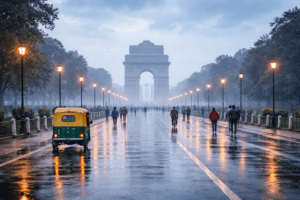
The familiar, gritty haze that often blankets India’s capital in winter was momentarily swept aside over the weekend, replaced by a crisp, damp chill that told a story of transient relief and enduring challenges. Following a spell of rain, New Delhi woke up on Saturday, January 24, 2026, to a significantly sharper bite in the air and a slight, yet welcome, improvement in its notoriously poor air quality. This meteorological event, while temporary, offers a compelling snapshot of Delhi’s complex relationship with its winter climate—a delicate dance between natural cleansing and persistent pollution.
The Temperature Tumble: A Dramatic Dip
The data from the India Meteorological Department (IMD) paints a clear picture of the sudden shift. At the Safdarjung observatory, often considered the city’s benchmark, the minimum temperature plummeted to 7.6°C. While this is just a tenth of a degree above the seasonal average, it represents a stark, six-degree drop from the previous day’s unusually high minimum of 13.7°C—a warmth that had been the highest recorded in four years for that date.
This sharp decline is a classic meteorological phenomenon. Rain, particularly in Delhi’s dry winter, acts as a climatic reset button. The precipitation washes away particulate matter, and the subsequent evaporation and increased cloud cover lead to a significant loss of heat from the surface. The city’s other stations registered even chillier readings: Ayanagar was the coldest at 6°C, with The Ridge at 6.6°C, and Palam and Lodhi Road both at 6.8°C. This post-rain chill is more than just a number; it signifies the arrival of the true winter nip that had been delayed, a sensation felt deeply by residents who hastily pulled out heavier woollens.
Air Quality: A Fleeting Breath of Less-Polluted Air
Concurrent with the drop in temperature was a modest improvement in the city’s air quality, a direct beneficiary of the rain’s cleansing action. According to the Central Pollution Control Board’s (CPCB) Sameer app, the average Air Quality Index (AQI) settled at 256, categorised as ‘poor’, but notably better than Friday’s 293, which sat on the cusp of the ‘very poor’ category.
This shift, while positive, requires nuanced understanding. An AQI of 256, while improved, is far from healthy. It indicates that pollution levels were still high enough to cause breathing discomfort to most people on prolonged exposure. The spatial distribution across monitoring stations was telling: 29 stations reported ‘poor’ air, while four remained in the ‘very poor’ zone. The outlier was Dwarka, which recorded the best AQI at 113 (‘moderate’), highlighting how microclimates and local factors, like proximity to water bodies or open spaces, can create pockets of relative relief within a polluted metropolis.
The science behind this slight improvement is straightforward. Rain droplets effectively scavenge and wash away suspended particulate matter (PM2.5 and PM10)—the primary villains of Delhi’s winter air. Furthermore, the rain and increased wind speed disrupt the formation of temperature inversions, a winter condition where a layer of warm air traps cold, polluted air close to the ground. However, as the Air Quality Early Warning System forecasted, this was a short-term gain. With air quality predicted to remain ‘poor’ for the next two days and possibly deteriorate to ‘very poor’ thereafter, the reprieve was always destined to be brief. It underscores a harsh reality: while meteorological events can provide temporary relief, they are no substitute for systemic, year-round emission control measures.
The Forecast: Clouds, Fog, and Winds—A Republic Day Precursor
Looking ahead, the IMD’s forecast for the coming days provides crucial context, especially with the 77th Republic Day celebrations on the horizon. The prediction of a generally cloudy sky with shallow to moderate morning fog, accompanied by strong surface winds of 10-20 km/h, is significant.
These conditions are a double-edged sword. The strong winds are beneficial for dispersing pollutants locally, helping to prevent rapid AQI deterioration. However, the combination of moisture (from the recent rain) and cool temperatures is a perfect recipe for fog formation, which can quickly turn into smog if pollutant concentrations rise again. The predicted temperature range—maximums of 17-19°C (1.3 to 3.3 degrees below normal) and minimums of 6-8°C (near normal)—suggests a sustained period of cool, wintry weather.
This forecast holds particular importance for the Republic Day preparations. The file photograph of spectators and security personnel taking shelter under plastic sheets during a rainy dress rehearsal at Kartavya Path is a potent reminder of how Delhi’s winter weather directly impacts its grand public events. The potential for morning fog on January 26th could affect visibility for both aerial displays and the live audience experience, while the cool temperatures will be a test of endurance for participants seated for long hours.
The Bigger Picture: Insights Beyond the Headlines
This episode of post-rain chill and slight AQI improvement is more than a daily weather update; it is a microcosm of Delhi’s perennial winter struggle.
- The Fragility of “Improvement”: The rapidity with which air quality can shift from “very poor” to “poor” and back again highlights the fragile equilibrium. It demonstrates that the underlying emission load—from vehicles, industry, construction, and regional farm fires—remains persistently high. The atmosphere is simply waiting for conducive, stagnant conditions to reconcentrate the pollutants once the cleansing winds and rains pass.
- The Human Impact of the Chill: The sharp temperature drop has immediate consequences. It increases energy demand for heating, exacerbates health issues for the homeless population, and can lead to a rise in respiratory and cardiovascular problems as the body stresses to adapt to the cold, often in tandem with polluted air.
- A Lesson in Atmospheric Dynamics: For the discerning reader, this news offers a clear, real-world lesson in basic meteorology. It connects the dots between precipitation, wind speed, temperature inversion, and particulate dispersion, making the often-abstract science of air quality more tangible.
- A Temporary Window, Not a Solution: For policymakers and citizens alike, such events should be viewed not as a solution, but as a demonstration of what cleaner air could feel like. It provides a brief, natural benchmark to strive for through human intervention.
In conclusion, the sharp drop in night temperature and the slight improvement in air quality in New Delhi on January 24, 2026, represent a classic winter interlude. It is a period of natural cleansing and climatic adjustment that offers a fleeting glimpse of a less-hazed city. Yet, the forecast of returning poor air quality and persistent cool, foggy conditions serves as a sobering reminder of the deep-rooted challenges that remain. As the capital gears up for Republic Day, this weather pattern underscores the ongoing battle between the city’s vibrant life and its demanding environment—a battle where temporary respites are valuable, but lasting solutions are imperative. The chill in the air is palpable; the need for sustained action to clear it, even more so.
You must be logged in to post a comment.