
Delhi’s Perfect Calm: A Sunday of Clear Skies, Moderate Air, and the Fleeting Comfort of Spring
On March 22, 2026, Delhi experienced a rare meteorological reprieve: a mainly clear sky with temperatures hovering around 30°C and a morning low of 15.6°C, offering residents a fleeting taste of spring before summer’s harsh onset. The air quality registered as “moderate” with an AQI of 154—a tolerable but cautionary reminder of the city’s persistent pollution crisis, even as a pleasant humidity of 87% lent a dewy freshness to the early hours. For Delhiites, the day became an invitation to reclaim public spaces, from leisurely garden walks to bustling Sunday markets, all while the India Meteorological Department’s forecast of partly cloudy evening skies hinted at the seasonal transition underway. Against a backdrop of looming summer heat and ongoing environmental health studies, this brief window of equilibrium served as both a moment of relief and a quiet acknowledgment of the delicate balance between nature’s rhythms and the city’s relentless pace.
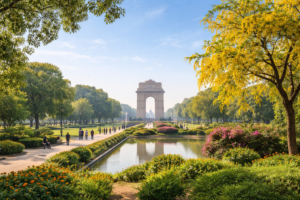
Delhi’s Perfect Calm: A Sunday of Clear Skies, Moderate Air, and the Fleeting Comfort of Spring
As the clock struck 9 a.m. on March 22, 2026, a familiar scene unfolded across the national capital. The morning sun, filtered through a gentle haze, began its ascent over the Yamuna, painting the sky in shades of pale gold and soft blue. For the residents of Delhi, who often brace themselves against the extremes of a punishing summer or a toxic winter, this Sunday offered something that feels increasingly precious: a moment of meteorological equilibrium.
The India Meteorological Department (IMD) delivered a forecast that read like a sigh of relief. After a cloudy morning that saw the mercury dip to 15.6 degrees Celsius—a notch below the seasonal average—the city was set to transition into a day characterized by a “mainly clear sky.” The maximum temperature was expected to hover around the pleasant 30°C mark, though the weather department added a caveat familiar to Delhiites: partly cloudy conditions would likely return towards the evening and night.
This isn’t just a weather report; it is the narrative of a city caught between seasons. March in Delhi is a month of transition. It is the gateway—the fragile period where winter’s grip has fully loosened but summer’s oppressive heat has not yet begun its suffocating reign. It is the season of blooming amaltas (golden shower trees) and the last few days where one can sip chai on a balcony without sweating.
The Morning’s Gentle Chill
For early risers, Sunday morning was a gift. The minimum temperature of 15.6°C, recorded 1.1 notches below normal, brought with it a slight nip in the air, a reminder of the winter that has just departed. The relative humidity was logged at a substantial 87% at 8:30 a.m. In any other city, such humidity might signal discomfort, but in Delhi, during this brief window of spring, it meant a dewy freshness. It was the kind of morning that invites a walk in Lodhi Garden, where the grass is still wet and the air is heavy with the scent of marigolds and freshly watered earth.
Yet, for the working class of the city—the hawkers setting up their rehris, the construction workers, the gardeners tending to the city’s green lungs—this dip in temperature was a reprieve. It allowed for a few extra hours of manageable labor before the sun reached its zenith.
The Air We Breathe: A ‘Moderate’ Paradox
No discussion about a day in Delhi is complete without addressing the elephant in the room: the air. According to the Central Pollution Control Board (CPCB) data released at 9 a.m., the Air Quality Index (AQI) stood at 154. This falls into the ‘moderate’ category—a classification that, in the context of Delhi’s history, is often met with a resigned sense of acceptance.
The CPCB’s scale is stark. Between 0 and 50 is ‘good’; 51 to 100 is ‘satisfactory’; 101 to 200 is ‘moderate’; 201 to 300 is ‘poor’; 301 to 400 is ‘very poor’; and 401 to 500 is ‘severe’. A reading of 154 is the definition of “moderate”—it is the gray zone. It is not so clean that one can breathe deeply without concern, but it is also not so toxic that it forces citizens to shutter their windows and retreat indoors.
For the average Delhiite, an AQI of 154 translates to a lived experience. It means that if you are a runner, you might notice a slight burning in your lungs after a long sprint. It means that those with pre-existing respiratory conditions—the elderly, the asthmatics, the young children—might feel a tightness in their chest. It is a reminder that while the weather gods have been kind, the human-induced pollution crisis remains a constant companion.
This moderate air quality is a product of several factors. The recent unseasonal rain in parts of North India had helped settle dust particles, providing a temporary cleanse. However, as construction activity picks up pace across the city and vehicular emissions remain unchecked on the arterial roads, the AQI often hovers in this mid-range. The ‘partly cloudy’ conditions predicted for the evening could potentially trap pollutants closer to the surface, a phenomenon known as temperature inversion, which might push the AQI slightly higher by Monday morning.
The Human Perspective: How Delhi Navigates the Day
For the families of Delhi, a Sunday with such benign weather is a call to action. In the bustling markets of Chandni Chowk and the upscale malls of Saket, foot traffic was expected to be heavy. The “mainly clear sky” of the afternoon provides an ideal backdrop for the quintessential Delhi Sunday—a long, leisurely lunch.
From the butter chicken at Pandara Road to the burgeoning cafe culture in Hauz Khas Village, the city’s culinary scene thrives on days like this. The 30°C high is the sweet spot. It is warm enough to enjoy a cold lassi or a kulfi falooda, but not so hot that sitting outdoors becomes an endurance test.
Meanwhile, in the residential colonies of South Delhi and the sprawling apartments of Noida and Gurugram, the day likely began with the sound of lawnmowers. The slight dip in temperature overnight had encouraged families to finally tend to their winter-dormant gardens. The weather, hovering at the edge of summer, offers a last call for planting seasonal flowers before the harsh heat of April and May wilts everything in sight.
The Political and Environmental Context
Interestingly, this weather update arrives against a backdrop of broader environmental concerns that have dominated headlines in the region. Just days prior, news broke of the Sir fallout—a political event that, according to analysts, obliterated local anti-incumbency in West Bengal. But for Delhi, the more relevant context lies in the ongoing scientific discourse about public health.
An AIIMS Delhi study, recently highlighted in the news, is probing the role of PM2.5—the fine particulate matter that is the primary pollutant in Delhi—in lung cancer. This research underscores the stakes of days like March 22. While a “moderate” day is a respite, it is a stark reminder of the chronic exposure residents face. For every clear-sky day that allows children to play cricket in the park, there are dozens of “severe” days that confine them indoors.
The IMD’s forecast also hints at the volatility of modern weather patterns. The “partly cloudy towards evening and night” suggests that even on a day of stability, the climate is not entirely predictable. This aligns with global patterns of erratic weather, where even the transitional seasons are shrinking. For Delhi, the pleasant window of spring has been shrinking over the last decade, often compressed into a few fleeting weeks before the mercury jumps to 40°C.
Looking Ahead: The Looming Summer
As the sun sets on this Sunday, the partly cloudy skies might offer a spectacular view—a canvas of oranges, purples, and greys reflecting off the glass facades of the city’s skyscrapers. For those who follow the weather closely, this day is a benchmark. The maximum temperature hitting 30°C is a signal.
Meteorologists are watching for signs of the Western Disturbances—weather systems that bring moisture and rain to North India—which are currently weakening. As they retreat, the winds shift from the north-west to the south-east, ushering in the dry, hot air from Rajasthan that characterizes the Delhi summer.
The fact that Delhi recorded its highest maximum temperature for the first week of March in 50 years just a few weeks ago serves as a warning shot. This Sunday’s relative coolness may be an anomaly. Residents are acutely aware that the pleasant “clear sky” of today is a prelude to the harsh “heatwave” warnings that will soon become the norm.
Conclusion: A Day to Savor
In a city that operates at a breakneck pace—politically, economically, and environmentally—days like March 22, 2026, are rare. It is a day where the weather is not a headline to be feared, but a backdrop to be enjoyed. The “mainly clear sky” is a blank slate for the city’s denizens to write their own stories: a child’s birthday party in a park, a long drive on the peripheral expressway, or simply a moment of stillness in a balcony, feeling the 30°C warmth on the skin without the sting of pollution.
The moderate AQI reading of 154 is a reminder that the city is not out of the woods. The fight for clean air is an ongoing battle, one that requires policy shifts and collective action. But for today, the numbers allow for a brief ceasefire. The weather department’s prediction is, in essence, permission for Delhi to breathe.
As evening falls and the clouds roll in, the city will cool down, wrapping itself in the last vestiges of the departing spring. For the millions who call this sprawling metropolis home, this Sunday is not just a weather update; it is a moment of grace—a perfect calm before the storm of summer begins.
You must be logged in to post a comment.