
Delhi’s Paradox: Shivering Through the Cleanest Air in Months as a Late Cold Snap Defies Spring
In late March, Delhi experienced an unusual cold snap that saw minimum temperatures dip to 13°C—well below normal—following heavy rainfall and clear skies that triggered strong radiational cooling, while dry northwesterly winds kept daytime warming gradual despite a spike in maximum temperatures. The weather pattern brought mild fog, extended the winter-like feel, and delivered the cleanest air the city had seen in five months, offering a rare respite from pollution. Meteorologists noted that temperatures would rise slowly over the coming days, signaling a progressive transition toward summer-like conditions, but for the moment Delhi remained caught in a paradoxical spring that felt more like a second winter.
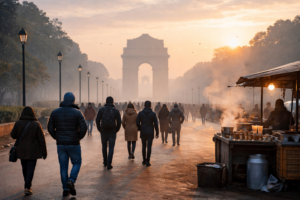
Delhi’s Paradox: Shivering Through the Cleanest Air in Months as a Late Cold Snap Defies Spring
For a city accustomed to the abrupt and often brutal transition from winter to scorching summer, Delhiites found themselves in a state of meteorological confusion this past weekend. Just as the city began to stow away its woolens and brace for the inevitable onslaught of heat, a formidable burst of northwesterly winds swept through the National Capital Region, delivering a sharp reminder that in Delhi, the seasons often refuse to follow the calendar.
The numbers released by the India Meteorological Department (IMD) painted a vivid picture of this climatic anomaly. While Saturday saw a significant spike in the maximum temperature—climbing to 27.4 degrees Celsius, a jump of 5.7 degrees from the previous day—the real story lay in the minimums and the unique conditions that have left residents reaching for their cardigans well into the latter half of March. Safdarjung, the city’s primary weather marker, recorded a minimum of 13 degrees Celsius, a full 3.5 degrees below the seasonal norm. This dip came hot on the heels of Friday, which was officially declared the coldest March day Delhi has endured in six years, with the mercury struggling to hit 21.7 degrees Celsius.
This isn’t just data on a spreadsheet; it is a lived experience that has disrupted the rhythm of the city. The early morning commuters on the Delhi Metro, who had grown accustomed to the pleasant nip of early spring, are now huddling inside the coaches, their breath visible in the dawn air. The vendors at roadside chai stalls are seeing a surge in demand for ginger-laced tea, not as a treat, but as a necessity to ward off the unexpected chill. It is a spring that feels suspiciously like a delayed winter, a phenomenon that has brought with it an unexpected silver lining: the cleanest air the capital has seen in five months.
The Science Behind the Shiver
To understand why Delhi is shivering in late March, one must look at the atmospheric theatrics of the preceding days. Mahesh Palawat, Vice President of Skymet Weather Services, explained the sequence of events that led to this unique scenario. The persistent and widespread rainfall that lashed the city on March 18, 19, and 20 played the role of a catalyst. While rain in March is not entirely unheard of, the intensity and duration were sufficient to saturate the lower levels of the atmosphere with unprecedented levels of moisture.
“Following the overnight clearing of the skies, there was a strong cooling of the ground,” Palawat said. This phenomenon, known as radiational cooling, is typically associated with the peak of winter. When the skies clear after rain, the heat absorbed by the ground during the day radiates back into the atmosphere. Without a cloud cover to trap that heat, the ground cools rapidly. This, in turn, cools the air sitting directly above the surface.
As this air cooled, it lost its capacity to hold moisture, leading to condensation. Tiny droplets of water vapor formed, creating a mild to moderate fog over Delhi-NCR—a sight rarely associated with the approach of summer. The result was a double whammy: the fog blocked the morning sun, delaying the warming process, while the cold ground kept the ambient temperatures suppressed.
Further complicating the forecast is the arrival of the northwesterly winds. Unlike the humid easterlies that brought the rain, these new winds are dry and cool. Originating from the snow-capped Himalayan regions, they are essentially sweeping down the plains, stripping away the moisture that led to the fog but simultaneously keeping the daytime temperatures from rising too sharply.
The Silver Lining of Unseasonable Weather
While the persistent chill has been a source of inconvenience—forcing schools to keep gates open a little longer in the morning and giving street vendors selling moongfali (peanuts) and bhutta (corn) an unexpected extension of their peak business season—it has gifted Delhi with something far more precious: breathable air.
The sharp drop in temperatures combined with the cleansing effect of the rain has resulted in a dramatic improvement in air quality. The Air Quality Index (AQI), which often languishes in the ‘poor’ or ‘very poor’ categories during the dry winter months, plummeted to the ‘satisfactory’ category. For a city where the fight for clean air is a perennial battle, this weekend offered a rare respite. Residents woke up to not only the nip of the cold but also clear skies and the ability to take a deep breath without the familiar burning sensation in their throats.
This phenomenon highlights a stark environmental truth about Delhi. The city’s notorious pollution is often exacerbated by stagnant, cool air that traps particulate matter close to the ground during winter. The recent spell of weather acted as a natural scrubber. The rain washed the pollutants out of the sky, and the subsequent strong winds ventilated the region, pushing the accumulated smog out. It serves as a potent reminder of what a healthy urban environment could feel like, contrasting sharply with the usual haze of construction dust, vehicular emissions, and industrial smoke that defines the typical Delhi day.
What Lies Ahead: The Gradual Return of Summer
For those wondering whether to pack away their jackets or keep them handy, the forecast suggests a transitional phase. According to meteorologists, the intensity of the cold is expected to wane gradually. The northwesterly winds will continue to dominate, ensuring that the spike in temperatures will not be sharp or immediate. The fog conditions, which complicated morning commutes over the weekend, are likely to decrease as the moisture levels in the atmosphere are sucked out by the dry winds.
“Temperatures will begin to rise gradually over the next two to three days, though the increase will not be sharp,” Palawat added. “Summer-like conditions will return progressively.”
This “progressive” return is crucial for the city’s infrastructure and its inhabitants. A sudden spike in temperature from the current pleasant-to-cool levels to the intense heat of April often puts a strain on the power grid as air conditioners are switched on en masse. It also tends to bring a spike in heat-related illnesses. A gradual warming allows for acclimatization.
A Season of Extremes and Adaptation
The current weather patterns in Delhi are emblematic of a larger, global trend of climatic unpredictability. The city’s weather is no longer neatly divided into the classic four seasons. Winters are punctuated by sudden heat waves; summers bring uncharacteristic dust storms; and springs, as evidenced this year, can feel like an extension of winter.
This unpredictability has real-world consequences. For the agricultural hinterlands surrounding Delhi, such temperature fluctuations can impact the yield of early-summer crops. For the urban poor, who often lack adequate shelter, a prolonged cold spell in March—a month typically associated with mild weather—can be a matter of survival, forcing night shelters to remain open longer than scheduled.
Moreover, the situation underscores the critical importance of urban planning. The fact that rain and wind can cleanse the air so effectively highlights the failures of existing pollution control measures. Instead of relying on meteorological lotteries to provide clean air, the city needs a more robust framework to ensure that the standard of air enjoyed this weekend becomes the norm, rather than the exception.
As Delhiites step out on Sunday morning, greeted by the pale winter sun and a crisp breeze, there is a sense of duality. There is the grumble of having to wear an extra layer when one expected to be donning cotton tees. But there is also gratitude—for the clean air, for the extended shelf-life of the winter wardrobe, and for the reminder that nature, despite the urban chaos, still holds the ultimate sway over the city.
The chilly winds will eventually subside. The mercury will inevitably climb. But for now, Delhi is savoring a meteorological anomaly: a spring break that feels like a second winter, offering a brief, cold, and crystal-clear interlude before the long, dusty summer begins.
You must be logged in to post a comment.