
Delhi’s Monsoon in March? How a ‘Western Disturbance’ Drenched the Capital and Reshaped the Weekend
A sudden and welcome spell of rain and drizzle, attributed by the India Meteorological Department to an active Western Disturbance, swept across Delhi-NCR early on March 15, 2026, providing significant relief from the rising temperatures of recent weeks. The weather system brought gusty winds, a noticeable drop of 3-4 degrees Celsius in maximum temperatures, and a slight chill, transforming the capital into a cool, grey morning without causing any major waterlogging or incidents. The IMD has issued an orange alert for the region over the next two days, forecasting continued thunderstorms, lightning, gusty winds, and even the possibility of hail, advising residents to enjoy the temporary reprieve while staying prepared for potentially unsettled weather.
Delhi’s Monsoon in March? How a ‘Western Disturbance’ Drenched the Capital and Reshaped the Weekend
It was the kind of morning that makes Delhiites fall in love with their city all over again.
As the first light of dawn crept over the horizon on Sunday, March 15, 2026, it wasn’t the harsh glare of the sun that greeted the national capital, but a soft, persistent drizzle. For a region that had been locked in a battle with steadily rising temperatures over the preceding weeks, the sudden arrival of rain, gusty winds, and a touch of chill felt less like a weather event and more like a collective blessing.
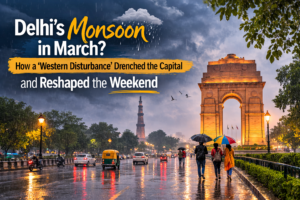
Social media, as expected, became a digital scrapbook of the moment. From the majestic colonnades of Connaught Place reflecting off wet pavements to the quiet, tree-lined streets of Dwarka glistening under a grey sky, Delhi-NCR woke up to a visual treat. This wasn’t just rain; it was a narrative shift in the city’s seasonal story, a reminder that in North India, the weather can pivot on a dime, often courtesy of a phenomenon known as the Western Disturbance.
A ‘Pleasant Surprise’ Before Sunrise
For the early risers and the late-night revelers still making their way home, the experience was surreal. The air, which just days before had carried the dusty, warm breath of an advancing summer, was now crisp and cool. Motorists navigating the streets of central, west, and southwest Delhi found their windshields dotted with raindrops, a welcome obstacle that slowed down the city’s frantic pace, if only for a few hours.
“It was absolutely unexpected,” said Ananya Sharma, a resident of Rajouri Garden, speaking over the phone. “We had the fans on all night because it was getting stuffy. When I woke up to the sound of the wind and the rain, I actually pulled my blanket back up. It felt like February all over again.”
This sentiment of joyful surprise was echoed across the region. Unlike the violent, chaotic downpours that often accompany the monsoon and lead to waterlogging and traffic jams, this spell was gentle. It was enough to wash the dust off the leaves and cool the concrete, but not so aggressive as to disrupt the city’s rhythm. Early reports confirmed no significant waterlogging or rain-related incidents, allowing residents to simply enjoy the moment.
The Science Behind the Sudden Shower: Meet the Western Disturbance
While it felt like magic to the residents, the India Meteorological Department (IMD) had a clear, scientific explanation: an active Western Disturbance was affecting the vast plains of northern India.
But what exactly is a Western Disturbance? In the simplest terms, it’s a storm system that originates in the Mediterranean Sea or the Caspian Sea. Laden with moisture, these systems travel eastwards, carried by the subtropical westerly jet stream. When they collide with the mighty Himalayas, they are forced to rise, cool, and condense, resulting in widespread precipitation over the western Himalayan region—Jammu & Kashmir, Ladakh, Himachal Pradesh, and Uttarakhand.
When these disturbances are particularly strong, their influence spills over the mountains and into the adjoining plains of Punjab, Haryana, Delhi, and Western Uttar Pradesh. This is precisely what happened on Sunday. The system not only brought rain but also ushered in a massive influx of cool air, leading to a significant drop in temperature.
The data confirmed what people felt in their bones. Over the previous 24 hours, Delhi had recorded a drop of 2–3 degrees Celsius in minimum temperatures and a more dramatic 3–4 degree drop in maximum temperatures. While the city had been simmering near the 35-degree mark, the rain and winds pulled the maximum down to a comfortable range between 31 and 34 degrees Celsius.
The ‘Orange Alert’ and What It Means for the Next 48 Hours
The weather system is not a one-hit wonder. The IMD, exercising caution, has issued an Orange Alert for Delhi-NCR and several other parts of north India for March 15 and 16. In the lexicon of weather warnings, an Orange Alert is a signal to “be prepared.” It indicates the potential for severe weather that could cause disruptions.
According to the forecast, the next two days could bring:
- Isolated Thunderstorms: Sudden, intense bursts of rain and wind.
- Lightning: A significant safety hazard, especially for those in open areas.
- Gusty Winds: Speeds could pick up, making driving conditions tricky and potentially causing minor damage to vulnerable structures.
- Possibility of Hail: This is a key point of concern. While the rain on Sunday was gentle, the possibility of hail in parts of the western Himalayan region and adjoining plains, including Delhi NCR, cannot be ruled out. Hail can damage standing crops and vehicles.
For residents, this means keeping an umbrella handy is non-negotiable. It also means exercising caution. Avoid seeking shelter under trees during lightning, secure loose items on balconies that could be blown away, and drive slowly on wet roads.
Beyond Delhi: A Region-Wide Weather Phenomenon
The story extends far beyond the borders of the national capital. This Western Disturbance is a major regional event, painting a complex picture of weather across the north of the country.
While Delhi enjoys its cool break, the impact elsewhere has been varied. Night temperatures have been significantly above normal in states like Uttarakhand and Bihar. This might seem counterintuitive, but it’s a common pre-rain phenomenon. The cloud cover associated with the approaching system acts like a blanket, trapping the day’s heat and preventing it from escaping into the atmosphere at night, leading to warmer-than-usual nights.
- Jammu & Kashmir, Uttar Pradesh, Gujarat, and parts of West Bengal have also recorded appreciably above-normal night temperatures.
- Punjab, Haryana, Chandigarh, Madhya Pradesh, Maharashtra, Odisha, Chhattisgarh, and Telangana are experiencing slightly higher-than-normal temperatures, showing the widespread, though varying, influence of the changing weather patterns.
This mosaic of temperatures highlights the delicate and dynamic nature of India’s pre-monsoon climate, heavily influenced by the interplay of Western Disturbances and local geographical factors.
A Respite in a Season of Heat
To truly appreciate Sunday’s rain, one must understand what preceded it. The weeks leading up to this event had been a story of relentless, escalating heat. The sun had been gaining strength, the afternoons were becoming uncomfortable, and the familiar hum of air conditioners and coolers was becoming a constant background noise across the city. Parks were emptier in the afternoons, and the demand for chilled drinks and ice cream was skyrocketing.
This rain, therefore, is more than just precipitation. It is a psychological reset. It gives residents a final, precious taste of pleasant weather before the inevitable onslaught of the North Indian summer. For farmers in the surrounding regions of Haryana and Uttar Pradesh, this rain, if not accompanied by damaging hail, can be beneficial for certain late Rabi crops, though it requires careful monitoring.
How to Make the Most of the Changed Weather
For those in Delhi-NCR, the next two days offer a golden opportunity to engage with the city differently. Here are a few ideas, keeping the IMD’s Orange Alert in mind:
- The Perfect ‘Chai-Pakora’ Afternoon: This is classic North Indian rainy-season behavior. The combination of cool winds and grey skies is the perfect excuse to ditch the office coffee and enjoy a cup of hot ginger tea with some crispy pakoras (fritters). Just make sure you have a covered space to enjoy them.
- A Walk in the Park (Post-Rain): Once the heavy stuff passes, Delhi’s parks like Lodhi Garden or Nehru Park are at their most beautiful. The washed greenery, the wet earth smell (petrichor), and the cool breeze create a sensory experience that is hard to beat.
- Roof-Top Dining with Caution: Many of Delhi’s famous roof-top restaurants and cafes will be in high demand. Booking a table for an early dinner could offer a spectacular view of the moody sky. However, be prepared for gusty winds and ensure you have the option to move indoors if the weather turns.
- Home-Cooked Comfort: For those preferring to stay in, it’s the ideal weather for comfort food. Think hot soups, khichdi, or even a baked dish that warms up the kitchen and the soul.
The Road Ahead: A Fading Effect
As pleasant as this interruption is, it’s important to remember its temporary nature. The IMD predicts that the influence of the Western Disturbance will gradually weaken. By the middle of the week, the skies are expected to clear, and the temperatures will begin their inevitable climb back up.
The rain serves as a crucial reminder of the power of natural systems like Western Disturbances to reshape our immediate environment. It also underscores the importance of heeding weather advisories. The IMD’s Orange Alert is not meant to cause panic, but to foster preparedness.
For now, though, Delhi-NCR can afford to simply breathe. Breathe the cool, clean air, listen to the rumble of the distant thunder, and enjoy this unexpected, beautiful pause in the city’s relentless march towards summer. It’s a moment to be savored, a story to be shared, and a welcome reminder that nature, in all its unpredictability, often provides exactly what we need, when we least expect it.
You must be logged in to post a comment.