
Delhi’s Hottest Holi: When the Festival of Colours Met the First Flush of Summer
On March 5, 2026, Delhi experienced its hottest day of the year as the mercury hit 33.2 degrees Celsius during Holi, marking a significant departure from the typical spring weather and serving as a tangible reminder of the region’s shifting climate patterns. The intense heat, which was nearly two degrees above normal across most city stations, fundamentally altered the traditional celebrations, forcing revellers to seek shade, consume more cold drinks, and cut their outdoor festivities short to avoid dehydration and heat exhaustion. This warm Holi was not an isolated incident but part of a concerning trend of premature summers and a shrinking spring season in northern India, driven by rising baseline temperatures and changing weather systems. While the overall air quality remained moderate, localized pockets like Punjabi Bagh recorded ‘very poor’ AQI, highlighting how the combination of heat, dust, and celebratory activities created health challenges. Ultimately, the day stood as a lived experience of climate change, transforming a beloved cultural festival into a marker of environmental shift and forcing residents to adapt their oldest traditions to the realities of a warming planet.
Delhi’s Hottest Holi: When the Festival of Colours Met the First Flush of Summer
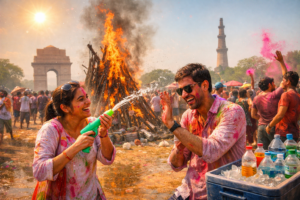
The date was March 5, 2026. In the narrow lanes of Old Delhi and the sprawling parks of New Delhi, the air was thick with more than just the usual festive spirit. As revellers armed with pichkaris (water guns) and bags of gulal took to the streets, they were greeted by an unmistakable, intense warmth. The mercury had climbed to 33.2 degrees Celsius at the city’s base station, Safdarjung, making it not just a warm Holi, but the hottest day of the year so far. The festival of colours, which often arrives as a perfect springtime celebration, had instead ushered in the first assertive touch of a Delhi summer.
This wasn’t just a weather update; it was an experience that defined the day for millions. The 33.2°C reading, a full 1.7 degrees above normal, transformed the celebrations. The usual morning chill that often necessitates a light sweater for early Holi rituals was conspicuously absent. In its place was a sun that felt more like late April, beating down on faces already smeared with vibrant pinks and blues.
At the sprawling Mughal Gardens or the more accessible Deer Park in Hauz Khas, families who had set up picnics were seen seeking refuge under the shade of ancient trees much earlier than usual. The water in the buckets, meant for friendly ambushes, was not the bracing cold splash of yesteryears but quickly warmed to a tepid temperature under the strong sun. The joy of spraying a friend with cool water was replaced by a fleeting moment of relief from the heat.
“It felt like the summer has arrived a month early,” remarked Anjali Sharma, a resident of Greater Kailash who was celebrating with her colony friends. “We usually have a thandai with a bit of a chill, but today, everyone was reaching for chilled bottled water straight from the icebox. The gujiyas were delicious, but eating them in this heat made us all feel lethargic by noon.”
The data from the India Meteorological Department (IMD) painted a clear picture of this atypical warmth. While Safdarjung recorded 33.2°C, other parts of the city mirrored the trend. Lodhi Road, with its verdant gardens, hit 32.8°C, while the Ridge area, often a few degrees cooler, touched 33.0°C. The minimum temperatures, too, were significantly above normal, hovering around 15-16 degrees Celsius, denying residents the cool evening reprieve that usually follows a warm day. The relative humidity, which dropped from 71% in the morning to 33% by evening, created that classic Delhi stickiness—a brief period of muggy air followed by a dry, parching heat.
This meteorological event, however, is more than just a statistic for a single day. It’s a palpable data point in a longer, more concerning narrative: the shifting climate of India’s capital.
From Pleasant Spring to Premature Summer: A Climate in Flux
To understand the significance of this “warm Holi,” one must look at the weeks and months that preceded it. The provided news clip hints at it with a related story: “Delhi’s Hot February Points To India’s Deepening Climate Shift.” February 2026 wasn’t just warm; it was historically so. The month shattered previous heat records, creating a baseline of higher temperatures that made March’s heat feel even more intense.
This isn’t an isolated phenomenon. Meteorologists and climate scientists have been observing a consistent trend over the past decade—a shortening of the spring season. The transitional period between the chill of winter and the oppressive heat of summer is shrinking. The cool, pleasant days of late February and early March, once perfect for outdoor Holi celebrations, are being increasingly encroached upon by heat waves that arrive prematurely.
“It’s a classic signal of climate change,” explains Dr. Anjali Chaudhary, a climate scientist at a Delhi-based policy research institute (a representative expert voice). “The overall baseline temperature is rising. This means that what we consider ‘normal’ for a given day is constantly being redefined upwards. An event like this—a 33°C day in early March—becomes more probable and more intense in a warming world. The jet stream patterns are altering, high-pressure systems are becoming more stubborn, and they are drawing hot air from the desert regions into the northern plains much earlier.”
This wasn’t a sudden heatwave, but a sustained period of high temperatures that coincided perfectly with the Holi festivities. The strong surface winds forecast by the IMD for the following day are another characteristic of this pre-summer heat, often acting like a giant hair dryer, further desiccating the land and cranking up the temperature.
The Colours of a Hotter Celebration
The human impact of this warmth went beyond mere discomfort. The way people celebrated Holi had to adapt. The traditional bonfire, or Holika Dahan, lit on the eve of Holi, was for many a sweltering experience rather than a warming one. The crowds around the fire were thinner, and people stood further back, seeking the cooler periphery.
For the vendors, the day took on a different economic hue. “I sold three times the amount of cold drinks and water than I did last year,” said Raju, a vendor at a popular market in Chandni Chowk, his own face stained with the colours thrown by customers. “The kanji (a fermented drink) and thandai were selling, but people wanted them with ice, ice, and more ice. The colour packets were melting in the sun, sticking together.”
The early heat also posed health risks. Doctors across the city reported a higher number of cases of dehydration, heat exhaustion, and even some cases of heatstroke, particularly among the elderly and children who were out in the sun for prolonged periods. The combination of physical exertion, alcohol consumption (often a part of Holi celebrations), and the intense sun proved to be a dangerous cocktail.
“It’s crucial to stay hydrated,” advised Dr. Sonali Mehta, a physician at a clinic in South Delhi. “On a normal warm day, we advise it. On a day like this, with people running around, often forgetting to drink water amidst the fun, it becomes a health imperative. We saw several people with headaches, dizziness, and nausea—classic signs of heat exhaustion.”
Even the spirit of the festival was subtly altered. The joy of a community Holi often lies in the extended hours of celebration—starting late morning and going on until evening. The oppressive heat cut this short. By 2 p.m., many gatherings had wound down, with people retreating to the cool confines of their air-conditioned homes. The post-Holi ritual of visiting friends and family in the evening was still pleasant, but the core daylight celebration was truncated by the sheer force of the sun.
A Festival Coloured by Air Quality
Another factor that coloured this Holi was the air. While the day itself was warm, the air quality index (AQI) settled at a ‘moderate’ 161. This was a relief compared to the ‘severe’ and ‘very poor’ categories that often plague Delhi’s winters. However, the data from the SAMEER app revealed a more complex picture. While 40 stations were in the ‘moderate’ category, pockets like Punjabi Bagh recorded a ‘very poor’ AQI of 320.
This localized variation tells its own story. The bursting of firecrackers, a common but controversial part of Holi celebrations in some areas, could have contributed to sudden spikes. Moreover, the dry, hot, and windy conditions can whip up dust and particulate matter, degrading air quality even without significant smoke. For those with respiratory conditions like asthma, the combination of heat, physical exertion, and pockets of poor air made the celebrations a challenge. The gulal, while colorful, can also be an irritant, and when mixed with sweat from the heat, it caused skin rashes for some.
Looking Ahead: The New Normal?
As the colours faded and people washed off the remnants of the day, a lingering question remained: is this the new normal? The IMD’s forecast for the following day offered no respite, predicting similar temperatures around 33 degrees Celsius. The long-term forecast from the Air Quality Early Warning System suggested the “moderate” air quality would persist, but with the heat likely to intensify as March progresses.
This warm Holi serves as a powerful, lived experience of a changing climate. It’s a story that goes beyond the headline-grabbing mercury reading of 33.2°C. It’s a story of a community adapting its oldest traditions to the pressures of a warming planet. It’s about the picnic blankets moved into the shade, the extra ice in the thandai, the shortened playtime, and the quiet concern in the eyes of a parent watching their child run in the unrelenting sun.
The festival of colours, which symbolises the triumph of good over evil and the arrival of spring, is now also becoming a marker of the advancing summer. It’s a reminder that climate change is not a distant, abstract threat. It is here, in the sweat on the brow of a Holi reveller, in the altered rhythm of a beloved festival, and in the stark data that confirms what millions felt on their skin. As Delhi moves forward, the memory of this warm Holi will likely not be just of the colours, but of the heat that came with them—a vivid, tangible sign of the times.
You must be logged in to post a comment.