
Delhi’s Fragile Reprieve: How a Single Rainstorm Lifts the Veil – And What Happens When It Leaves
The recent rainfall in Delhi provided a temporary but starkly visible reprieve from the capital’s toxic air, washing down pollutants and improving the AQI from ‘very poor’ to ‘poor,’ which highlighted how breathable air is achievable yet remains entirely dependent on climatic intervention rather than systemic change. The IMD forecast predicts dense fog until January 30th—a condition that will likely facilitate the rapid re-accumulation of pollution—followed by more showers on February 1st, illustrating the city’s cyclical pendulum between fleeting relief and prolonged distress. This pattern underscores an unsustainable dependency on weather events, exposing the urgent need for sustained, year-round policy action on emission sources, as the post-rain clarity serves as both a momentary gift and a sobering blueprint for what permanent change could look like.
Delhi’s Fragile Reprieve: How a Single Rainstorm Lifts the Veil – And What Happens When It Leaves
The headline itself reads like a sigh of relief: “Delhi rains bring relief from toxic air.” For millions in the capital, the persistent, gritty taste of pollution that defines winter mornings was, for a moment, washed away. The Air Quality Index (AQI), after hovering in the ‘severe’ and ‘very poor’ categories for weeks, tumbled into the ‘poor’ band following heavy rainfall on January 27th. But this meteorological interlude is more than just a weather update; it’s a stark lesson in Delhi’s fragile relationship with its environment, a temporary clearing that exposes both the potential for breathable air and the profound systemic failures that make it an anomaly.
The Morning After: A Capital Transformed
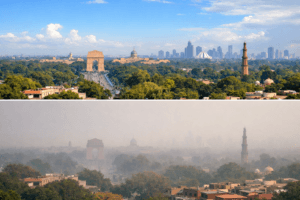
Imagine the shift. On Tuesday, Delhi was a city seen through a sepia filter, its landmarks blurred, sunlight diffused into a faint glow. By Wednesday morning, the city had emerged. The rhythmic patter of rain hadn’t just dampened the streets; it had performed a dramatic act of atmospheric cleansing. Particulate matter (PM2.5 and PM10)—those microscopic, lung-penetrating pollutants from vehicle exhaust, construction dust, industrial emissions, and stubble burning—were literally scrubbed from the air, dragged down to the earth by the raindrops in a process known as “wet deposition.”
The data told the story. The Central Pollution Control Board (CPCB) monitors showed a precipitous drop in concentrations. Residents didn’t need the numbers; they felt it. The customary morning throat itch was absent. The horizon, usually truncated at a few hundred meters, stretched out. For the first time in weeks, taking a deep breath outdoors felt like an act of nourishment, not of risk. This immediate, visceral transformation underscores a critical, often overlooked point: the air quality Delhi experiences is not an immutable fact of geography, but a direct result of anthropogenic activity. The rain proves that clean air is physically possible here; the tragedy is that it requires a meteorological event to achieve it.
The Mechanics of a Temporary Fix: More Than Just Water
While the relief is welcome, understanding why it happens reveals its fragility. The rainfall acts on multiple fronts:
- Washout Effect: As raindrops fall through the atmosphere, they collide with and capture aerosol particles and gaseous pollutants, carrying them to the ground.
- Increased Dispersion: Rain events are often accompanied by higher wind speeds and atmospheric instability, which prevent pollutants from settling and forming the dense, stagnant layers typical of a winter inversion.
- Humidity and Particle Growth: High humidity can cause smaller particles to swell in size, making them heavier and more likely to fall out of the air or be caught more easily by precipitation.
However, this cleaning is superficial. It does not address the sources. The factories haven’t shut down, the traffic hasn’t vanished, and the underlying infrastructural challenges remain. The rain is a reset button, not a solution. As the skies clear and winds calm, the emission engines of the metropolis roar back to life, beginning the slow, steady process of rebuilding the toxic blanket.
The Forecast: A Precarious Balance of Fog and Hope
The India Meteorological Department’s (IMD) forecast paints a picture of a city in climatic transition. The promise of “fresh showers on 1 February” due to a fresh Western Disturbance offers another window of relief. Yet, the intervening days are laced with a different challenge: dense fog.
The IMD’s yellow alert and warning for dense fog in isolated pockets over Delhi, Haryana, and Punjab from January 28th-30th is a crucial part of the narrative. Fog, particularly when it mixes with pollutants to form smog, is the antithesis of the cleansing rain. It signifies calm, stable atmospheric conditions where cold air gets trapped near the ground (inversion), acting as a lid that seals in all emissions. The “shallow to moderate fog” predicted for mornings is not just a travel hazard; it is the precondition for rapid pollution re-accumulation. The visibility drop is a direct correlate to an AQI rise.
The temperature forecast adds another layer. With maximum temperatures “appreciably below normal” (by 3.1°C to 5.0°C), the incentive for increased biomass burning for warmth in informal settlements and surrounding regions grows. The predicted 5-6 degree Celsius fall in minimums until January 30th will intensify the cold, tightening the grip of the inversion layer.
The Human Insight: Between Relief and Resignation
For Delhi’s residents, this cycle breeds a unique form of environmental fatigue. There is a palpable, almost collective, joy on a post-rain morning—parks fill, walks are taken, windows are opened. But beneath it lies a deep-seated resignation. The knowledge is pervasive: this is borrowed time. The conversation shifts from “The air is clean!” to “How long will it last?” The forecast of more rain on February 1st isn’t just a weather note; it’s a date circled on a mental calendar, a scheduled respite to be maximized before the inevitable regression.
This psychological pendulum swing—between brief relief and prolonged distress—has tangible effects. It influences daily decisions: Do we plan the outdoor family gathering for the weekend after the rain? Should we buy those air purifier filters now or wait to see if the rains persist? It highlights the profound inequality of the air quality crisis: those with resources can retreat to climate-controlled sanctuaries; for the vast majority working outdoors, the foggy, polluted morning is an inescapable workplace condition.
Beyond the Headline: The Unsustainable Dependency
The real story, therefore, is not that rain improves air quality—that’s basic atmospheric science. The story is Delhi’s unsustainable dependency on these erratic climatic events for breathable air. It frames the city’s environmental policy as a passive waiting game, hoping for the next Western Disturbance to do what systemic change has not.
The post-rain period should be the moment of greatest clarity, both visual and strategic. It is the evidence that the goal of ‘moderate’ or ‘satisfactory’ AQI is not a fantasy. It demonstrates what effective, large-scale source control could achieve year-round. When the veil lifts, we see not just the distant buildings, but the stark outline of what is needed: accelerated transition to electric public transport, stringent and transparent regulation on construction and industrial emissions, year-round vigilance rather than seasonal crisis management, and robust, multi-state coordination on agricultural residue burning.
As Delhi braces for more showers on February 1st, the city stands at a crossroads. It can choose to see the rainfall as a lucky break, a fleeting pardon from an unchangeable sentence. Or, it can see the freshly washed sky as a blueprint, a powerful, natural demonstration of what is possible. The rain brings relief, but it also brings a mirror. In the clearer air, Delhi is confronted with the reflection of its own choices—and the urgent need to build a future where clean air is not a weather event, but a civil right. The true forecast the city needs is not for the next shower, but for the political will and collective action that can make these precious days of ‘poor’ air the new normal, rather than a temporary exception.
You must be logged in to post a comment.