
Delhi’s February Paradox: When ‘Pleasant’ Weather Masks a Deeper Unsettling Truth
On February 11, 2026, Delhi’s seemingly pleasant weather—a minimum of 13.2°C (three notches above normal) and an AQI of 295 classified as ‘poor’—masks a more unsettling reality of gradual climate normalization, where residents and systems have recalibrated their expectations downward to accommodate winters that arrive milder, air that damages slowly rather than dramatically, and a deepening disparity between those who can filter their environment and those who must simply endure it; behind the routine statistics lies a city adapting through individual coping mechanisms—from farmers facing early crop bolting to physicians treating unexplained fatigue and vendors whose livelihoods are now subject to seasonal confusion—while the very instruments designed to measure environmental health have inadvertently become tools for legitimizing decline, transforming what were once extreme events into ordinary benchmarks against which Delhi measures its slow, unidirectional drift toward warmer, more toxic thresholds.
Delhi’s February Paradox: When ‘Pleasant’ Weather Masks a Deeper Unsettling Truth
Rajni Mehra pulled her pashmina shawl tighter, stepping onto her balcony with a steel tumbler of cutting chai. The sun was a pale orange disc struggling through the haze. On any normal February morning—the kind she remembered from her childhood in this very neighbourhood—she would have needed a sweater until at least 10 AM. But today, at dawn, the air already carried the reluctance of a season refusing to commit to winter.
She didn’t need the India Meteorological Department to tell her something was off. Her skin knew. Her father’s asthmatic wheeze from the bedroom knew. The marigolds in her balcony pots, blooming two weeks early, knew.
By official accounts, February 11, 2026 was a “pleasant” day in the national capital. The minimum temperature at Safdarjung settled at 13.2 degrees Celsius—three notches above what is considered normal for this time of year. The maximum was predicted to hover around a comfortable 26 degrees. Mist was likely. The Air Quality Index stood at 295, brushing the upper threshold of the ‘poor’ category.
On paper, this reads like a reprieve. Delhiites have endured worse—far worse. Just last November, the city choked through AQI readings beyond 800. By that brutal benchmark, 295 is almost gentle. Almost.
But numbers, like winter mornings, have a way of lying.
The Warmth That Shouldn’t Be
Dr. Anjali Mathur has been tracking Delhi’s winters for thirty-three years. Not as a climatologist—she’s a general physician at a government dispensary in Moti Bagh—but as someone whose patients’ ailments arrive with the seasons.
“Ten years ago, February meant bronchitis, viral fevers, and the occasional pneumonia,” she said, flipping through a stack of outpatient records. “Now? Allergies, unexplained skin rashes, and this peculiar low-grade fatigue that doesn’t quite qualify as illness but isn’t wellness either.”
The warmth that felt pleasant to morning walkers was, in her assessment, a physiological stressor. The body, conditioned to expect cold in February, was being forced to recalibrate. “We are seeing more patients with seasonal affective disorder symptoms—but the season isn’t behaving like it’s supposed to. There’s a dissonance. People feel it in their bodies before they read about it in the news.”
The IMD’s data is unambiguous. At Palam, the minimum temperature was 14.4°C—4.1 notches above normal. At Lodhi Road: 13.4°C, 4.4 notches above normal. Ridge: 13.6°C. Ayanagar: 13.3°C. Station after station, the story repeated itself: a city running warmer than its historical baseline.
But what does “three notches above normal” actually mean for a family in a south Delhi colony without central heating? What does it mean for the Punjabi bagh farmer bringing mustard greens to the mandi, watching his crop bolt earlier than it should? What does it mean for the night-shift cab driver whose sleep cycle is now governed not by darkness but by when his non-AC room becomes bearable?
The AQI of 295: A Closer, More Uncomfortable Look
At 8:47 AM, Sameer—the CPCB’s mobile application—displayed a city-wide average of 295. Twenty monitoring stations reported ‘very poor’ air. Sixteen reported ‘poor’. Two stations, outliers by geography or fortune, registered ‘moderate’.
Most Delhi residents have developed a kind of selective literacy when it comes to air quality numbers. We know that ‘severe’ means schools close. ‘Very poor’ means we consider masks but rarely wear them. ‘Poor’ means we exhale a small sigh of relief and proceed with our day.
This is coping, not comprehension.
Dr. Ravi Khanna, pulmonologist at Safdarjung Hospital, offered a more visceral translation. “At 295, you are breathing particulate matter that reaches the deepest recesses of your alveoli. It doesn’t trigger the immediate, dramatic response of 450-plus—you won’t cough visibly, your eyes won’t burn. Instead, it works slowly, like a tenant who moves in quietly and never leaves. Inflammation builds. Lung capacity diminishes imperceptibly. For children, whose lungs are still developing, this is not a bad day. This is a bad childhood.”
The ‘poor’ category, in other words, is not a reprieve. It is merely a slower form of damage—one that doesn’t interrupt the rhythms of capital-C City life. Office attendance is unaffected. Weddings proceed. Construction continues.
On Wednesday morning, at the ITO intersection, a traffic policeman directed vehicles without a mask. His reason was pragmatic, not defiant. “It fogs up my glasses,” he said. “And honestly, on days like this, you can’t really tell. If it were choking, I’d know. Today is fine.”
Today was 295.
The Geography of Disparity
Air quality, like most things in Delhi, is not evenly distributed.
At Anand Vihar, the transit hub that funnels millions of commuters between Delhi and its satellite cities, the AQI touched 312 by mid-morning—firmly ‘very poor’. At the opposite end, the Delhi Technological University campus in Rohini registered 208, the lower end of ‘poor’.
This is not a matter of wind direction alone. The city’s environmental burdens follow its economic fault lines. Areas with denser populations, older housing stock, and closer proximity to industrial clusters breathe worse air. Colonies with tree cover, wider roads, and fewer polluting sources nearby breathe marginally better air.
“We have normalized the idea that some Delhis are more breathable than others,” said environmental researcher Preeti Sharma. “But air doesn’t respect postal codes. The particulate matter from an unauthorized colony in east Delhi travels to a gated community in Gurugram. The difference is that one has the resources to install purifiers, the other opens windows and hopes for the best.”
The morning of February 11 was, by this measure, a typical Delhi day: unequal, stratified, and quietly unjust.
Mist as Metaphor
The IMD forecast mentioned “mist likely during the day.” The phrasing was cautious, probabilistic. But for those who navigated Delhi’s roads Wednesday morning, the mist was not a likelihood. It was a presence.
Near Kashmere Gate, the Yamuna’s visible exhalation merged with vehicular emissions and the lingering residue of overnight construction dust. Visibility dropped to under 500 meters in patches. Commuters on two-wheelers wiped their visors repeatedly.
Mist in February is not unusual. Mist as a cover for everything else we are doing to our atmosphere—that is the story.
Mohan Lal, 67, has been selling hot samosas from a handcart outside Vijay Nagar for thirty-eight years. He remembers when February mornings required him to keep his chai kettle on a constant low boil, just to offer warmth to shivering customers. “Now they ask for cold drinks even in winter,” he said, adjusting the newspaper lining his basket. “The weather is confused. My business is confused. I don’t know what to prepare anymore.”
His observation, delivered without pretence, contains more insight than most policy documents. When seasons become unpredictable, the informal economy—which lacks the cushion of weather-proof infrastructure—takes the first and hardest hit.
The Silence of Normalcy
Perhaps the most striking aspect of Wednesday’s weather report was not what it contained but what it omitted. No red alerts. No emergency declarations. No advisory for schools to suspend outdoor activities. By Delhi’s standards, this was news only in its ordinariness.
That ordinariness, however, is itself a kind of deterioration.
“The baseline has shifted,” said meteorologist Sanjay Upadhyay, who retired from IMD in 2023 but continues to track weather patterns independently. “What we now call ‘above normal’ would have been considered an extreme event twenty years ago. We have recalibrated our expectations downward because the alternative—acknowledging how much the climate has already changed—is too uncomfortable.”
His own data, maintained in a handwritten register, shows that Delhi’s February minimum temperatures have risen by an average of 2.1 degrees Celsius over the past three decades. The shift has been gradual, almost imperceptible on a year-to-year basis. But the cumulative effect is unmistakable: a winter season that arrives later, stays milder, and retreats earlier.
The consequences extend beyond human comfort. Crop cycles are disrupted. Migratory bird patterns are shifting. The city’s water demand, even in February, strains resources that were once adequate through March.
What Resilience Looks Like
And yet, the city endures. Not because of adequate planning or visionary policy, but because its residents have developed an almost pathological capacity for adaptation.
In Chattarpur, nursery owners have begun stocking plant varieties that tolerate warmer winters. In Karol Bagh, textile traders report that sales of heavy woolens have declined steadily for five consecutive years—not because of changing fashion, but changing necessity. In defence colonies, retirees who once spent winter afternoons in sun-drenched parks now seek shaded benches.
This is resilience, but it is the resilience of coping, not solving. It is the resilience of individuals making micro-adjustments while the macro-environment continues its unidirectional drift.
Dr. Mathur, the physician from Moti Bagh, sees this in her consultation room every day. “Patients don’t say, ‘Doctor, the weather has changed and it’s affecting my health.’ They say, ‘I haven’t been sleeping well.’ Or, ‘My allergies are acting up for no reason.’ They connect the symptom but not the cause. That’s the most dangerous part—when you stop perceiving the abnormal as abnormal.”
The Evening, and After
By 5:30 PM, the mist had thickened. Streetlights on M.G. Road flickered on earlier than usual. The AQI, which had improved marginally during the afternoon breeze, began its inevitable evening climb.
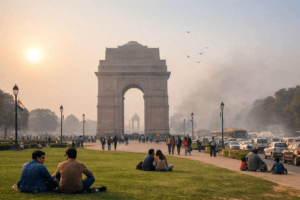
At India Gate, families continued their nightly ritual of chaat and selfies. The war memorial, illuminated against the grey dusk, attracted the usual crowd of out-of-town tourists. A child chased a balloon seller. Two college students debated where to eat. A vendor arranged his trays of imitation jewellery under a portable lamp.
None of this would appear in tomorrow’s weather bulletin. The IMD would report fresh data—a new minimum, a revised maximum, an updated AQI. The numbers would shift, perhaps slightly better, perhaps slightly worse.
But the underlying story would remain unchanged. Delhi is getting warmer. Its air is persistently toxic. And the mechanisms we have built to monitor these phenomena—the monitoring stations, the AQI scale, the temperature benchmarks—have inadvertently become instruments of normalization. They measure our decline and present it as information.
On Wednesday, February 11, 2026, the minimum temperature in Delhi settled three notches above normal. The air quality was poor.
On Thursday, the city will wake to another forecast. Another commute. Another day of calibrated endurance.
The mist will lift, as it always does. The question is whether we will see more clearly when it does—or whether we have already grown too accustomed to the haze.
You must be logged in to post a comment.