
Delhi’s February Breather: Warm Days, Choking Reality in the National Capital
Delhi is experiencing an anomalous warm spell in mid-February, with temperatures soaring 4-5 degrees above normal to reach 28.5°C, creating pleasant days but cool nights, yet this weather paradox is overshadowed by the capital’s persistently poor air quality, which averaged an AQI of 218 on Monday—with hotspots like Shadipur breaching the ‘very poor’ category at 308. While meteorological dry spells and clear skies drive the unseasonable warmth, local pollutants from vehicular emissions and construction dust continue to choke the city, exposing residents to a “grey zone” of health dilemmas where warm sunshine invites outdoor activity but toxic air forces caution. Health experts warn that the prolonged ‘poor’ AQI rating, now normalized by Delhiites, triggers chronic respiratory issues, while anti-smog guns remain largely symbolic measures against fine particulate matter. With forecasts predicting continued dry weather and stagnant air quality until at least February 17, the city finds itself caught between an early spring teaser and the enduring reality of its pollution crisis.
Delhi’s February Breather: Warm Days, Choking Reality in the National Capital
For Delhiites, the middle of February has brought an unexpected gift from the weather gods: the kind of warm, sunny days typically reserved for late March. But beneath the pleasant sunshine, a familiar winter foe lingers. The air, carrying the scent of dry earth and exhaust, remains firmly trapped in the ‘poor’ category, a stark reminder that in India’s capital, a beautiful day and a breathable one are often mutually exclusive.
On Monday, February 16, 2026, as the mercury at the Safdarjung observatory touched 28.5 degrees Celsius—a full four degrees above normal—the city found itself in a peculiar seasonal paradox. Children played in Lodhi Garden without their winter jackets, office-goers shed their sweaters by noon, and chaiwallahs saw a dip in sales as the sun eliminated the need for a midday warm-up. Yet, just a few kilometers away at the Shadipur monitoring station, the Air Quality Index (AQI) read a concerning 308, entering the ‘very poor’ zone and serving as a toxic outlier in a city already struggling to breathe.
This is Delhi in late winter 2026: a city caught between the early arrival of spring and the stubborn departure of its most persistent resident—pollution.
The Great Temperature Anomaly
The India Meteorological Department (IMD) data tells a story of significant deviation. Safdarjung’s 28.5°C on Sunday was not an isolated spike. At the Ridge, temperatures soared to 28.8°C, a staggering 5.7 notches above the seasonal norm. Ayanagar and Lodhi Road followed suit, recording similar anomalies.
“This is a classic setup of a dry spell coupled with clear skies,” explains a retired IMD scientist who prefers not to be named. “We aren’t seeing any active western disturbances affecting the region. When there’s no cloud cover, the sun’s radiation heats the ground intensely during the day. However, because the air is dry, that heat radiates back out quickly after sunset, which is why we are still seeing cool nights.”
Indeed, the nights remain stubbornly cool. Safdarjung recorded a minimum of 10.1 degrees Celsius, slightly below normal. This diurnal temperature variation—a 18-degree swing between day and night—is hard on the body. “We are seeing a spike in patients with viral fever and sore throats,” says Dr. Meera Krishnan, a general physician at a clinic in Karol Bagh. “People get fooled by the afternoon heat. They step out in a light shirt, but by evening, the chill is back. The body struggles to adapt to this whiplash.”
For farmers in the peri-urban areas of NCR, the warmth is a growing concern. “The wheat crop needs a bit of chill during the grain-filling stage,” says Surendra Singh, a farmer from Ghaziabad. “This sudden warmth is not ideal. We are worried about a dip in yield if this continues.”
Mapping the ‘Poor’ Air: More Than Just a Number
While the weather oscillates, the air quality remains persistently mediocre. With an average AQI of 218 on Monday morning, Delhi was firmly in the ‘poor’ category. While this is a far cry from the ‘severe’ episodes of November, health experts warn against becoming desensitized.
“‘Poor’ is not ‘good’,” asserts Dr. Arun Sharma, a pulmonologist at a private hospital in Noida. “When we talk about AQI 200-300, we are talking about air that triggers discomfort for sensitive groups—the elderly, children, and those with pre-existing heart or lung conditions. But what we are seeing is that with prolonged exposure, people who consider themselves ‘healthy’ also start showing sub-clinical symptoms: eye irritation, a persistent tickle in the throat, and reduced lung capacity.”
The data from the CPCB’s Sameer app painted a varied picture across the city. While the average hovered around 218, 25 stations recorded ‘poor’ air, and 12 managed a ‘moderate’ rating. The outlier was Shadipur, breaching the 300 mark into ‘very poor’. This micro-variation is a crucial detail often lost in the headlines. It tells us that where you live, work, or commute in Delhi drastically changes the quality of air you inhale.
Areas with higher green cover or better ventilation, like those near the Ridge, often fare slightly better. In contrast, densely populated, traffic-choked corridors like Shadipur become pollution traps. The primary culprit this time of year is not stubble burning, which ended months ago, but local surface-level pollutants: vehicular emissions, dust from construction sites, and the burning of refuse in low-income settlements to ward off the lingering nighttime chill.
The Anti-Smog Gun: A Symbolic Sprinkle?
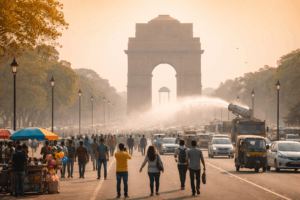
A poignant image accompanying the news report shows an anti-smog gun spraying a mist of water over a road in Delhi. It has become the quintessential stock photo of Delhi’s pollution crisis—a mechanical beast fighting an invisible enemy.
But how effective is this theatre of action?
“Anti-smog guns are highly inefficient at this scale,” admits a civil engineer working with a municipal corporation, on condition of anonymity. “They are designed to settle dust particles in a localized area, usually at a construction site. When you mount one on a truck and drive it around, the water evaporates quickly, and the fine particles—the PM 2.5 that really damages your lungs—remain suspended. It’s a visual reassurance, a check in the box, but it’s not a solution.”
Environmental activists argue that such measures distract from the core issue: the relentless, unoptimized load of vehicles on Delhi’s roads and the lack of a comprehensive plan to tackle dust.
“We celebrate when the AQI is 220 because we remember the days of 450,” says Bhavna Singh, a climate activist with a local NGO. “But we’ve normalized a health emergency. ‘Poor’ air should not be acceptable. It should be the starting point for emergency action, not a sign of relief. We need to see a radical shift in commuting habits and a serious crackdown on construction dust, not just water sprinkling for photo-ops.”
Living in the Grey Zone: The Human Cost
For the average Delhiite, this combination of warm sun and bad air creates a dilemma. It’s a “grey zone” of decision-making.
Take Ramesh Kumar, a 52-year-old cab driver who spends 10 hours on the road. “The warm sun is good for business,” he says, wiping sweat from his brow as he waits for a fare outside a metro station. “People want to go out. But my eyes have been burning since morning. I keep the windows up in the cab, but then it gets stuffy. You can’t win.”
For students, the implications are more severe. With CBSE exams looming, many are in their final stretch of preparation. Schools are open, and children are commuting during peak traffic hours. “My son has a dry cough that just won’t go away,” shares Priyanka Mehra, a mother of a 15-year-old. “The doctor said it’s because of the air. We’ve bought an air purifier for his room, but what can we do about the school bus ride? He can’t wear a mask all day; it’s uncomfortable.”
This is the invisible cost of Delhi’s air crisis: reduced productivity, increased healthcare spending, and a baseline of poor health that the city’s 20 million residents have come to accept as normal. The forecast offers little immediate respite. The Air Quality Early Warning System (AQEWS) predicts that the air will likely remain ‘poor’ until at least February 17, with the outlook for the subsequent six days suggesting the same band will persist.
The February Outlook: Waiting for a Respite
The weather forecast indicates a shift to a generally cloudy sky towards the afternoon and evening, with mist in the morning. Surface winds from the east are expected to pick up speed later in the day. For air quality, wind speed is the great equalizer.
“Dispersion is the key,” explains the IMD scientist. “If the wind speed picks up to a steady 10-15 km/h, it can blow the pollutants away and improve the AQI. However, if the winds remain light, as forecast, the pollutants will just hang around. The lack of rain is also a factor. We need a strong western disturbance to wash the atmosphere clean, but there’s no sign of that until at least the weekend, and even then, it might bypass Delhi.”
This stagnation is typical for February, a transition month. The extreme cold that traps pollution near the surface is gone, but the convective forces of summer that create strong, dust-laden winds haven’t yet kicked in.
Conclusion: A New Normal?
As Delhi navigates this stretch of warm days and poor air, the city is confronted with a new facet of its environmental reality. The climate is changing, bringing warmer winters and unpredictable shifts. The pollution, however, remains a constant, merely fluctuating in intensity.
The data from the IMD and the CPCB tells us that on February 16, 2026, Delhi was warm and polluted. But the story behind the numbers is about the cab driver with burning eyes, the farmer worried about his wheat, the student coughing before an exam, and a city going about its business under a hazy, warm sun.
The anti-smog guns will continue to sprinkle water, the advisories will be issued, and the AQI will be watched. But until the underlying drivers of vehicular pollution, industrial emissions, and dust are tackled with the same urgency as a weather emergency, Delhi will continue to live in this paradox: enjoying the sunshine while holding its breath.
You must be logged in to post a comment.