
Delhi’s Dual Crisis: The Choking Grip of ‘Very Poor’ Air and Record-Breaking Cold
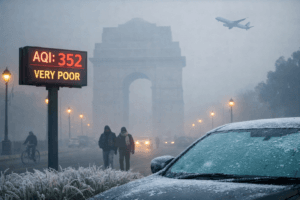
Delhi is currently grappling with a severe public health crisis as a record-breaking cold wave and hazardous air pollution converge, with temperatures plunging to a three-year low of 2.9°C while the air quality index (AQI) remained in the ‘Very Poor’ category at 352, creating a dangerous inversion layer that traps toxic pollutants like PM2.5 close to the ground.
This combination triggers severe respiratory and cardiovascular issues, especially for vulnerable populations, and has led to widespread flight disruptions and frost damage to crops. In response, authorities have implemented emergency measures under the Graded Response Action Plan (GRAP), highlighting the critical need for sustained regional cooperation and a shift to clean energy to combat this recurring seasonal emergency.
Delhi’s Dual Crisis: The Choking Grip of ‘Very Poor’ Air and Record-Breaking Cold
As dense, grey smog blankets India’s capital and a bitter cold wave sends temperatures plummeting near zero, Delhi finds itself in the suffocating embrace of a dual crisis. On January 15, 2026, the city awoke to its coldest morning in three years, with the mercury dropping to 2.9°C, while the Air Quality Index (AQI) remained dangerously lodged in the ‘Very Poor’ category at 352. This perilous combination—where extreme cold traps toxic pollutants at breathing level—is not just an inconvenience but a severe public health emergency, disrupting lives, grounding flights, and forcing residents to make impossible choices about their daily routines.
The cold wave, coupled with hazardous air, has become a perilous seasonal norm for Delhi. This article explores the scientific interplay between the weather and pollution, its profound impact on human health, the policy measures being enacted, and the long-term solutions that offer a glimmer of hope for the city’s future.
The Current Snapshot: A City in Distress
The data paints a stark picture of a city under siege. On the morning of January 15, air quality monitors across Delhi recorded alarming pollution levels, with readings in central and south Delhi among the worst: RK Puram at 383, ITO at 380, and Chandni Chowk at 384. Simultaneously, the India Meteorological Department (IMD) reported temperatures well below normal, with dense fog reducing visibility to near-zero and delaying flights at Indira Gandhi International Airport.
This scenario extends beyond the capital. The cold wave has gripped the entire Indo-Gangetic plain, with places like Gurugram in Haryana recording temperatures as low as 0.8°C earlier in the week—a level comparable to or colder than many Himalayan hill stations. The phenomenon has left visible signs: frost, known locally as pala, covering crops, grasslands, and car windshields, raising concerns for agriculture and daily life alike.
How Delhi’s Air Compares
While Delhi grapples with “Very Poor” to “Severe” air, a look at other major Indian cities on the same day reveals a troubling disparity:
| City | AQI (Approx.) | Category | Key Context |
| Delhi | 352 | Very Poor | Multiple stations above 380; cold wave trapping pollutants. |
| Mumbai | 108 | Moderate | Coastal breeze aids dispersal. |
| Bengaluru | 95 | Satisfactory | Geographical advantage. |
| Hyderabad | 85 | Satisfactory | Better air quality management. |
| Chennai | 120 | Moderate | Moderate level, lower than northern cities. |
| Jaipur | 176 | Poor | Affected by regional dust and weather patterns. |
The Science of the Smog: Why Winter Is the Worst
The extreme pollution Delhi faces each winter is the result of a perfect storm of meteorological and human factors. Unlike summer, when hot air rises and disperses pollutants, winter brings temperature inversions. A layer of warm air acts like a lid, trapping cold, dense air—and all the pollutants in it—close to the ground. This phenomenon is drastically worsened by the cold wave, as the colder the surface air, the stronger and more persistent the inversion layer becomes.
Into this stagnant air mix pours a relentless stream of emissions. Key sources include:
- Vehicular Emissions: A constant and major contributor to PM2.5 and nitrogen oxides.
- Industrial and Power Plant Emissions: Thermal power plants in the National Capital Region (NCR) are significant point sources of sulfur dioxide and particulates.
- Local and Regional Biomass Burning: This includes winter heating fires, burning of garbage, and, critically, stubble burning from agricultural fields in neighbouring Punjab and Haryana. During peak burning season, this practice can contribute up to 45% of Delhi’s particulate pollution.
- Construction Dust and Road Dust: These are major contributors to coarser PM10 particles.
This combination creates the dense, toxic smog that defines a Delhi winter, making breathing the air equivalent to smoking dozens of cigarettes a day.
A Body Under Attack: The Multisystem Health Impact
The health consequences of breathing this toxic cocktail are severe and systemic. While lung and heart diseases are widely discussed, the assault is far more comprehensive.
- Respiratory System: The primary victim. Cold air naturally irritates and narrows airways. When laden with PM2.5 particles—so fine they bypass the body’s natural filters—the damage multiplies. These particles penetrate deep into the alveoli (the lung’s air sacs), triggering inflammation, reducing lung capacity, and exacerbating conditions like asthma and COPD. Early warning signs, often dismissed as a winter cold, include a persistent dry cough, shortness of breath during routine activity, and chest tightness.
- Cardiovascular System: PM2.5 particles don’t stop at the lungs. They enter the bloodstream, causing systemic inflammation that can destabilise arterial plaques, leading to an increased risk of heart attacks and strokes.
- Ocular Health: Eyes are directly exposed and particularly vulnerable. Doctors report a 50-60% surge in patients with itchy, burning, and watery eyes during smog episodes. Pollutants damage the tear film, leading to a condition often described as feeling like “sand in the eyes,” and increase the risk of infections and chronic inflammation.
- Vulnerable Groups: The risks are magnified for children, the elderly, pregnant women, and those with pre-existing conditions. For expectant mothers, exposure is linked to low birth weight and preterm birth. A startling report indicates that air pollution has irreversibly damaged the lungs of 2.2 million children in Delhi.
Policy and Response: From Emergency Measures to Long-Term Strategy
Faced with the escalating crisis, authorities have activated emergency protocols. The Commission for Air Quality Management (CAQM) has enforced Stage-III measures of the Graded Response Action Plan (GRAP) across the NCR. This “Severe” category action includes stricter controls on construction, industries, and vehicles, and is a proactive attempt to prevent the AQI from crossing into the “Severe Plus” category (above 450).
This action sits within India’s broader, yet complex, air quality framework. The country operates under its own National Ambient Air Quality Standards (NAAQS), which are significantly more lenient than WHO guidelines. For instance, the NAAQS annual limit for PM2.5 is 40 μg/m³, eight times higher than the WHO’s recommended 5 μg/m³. The government argues these standards account for India’s unique geographical and developmental context, including high natural background dust levels.
The flagship National Clean Air Programme (NCAP), launched in 2019, aims for a 40% reduction in particulate pollution by 2026 (revised from an initial 20-30% by 2024 target). While progress has been slow and 2025’s AQI has been among the worst in recent years, experts point to a crucial shift in thinking: the move toward airshed management.
This approach recognizes that Delhi’s air is a regional problem, polluted by sources across state borders. Effective solutions, therefore, must address crop burning in Punjab, industrial emissions across the NCR, and vehicular pollution in a coordinated manner.
Finding a Way Forward: Protection and Hope
While systemic change is essential, individual action remains critical for immediate protection. Pulmonologists and health experts recommend a multi-layered defence strategy:
- Stay Informed and Adjust Routines: Monitor the real-time AQI and avoid outdoor exercise, especially early morning walks, when pollution is high.
- Create a Clean Air Sanctuary at Home: Use HEPA air purifiers in bedrooms and living spaces, maintain indoor humidity between 30-50%, and ensure proper ventilation when outdoor air quality improves.
- Use Right Protection Outdoors: Simple cloth masks are ineffective. Wear a well-fitted N95, KN95, or N99 mask when outside.
- Fortify Your Body: Stay hydrated, consume a diet rich in anti-inflammatory foods (like turmeric and fruits high in Vitamin C), and ensure you are up-to-date with flu and pneumonia vaccinations.
- Listen to Your Body: Seek medical advice for a cough lasting more than three weeks, new breathlessness, or persistent chest discomfort.
Despite the grim annual tableau, experts express cautious optimism. They point to historical precedents: London cleaned up its Great Smog, and Beijing has made remarkable progress since being the world’s smoggiest city. Solutions like market-based instruments for trading particulate emissions (successfully piloted in Surat) and a rapid, equitable transition to clean energy and electric mobility are viable.
The path forward requires political will, regional cooperation, sustained investment, and unwavering public pressure. For the millions who call Delhi home, the hope is that the city’s future winters will be defined not by a struggle for breath, but by clear skies and a season of festivity. The battle for clean air is difficult, but as history shows, it is one that can be won.
You must be logged in to post a comment.