
Delhi’s Deep Freeze: Cold Wave Intensifies with Widespread Disruption Across North India
A severe cold wave and persistent dense fog are intensifying across Delhi-NCR and much of North India, with the India Meteorological Department forecasting these harsh conditions, including minimum temperatures 4.5–6.5°C below normal, to last until at least January 11. The near-zero visibility has caused major travel chaos, particularly at Delhi’s airport, leading to over 60 flight cancellations and hundreds of delays, while also worsening air quality into the “Very Poor” category. This spell marks a significant weather event, as Delhi recently experienced its coldest December day since 2019, with the intense chill and widespread fog disrupting daily life for millions across several states.
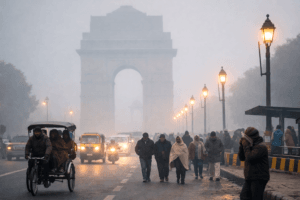
Delhi’s Deep Freeze: Cold Wave Intensifies with Widespread Disruption Across North India
A severe winter chill has tightened its grip over northern India, with dense fog and a biting cold wave set to intensify across Delhi-NCR and neighboring states in the coming days. The India Meteorological Department (IMD) forecasts these harsh conditions to persist until at least January 11, affecting daily life, crippling transportation networks, and worsening air quality for millions. This extended spell of cold marks one of the most significant winter disruptions in recent years.
Detailed Forecast: A Prolonged Chill and Widespread Fog
The IMD has issued a series of clear warnings indicating that relief is not imminent. The cold wave, declared when minimum temperatures drop 4.5 to 6.5 degrees Celsius below the seasonal average, is expected at isolated places in Delhi and is likely to affect several northern states.
- Extended Timeline: While initial forecasts covered January 2-5, the latest outlook is more severe. Dense to very dense fog is predicted during night and morning hours over Punjab, Haryana, and Chandigarh until January 7, and over eastern Uttar Pradesh until January 8. Isolated dense fog may linger in parts of Punjab, Bihar, Uttar Pradesh, Haryana, and Chandigarh until January 11.
- Temperature Trends: For Northwest India, including Delhi, the IMD predicts no significant change in minimum temperatures for the next two days, followed by a gradual decline of 2–3 degrees Celsius. In Central and Eastern India, minimums are expected to fall gradually by 2–4 degrees Celsius over the next three days. This means the already-low temperatures recorded on January 4—with Delhi’s Safdarjung at 7.4°C and Palam at 6.8°C—are likely to drop further.
- Geographic Spread: The severe conditions are not confined to Delhi. Cold wave and dense fog warnings are active for Rajasthan until at least January 9-10, and for Punjab, Haryana, and Chandigarh from January 5-8. Eastern states like Jharkhand may also experience cold wave conditions on January 6 and 7.
Regional Temperature Extremes
The cold wave’s intensity is evident in the extreme lows being recorded across North India:
| Region/Location | Recorded Minimum Temperature | Condition |
| Delhi (Safdarjung) | 7.4°C | Cold Wave, Dense Fog |
| Rajasthan (Fatehpur) | 1.1°C | Severe Cold, Dense Fog |
| Kashmir (Gulmarg) | -6.5°C | ‘Chilla-e-Kalan’ Winter Phase |
| Kashmir (Srinagar) | -3.2°C | Awaiting Seasonal Snowfall |
Human and Economic Impact: Travel Chaos and Health Concerns
The combination of near-zero visibility and freezing temperatures is causing widespread disruption.
- Major Transportation Disruptions: Delhi’s Indira Gandhi International Airport (IGIA) was severely paralyzed on January 4. Over 60 flights were cancelled and hundreds more were delayed as thick fog blanketed the runways. While the airport’s CAT-III instrument landing systems allow operations in very low visibility, many aircraft, particularly older models operated by budget airlines, are not certified for such conditions, leading to cascading delays. The ripple effect impacted both domestic networks and international hubs like Dubai and Singapore.
- Widespread Airline Advisories: Major carriers have been forced to issue continuous advisories. IndiGo suspended all flight operations at Leh airport due to heavy snowfall, and warned of impacts from fog in cities including Bhopal, Udaipur, Hyderabad, and Guwahati. SpiceJet issued similar warnings for Leh and Gorakhpur due to poor visibility. Airlines are advising passengers to check flight status constantly and are offering rebooking options.
- Deteriorating Air Quality: The fog is trapping pollutants close to the ground. On the morning of January 4, Delhi’s overall Air Quality Index (AQI) was 299 (“Poor”), with several areas faring much worse. Anand Vihar recorded an AQI of 320 (“Very Poor”), and Chandni Chowk reached 337. Although Stage III restrictions of the Graded Response Action Plan (GRAP) were lifted recently due to a brief improvement, authorities have urged continued adherence to Stages I and II measures to prevent further deterioration.
Flight Disruption Snapshot (January 4-5, 2026)
| Metric | Detail | Primary Cause |
| Flight Cancellations | 66+ at Delhi IGIA | Dense Fog / Low Visibility |
| Flight Delays | 170+ at Delhi IGIA | Dense Fog / Low Visibility |
| Airport Operations Suspended | Leh (IXL) | Heavy Snowfall |
| Cities with Fog Advisories | Bhopal, Udaipur, Gorakhpur, Hyderabad, etc. | Low Visibility |
Historical Context and Broader Regional Effects
This cold spell stands out in recent history. Delhi ended 2025 with its coldest December day in six years on December 31, when the maximum temperature plunged to 14.2°C—about 6.2 degrees below normal. The last time a lower maximum was recorded in December was in 2019.
Beyond the plains, the winter is biting hard in the Himalayas. Kashmir is in the midst of ‘Chilla-e-Kalan,’ the traditional 40-day harshest winter period. While the plains of the valley await their first major snowfall of the season, higher reaches like Gulmarg are experiencing severe sub-zero temperatures. The IMD has forecast light rain or snow for higher reaches of north and central Kashmir on January 5 and 6. Similarly, higher reaches of Uttarakhand, including Kedarnath, have received snowfall, hampering reconstruction work and travel.
Practical Advice for Navigating the Cold Wave
For residents and travelers, preparedness is key:
- For Commuters: If you must drive, use fog lights and maintain low speeds. Keep a greater following distance. Public transport users should expect significant delays on roads and rails.
- For Air Travelers: The situation remains fluid. Always check your flight’s status directly with the airline before leaving for the airport. Consider enrolling in biometric systems like DigiYatra for faster processing during crowded delays. Allow an extra 3-4 hours for airport procedures during early morning and late-night hours when fog is thickest.
- For Health: Limit outdoor exposure during early mornings and late nights, especially for children, the elderly, and those with respiratory conditions. Dress in multiple layers to retain body heat. The poor air quality necessitates continued use of N95/KN95 masks outdoors for those with sensitivities.
A Persistent and Significant Winter Event
The current cold wave and fog spell across North India is notable for both its intensity and predicted duration. With temperatures dropping to multi-year lows and visibility often reduced to a few hundred meters—or even less—the impact on public health, safety, and the economy is substantial. The extended forecast until January 11 suggests that the region must brace for more than a week of challenging conditions.
Authorities are monitoring the situation closely, but individual caution and adaptation are essential. As cold northwesterly winds continue to funnel into the plains and atmospheric conditions remain stable, this deep winter freeze serves as a stark reminder of the profound effects severe weather can have on one of the world’s most densely populated regions.
You must be logged in to post a comment.