
Delhi’s Deadly Winters: When Fog and Toxic Air Create a Health Emergency
Delhi’s Deadly Winters: When Fog and Toxic Air Create a Health Emergency
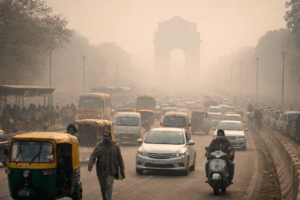
The sun is up over Delhi, but you wouldn’t know it. At 9 AM, the world ends a hundred meters away in a soupy, yellowish-gray void. Flights are delayed, car horns bleat nervously in the gloom, and a faint, acrid taste lingers in the air. The India Meteorological Department (IMD) has issued a yellow alert, warning residents of dense fog and “very poor” air quality with an AQI of 319. This isn’t a scene from a dystopian film; it’s a regular winter morning for over 30 million people in India’s capital, where meteorological fog and human-made smog have merged into a single, hazardous phenomenon.
The Daily Disruption: Life in the Haze
The data paints a stark picture of a city grinding to a halt. On the morning of February 4, 2026, visibility at both Palam and Safdarjung—Delhi’s primary weather stations—plummeted to just 100 meters. For airline passengers, this meant cancellations and indefinite delays as airport authorities scrambled. For millions of commuters, it translated into perilous, snail-paced journeys on roads and highways.
While the dense fog is a natural winter occurrence in the Indo-Gangetic plains, what makes Delhi’s situation particularly dangerous is the toxic cocktail it traps. On this day, the Air Quality Index (AQI), which measures pollutants like PM2.5 and PM10, settled deep in the “very poor” category (301-400). Neighbourhood-level readings were even more alarming, with areas like Anand Vihar recording an AQI of 334 and Chandni Chowk at 324. These microscopic particles, 1/30th the width of a human hair, bypass the body’s natural defenses, embedding deep in lung tissue and even entering the bloodstream.
The human response is a mix of resignation and adaptation. Schoolchildren are kept indoors during morning sports, outdoor workers tie cloth masks around their faces, and those with means retreat behind the whir of air purifiers. The city carries on, but at a cost measured in strained lungs, anxiety, and a pervasive sense of siege.
A City Divided: The Privilege of Clean Air
The burden of this crisis is not shared equally. As urban researcher Ivan Turok noted after visiting Delhi, the city is a tale of two realities. On one hand, there are privileged enclaves like the redeveloped Kidwai Nagar—a government complex with 75 towers featuring its own sewage treatment, solar panels, and internal parks. The smallest apartment here is triple the size of the largest home in the resettlement colonies.
Contrast this with Madanpur Khadar, a resettlement colony in eastern Delhi where between 20-40% of the city’s population lives in informal settlements. Here, narrow alleyways limit light and ventilation, open drainage channels overflow, and the lack of centralized waste collection leads to fly-tipping. A nearby power station adds fly ash to the already toxic air. For residents here—many of whom work outdoors as street vendors, security guards, or domestic help—escaping the smog is not an option. They cannot work from home, invest in air purifiers, or relocate.
This inequality is starkly visible in health outcomes. A doctor from Sir Ganga Ram Hospital reported that three decades ago, most lung cancer patients were male smokers in their 60s. Today, a significant number are non-smokers, about 40% are women, and roughly 10% are in their 30s and 40s. In the lungs of teenage patients, doctors now find black deposits that would have been “unthinkable” a generation ago.
The Human Toll: Stories of an Exodus
For a growing number of Delhi’s professional class, the recurring winter emergency has become a breaking point. They are making a painful choice: leave.
Saurabh Bhasin, a corporate lawyer who loved Delhi’s winters as a child, filed a Supreme Court petition in 2015 on behalf of his toddler to ban firecrackers. When his daughter was diagnosed with asthma in November 2022, the family’s decision was made. They moved to Goa, 2,000 kilometers away, trading careers and community for the hope of healthier lungs. “We know that bringing her to Goa doesn’t mean her asthma will go away,” Bhasin says. “But we are sure that had we kept her in Delhi, the chances of it getting worse would have been much higher”.
He is not alone. Rekha Mathur (name changed) relocates seasonally to Dehradun with her baby each winter, separating the family as her husband stays in Delhi for work. Journalist Om Thanvi moved to Rajasthan in 2018 and found he no longer needed his inhaler. A 2022 study by the University of Chicago delivered a chilling statistic: air pollution can shorten the lives of Delhi’s residents by almost ten years.
These “smog refugees” represent a tiny, affluent fraction. For the vast majority, like Sarita Devi, who irons clothes for a living outdoors, leaving is not an option. “I can’t go back to Patna because I can’t earn money there,” she says. “And even if I did go, it wouldn’t change much… the air there was equally hazy”.
Sources of the Smog: A Complex Culprit
Untangling Delhi’s pollution reveals a web of contributors that extends far beyond the city limits. Real-time data from the Decision Support System shows that on a typical winter day:
- Transport contributes up to 13.1%
- Industries in Delhi and peripheries account for 11.3%
- Residential sources (like heating and cooking) add 3.3%
Significantly, the wind carries pollution from neighboring regions. On some days, districts like Sonipat can contribute around 15.1% to Delhi’s pollution load, with Jhajjar, Panipat, and Bahadurgarh following. A major historical culprit was the Badarpur Thermal Power Station. Though it produced only 8% of Delhi’s power, it was responsible for 80-90% of its particulate pollution before being permanently shut down in 2018.
Nationally, the sources are systemic:
- Over 50% from industry
- 27% from vehicles
- 17% from crop burning (the infamous post-harvest stubble burning in Punjab and Haryana)
- 7% from domestic cooking using biomass like wood, dung cakes, and charcoal
Policy and Perception: The Gap Between Standards and Safety
India’s fight against pollution is complicated by a significant gap between national standards and global health guidelines. The country’s National Ambient Air Quality Standards (NAAQS) set the annual average limit for PM2.5 at 40 micrograms per cubic meter.
The World Health Organization (WHO), based on the latest health research, recommends a safe limit of 5 micrograms per cubic meter. This means India’s legal “safe” limit is eight times higher than the WHO’s health-based guideline.
The government’s stance is that WHO guidelines are advisory, not legally binding, and that India’s unique geography—with natural dust from the Thar Desert and the Indo-Gangetic plains—creates a higher background level. The flagship National Clean Air Programme (NCAP) aims for a 40% reduction in particulate matter by 2026 in 131 cities. While this is a step forward, critics argue the pace and scale of action do not match the severity of the public health emergency.
The Forecast and The Path Forward
The immediate meteorological outlook offers little respite. The IMD forecasts that dense fog conditions will persist over northwest India, with potential rainfall around February 9-10 due to incoming western disturbances. AQI is predicted to remain “poor” before possibly improving to “moderate” by February 5-6.
Long-term solutions require acknowledging the crisis as a regional “airshed” problem, not confined by city boundaries. Experts advocate for:
- Regional airshed authorities to manage transboundary pollution.
- Integrated monitoring combining ground stations, sensors, and satellite data.
- Transparent, real-time public data to empower citizen action.
On the ground, organizations like Participatory Research in Asia (PRIA) are demonstrating that change is possible through community empowerment. By involving residents—especially youth and women—in monitoring local conditions and advocating for solutions like decentralized waste management, they turn neighborhoods “from zones of poverty and exclusion into domains of mobilisation”.
Delhi’s foggy mornings are a visible symptom of a deeper malaise. They represent a collision of climate, geography, unsustainable urbanization, and industrial growth. The true cost is measured not just in flight delays or poor visibility, but in the strained breaths of its children, the forced migrations of its families, and the silent, daily acceptance of a compromised life. Clearing the air will require more than a change in the wind; it demands a fundamental shift in policy, priority, and the political will to value public health over short-term gain. The future of the world’s largest metropolis depends on it.
You must be logged in to post a comment.