
Delhi’s Choking Winter: How Record Cold Traps a City in Toxic Air
Delhi’s record-breaking cold wave, with temperatures plunging to a three-year low of 2.9°C, has tragically exacerbated the city’s perennial air pollution crisis, trapping hazardous pollutants under a layer of warm air in a phenomenon known as temperature inversion and transforming the region into a sealed chamber of toxic smog with an AQI solidly in the “Very Poor” category above 350.
This winter spike is driven not by seasonal farm fires, whose contribution becomes negligible by December, but by a dangerous synergy of persistent local emissions—primarily from vehicles, industry, and construction—and calm winds that fail to disperse the pollution, which is now recognized as a regional “airshed” problem where over 65% of Delhi’s PM2.5 pollution originates from sources in neighboring NCR districts.
The human cost is severe, with hospitals reporting surges in respiratory illnesses and the air acting as a “slow poison,” particularly for vulnerable groups, underscoring that temporary fixes are inadequate and the solution requires aggressive, year-round action across the entire region to tackle the fundamental emission sources that make every winter a public health emergency.
Delhi’s Choking Winter: How Record Cold Traps a City in Toxic Air
The Record-Breaking Chill
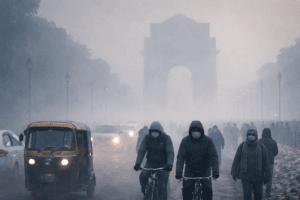
On a Thursday morning in mid-January, residents of Delhi awoke to a double assault. The mercury at the Safdarjung observatory, the city’s primary weather station, had plunged to 2.9 degrees Celsius, marking the coldest January morning in three years. Just west at Palam, it was even colder at 2.3°C, a low not seen since 2010. This bitter cold was cloaked in a dense, disorienting fog that reduced visibility at the airport to as low as 50 meters. More insidiously, the air itself had turned hazardous. Delhi’s overall Air Quality Index (AQI) hovered stubbornly around 352-357, solidly in the “Very Poor” category—a range where prolonged exposure can cause respiratory illness and seriously impact those with existing health conditions.
This pairing of extreme cold and extreme pollution is not a coincidence but a feature of Delhi’s modern winters. While much attention is paid to the visible plumes of stubble burning from neighboring states in October and November, a critical analysis reveals a more persistent and complex crisis. A recent study by the Centre for Science and Environment (CSE) found that air pollution in the National Capital Region (NCR) actually intensifies in December, long after the influence of farm fires has faded to nearly zero. This “post-stubble surge” forces a reckoning with the deeper, year-round sources of pollution that are locked in place by winter’s unique meteorological prison.
The Science of the Smog Trap: Why Cold Air is Dirty Air
The dramatic deterioration of Delhi’s air each winter is driven by fundamental atmospheric science. Several factors conspire to transform the region into a sealed pollution chamber.
- Temperature Inversion: Typically, air temperature decreases with altitude, allowing warmer, pollutant-laden air to rise and disperse. During a winter inversion, however, a layer of warmer air sits atop cooler, denser air near the ground. This acts like a massive atmospheric “lid,” trapping vehicles, industry, and domestic emissions at the level where people live and breathe.
- Stagnant Winds and the “Bowl Effect”: Winter in North India is characterized by slower, calmer wind patterns. Without strong air currents to disperse it, pollution simply accumulates over the city. Delhi’s geography exacerbates this: its landlocked, flat topography, bounded by the Himalayas to the north, creates a natural “bowl” that traps polluted air with nowhere to go.
- The Seasonal Shift in Sources: While winter weather traps the pollution, its sources shift significantly as the season progresses. The CSE analysis shows that in the “post-farm fire” period of December, the contribution of stubble burning to Delhi’s PM2.5 (the most harmful fine particles) plummets to a negligible 0.2%. Yet, average PM2.5 concentrations rose by 29% compared to the October-November period. This proves that local and regional urban sources—not agriculture—become the dominant drivers of the deepest winter smog.
Beyond Delhi’s Borders: An “Airshed” in Crisis
The pollution choking Delhi is not a city-specific problem but a regional epidemic. The CSE report frames it as an “airshed” issue, where air pollution disregards political boundaries and flows across the entire NCR. Data from the Indian Institute of Tropical Meteorology’s Decision Support System (DSS) for the first half of December reveals a startling breakdown: only about 35% of Delhi’s PM2.5 came from sources within the city itself. The overwhelming majority, 65%, was transported from neighboring NCR districts and beyond.
This regional nature of the crisis is evident in the pollution trends. During a severe smog episode in mid-December, while Delhi’s PM2.5 averaged a hazardous 343 µg/m³, the satellite city of Noida recorded an even higher 352 µg/m³. Smaller towns like Baghpat were also engulfed, showing the widespread nature of the winter pollution blanket.
Delhi’s Pollution: A Local and Regional Breakdown Pie chart illustrating that 65% of Delhi’s winter PM2.5 comes from regional sources outside the city, while 35% originates from local sources within Delhi.
Within Delhi’s 35% local contribution, the single largest source is vehicular emissions, accounting for nearly half of all local primary emissions. This is compounded by other urban activities: construction dust, industrial point sources, the open burning of waste, and the use of solid fuels for heating in the winter cold.
The Human Cost: A “Silent Genocide”
The clinical AQI numbers translate into a profound public health emergency. Doctors in the region report a 50% increase in patients with breathing problems during the winter months. The tiny PM2.5 particles, about 30 times thinner than a human hair, penetrate deep into the lungs and bloodstream, linked to severe respiratory and cardiovascular diseases, cognitive decline, and cancer.
- Health Impact: Air pollution has been described by health professionals as a “silent killer” and even “slow poison“. A 2022 report in The Lancet attributed 1.72 million deaths in India to air pollution from fossil fuels—a toll greater than deaths from terror attacks, riots, epidemics, and natural disasters combined.
- Vulnerable Groups: The “Very Poor” AQI category explicitly warns of serious impacts for vulnerable groups, which include children, the elderly, and those with pre-existing conditions. It is estimated that poor air quality has irreversibly damaged the lungs of 2.2 million children in Delhi.
As activist Bhavreen Kandhari starkly put it, “The air is absolutely poison”. For residents, the advice from medical professionals like Dr. Alok Ranjan in Ghaziabad is tragically simple and impossible: “All I can say is stay away from bad air, but that’s not possible”.
Looking Ahead: From Temporary Fixes to Systemic Solutions
Government responses have often been reactive and temporary—banning certain vehicles, halting construction, and deploying water sprinkler trucks when AQI levels cross a threshold. These measures, criticized as “miserably inadequate,” do little to address the root causes. The CSE analysis concludes that air quality goals “cannot be met without aggressive, year-round action against urban and regional emission sources”.
This requires a fundamental shift in strategy:
- Airshed-Level Management: Treating the NCR as a single pollution entity with coordinated policy across state lines.
- Zero-Emissions Transition: Aggressively accelerating the shift to electric public transport, cleaning up industrial and power plant emissions, and managing construction and waste without burning.
- Addressing Secondary Particles: A major finding is that much of Delhi’s PM2.5 is composed of secondary particles formed in the atmosphere from precursor gases. This means policies must target not just visible dust and smoke, but also the invisible gases from vehicles and industry that chemically transform into deadly particulates.
Conclusion: A Crisis Beyond the Cold Snap
The cold wave will eventually break. The IMD forecasts that a western disturbance will push temperatures up slightly in the coming days. However, the reprieve from the cold will not mean a reprieve from toxic air. The Air Quality Early Warning System predicts air quality will remain in the “Very Poor” category for at least the next six days, with a risk of slipping into “Severe”.
The record-low temperature of January 2026 has therefore served as a stark magnifying glass, highlighting a truth that persists year-round but becomes undeniable in winter: Delhi’s air pollution is a chronic, structural crisis. It is sustained by the region’s daily economic activities and locked in place by seasonal meteorology. Solving it demands moving beyond blaming seasonal farm fires or awaiting favorable winds. It requires a sustained, scientific, and collective war on emissions from every sector, recognizing that the air over Delhi is a shared resource—and currently, a shared poison. The city’s future habitability depends on this recognition turning into decisive, uninterrupted action.
You must be logged in to post a comment.