
Delhi’s Chilled Welcome to 2026: A Perfect Storm of Record Cold, Toxic Air, and Travel Chaos
Delhi’s Chilled Welcome to 2026: A Perfect Storm of Record Cold, Toxic Air, and Travel Chaos
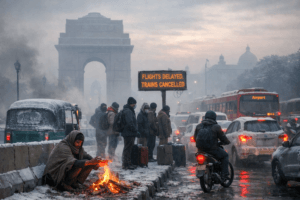
Delhi’s Air Quality Index (AQI) on New Year’s Day 2026 was 382, firmly in the “very poor” category, while the maximum temperature plummeted to 14.2°C—marking the coldest December day in six years and disrupting over 148 flights. As the national capital and its surrounding regions shivered into the new year, residents confronted a triple threat of severe meteorological conditions: a historic cold snap, dangerously polluted air, and widespread fog-induced travel paralysis. This convergence was not merely a day of bad weather but a revealing stress test on the city’s infrastructure, public health, and the daily lives of millions.
The Scene on New Year’s Day
The first morning of 2026 dawned not with hope and sunshine, but with a dense, greyish-white blanket. Visibility in many parts of the city and at the Indira Gandhi International Airport (IGI) dropped dramatically, at times to as low as 50 meters, transforming familiar landmarks into faint shadows. This was no ordinary winter fog; it was a persistent smog cocktail—a mix of meteorological fog and trapped anthropogenic pollutants—that refused to lift even during daytime hours.
The India Meteorological Department (IMD) had forecast this grim scenario: a generally cloudy sky with the possibility of very light rain, accompanied by moderate to dense fog during the morning. However, the reality proved more severe. The maximum temperature struggled to reach 14.2°C, a staggering 6.2 degrees below the normal for this time of year. This wasn’t just a cold day; by IMD’s classification, it met the criteria for a “severe cold day” in several locations, including Palam and Lodhi Road, where maximum temperatures were more than 6.5°C below normal. The city found itself locked in a cold, stagnant air mass, a fittingly frigid climax to a year that had seen notable weather extremes.
A Cold Snap for the History Books
To understand the significance of January 1, 2026, one must look at the preceding day. December 31, 2025, carved its place in Delhi’s weather history as the coldest December day recorded in six years. The last time the capital experienced a lower maximum temperature in December was on the same date in 2019, when it dropped to 9.4°C.
Table: Delhi’s Recent History of Cold December Days
| Date | Maximum Temperature | Deviation from Normal | Significance |
| Dec 31, 2025 | 14.2°C | 6.2°C below normal | Coldest December day since 2019. |
| Dec 31, 2019 | 9.4°C | Not specified | Previous record-holder for low December maximum. |
| Dec 20, 2025 | 16.9°C | Below normal | The season’s first official “cold day”. |
The phenomenon was widespread. While Delhi endured “cold” to “severe cold day” conditions, the winter chill had a firm grip on much of North India. Fresh snowfall blanketed the higher reaches of Kashmir, including tourist hotspots like Gulmarg and Sonamarg, while Himachal Pradesh saw mild snowfall in its elevated districts. Interestingly, even Kolkata in the east reported unusually cold conditions, with minimum temperatures dipping below 10°C.
The Making of a Perfect Storm
Several interconnected meteorological factors conspired to create this severe weather episode. Mahesh Palawat of Skymet Weather explained that an active western disturbance—a storm system originating from the Mediterranean region—interacted with easterly winds from the Bay of Bengal. This combination pumped significant moisture into the northwestern plains of India.
The results were twofold:
- Persistent Fog Formation: The high humidity levels, reportedly over 80% during the day on December 31, provided ample moisture for the formation of a thick, dense fog layer. Unlike typical fog that dissipates by mid-morning, this layer was continuously fed and sustained.
- Suppressed Daytime Heating: A layer of upper-level clouds associated with the weather system acted like a lid. It blocked sunshine from reaching the surface, preventing the normal daytime heating that would help break up the fog and lift the chill. This created a self-perpetuating cycle of cold and gloom.
Furthermore, the air quality crisis was both a cause and a consequence of these conditions. On New Year’s morning, the overall AQI was recorded at 372, with eight monitoring stations, including Anand Vihar (AQI 421), tipping into the “severe” category. The CPCB classifies an AQI between 301-400 as “very poor,” and 401-500 as “severe,” posing health risks to all residents.
The stagnant weather was the worst possible scenario for pollution dispersion. Officials cited a low ventilation index and weak wind speeds (below 10 kmph) as the primary reasons pollutants—from vehicles, industry, and other sources—remained trapped near the ground. The fog and smog became indistinguishable, creating a toxic haze that lingered for days. The Air Quality Early Warning System predicted that “very poor” air would persist for at least the next six days.
Travel and Transportation Grind to a Halt
The human and economic impact of this weather convergence was most starkly visible in the chaos that engulfed Delhi’s transportation networks. The aviation sector bore the brunt.
Table: Progression of Fog-Induced Travel Disruption
| Timeline | Event | Impact |
| Dec 31, 2025 | Dense fog reduces visibility to ~50m at IGI Airport. | CAT-III landing protocols activated. 148 flights cancelled (78 arrivals, 70 departures), over 150 delayed. |
| Jan 1, 2026 | Continued low visibility (~500m at 8 AM). | Airlines issue proactive advisories. Cascading delays affect schedules nationwide. |
| Pre-emptive Action | DGCA’s official “fog window” (Dec 10, 2025 – Feb 10, 2026) in effect. | Airlines like Air India offer “Fog Care” services for rescheduling/refunds. |
The airport authority and major airlines like IndiGo, Air India, and SpiceJet were forced to issue repeated advisories, urging passengers to check their flight status before heading to the airport. The cascading effect of initial delays and cancellations rippled across the national air network, causing logistical nightmares for thousands of travelers.
The disruption was not limited to the skies. Road travel became perilous as visibility dropped on highways, while over 100 trains under the Northern Railways’ Delhi division were delayed, compounding the New Year travel misery for millions.
Looking Ahead: What January 2026 Holds for Delhi-NCR
If the first day is an indicator, January 2026 is shaping up to be a definitive winter month for the capital region. According to IMD forecasts, the dominant themes for the coming weeks will be persistent fog, cold nights, and continued air quality challenges.
- Fog-Dominated Mornings: Moderate to dense fog is likely to persist during night and early morning hours through much of January, with the first half of the month expected to see more intense conditions. This will continue to affect visibility for commuters and travelers.
- Temperature Trends: While daytime maximum temperatures are expected to hover near normal levels (in the high teens to low twenties), frequent cloud cover may keep afternoons feeling cooler. The more significant concern is the minimum temperature, which is predicted to remain low, especially during the first two weeks of January. The IMD has indicated that colder northerly winds from the Himalayas are likely to sweep into the region around January 3, potentially deepening the chill.
- Limited Rainfall Relief: The forecast suggests only limited rainfall activity for the month. Any precipitation will likely be light and linked to weak western disturbances, which may temporarily increase cloud cover and even intensify fog conditions.
- Air Quality Outlook: The meteorological conditions are not favorable for pollution dispersion. The IMD notes that air quality is likely to fluctuate between “poor” and “very poor” on many days, with only short-lived improvements possible during windy spells or after light rain.
Navigating the Winter: Guidance for Residents
Facing such prolonged periods of severe weather requires proactive measures. Based on the forecasts and current conditions, here is practical guidance for Delhi-NCR residents:
- Health First: The combination of cold and “very poor” air quality poses serious risks, especially for children, the elderly, and those with respiratory or cardiovascular conditions. Minimize outdoor activities during early morning and late evening hours when pollution and cold are at their peak. Use N95 or N99 masks effectively when going outside.
- Travel Smart: If you have travel plans, especially by air, in the coming weeks, stay in constant touch with your airline. Monitor flight status via official apps or websites before leaving for the airport. Consider travel insurance that covers weather-related disruptions. For road travel, check real-time visibility and traffic updates, use fog lights, and maintain safe speeds.
- Prepare Your Home: Ensure adequate heating is available. Seal drafts around windows and doors to keep the cold out. Use air purifiers indoors to create a cleaner air sanctuary, especially in bedrooms.
- Stay Informed: Rely on official sources like the India Meteorological Department (IMD) and the Central Pollution Control Board (CPCB) for forecasts and AQI updates. Avoid spreading unverified weather predictions or pollution data.
Conclusion: More Than Just a Cold Snap
Delhi‘s frigid and foggy entry into 2026 is a potent reminder of the complex environmental challenges facing megacities. It is a story where natural weather patterns intersect with human-made pollution, creating crises that disrupt economies, endanger health, and diminish quality of life. While the current cold spell will eventually pass, the underlying issues of air pollution and urban vulnerability to climate variability remain.
The days ahead will test the resilience of the city’s infrastructure and the adaptability of its people. As Delhi navigates this cold, polluted haze, the event underscores an urgent need for sustained, year-round action on clean air and robust urban planning that can withstand the growing volatility of weather in an era of climate change. The frost on the windowpane is clear, but the path to a clearer, healthier winter remains obscured.
You must be logged in to post a comment.