
Delhi’s Air Quality Crisis: GRAP Revisions and a City Struggling to Breathe
In response to persistently ‘severe’ to ‘very poor’ air quality, with AQI levels soaring above 400 in Delhi-NCR hotspots like Anand Vihar and Bawana, authorities have fundamentally restructured the Graded Response Action Plan (GRAP) by shifting measures from Stage IV to Stage III, effectively normalizing extreme pollution responses.
This revision allows state governments to implement previously worst-case scenario actions—such as permitting 50% capacity in offices and work-from-home arrangements—sooner, while also moving other restrictions to lower alert levels in a bid for more proactive intervention. The crisis, fueled by a combination of vehicular emissions, industrial pollution, construction dust, and agricultural stubble burning, has created a public health emergency, leading to canceled outdoor sports events, increased respiratory illnesses, and significant disruption to daily life amid dense, hazardous smog.
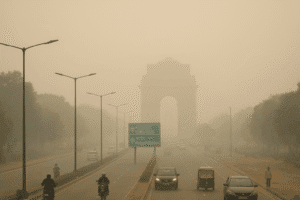
Delhi’s Air Quality Crisis: GRAP Revisions and a City Struggling to Breathe
Image: Toxic smog envelops Delhi’s landmarks, a visible sign of the air quality crisis. (PTI)
Introduction: A City Choking on Smog
Delhi’s air quality has deteriorated to alarming levels, with the Air Quality Index (AQI) consistently registering in the ‘severe’ to ‘very poor’ range across multiple monitoring stations. On recent readings, key areas including Anand Vihar (AQI 422), Bawana (AQI 419), and Ashok Vihar (AQI 403) recorded levels far exceeding safe limits, creating a public health emergency that affects millions of residents. The Commission for Air Quality Management (CAQM) has responded by implementing significant revisions to the Graded Response Action Plan (GRAP), moving measures previously reserved for the most severe pollution levels to less stringent categories, indicating a troubling normalization of extreme pollution in the National Capital Region (NCR).
GRAP Revisions: What’s Changed and What It Means
The Commission for Air Quality Management has implemented crucial revisions to the Graded Response Action Plan that fundamentally change how Delhi-NCR responds to deteriorating air quality.
Key Changes to the GRAP Structure
- Measures under GRAP Stage IV have been shifted to GRAP Stage III: This means actions previously reserved for when the AQI crosses 500 are now implemented when the AQI reaches the ‘severe’ category (401-500)
- GRAP Stage III measures have been moved to GRAP Stage II: Restrictions that previously required AQI levels of 401-500 now take effect at the ‘very poor’ level (301-400)
- GRAP Stage II measures have been shifted to GRAP Stage I: Early intervention measures are now implemented at even lower pollution thresholds
Specific Measures Under Revised GRAP
Under the new GRAP Stage III (previously Stage IV):
- NCR State Governments/GNCTD can decide whether public, municipal, and private offices operate at 50% strength
- The remaining employees would be expected to work from home
- Central Government may permit work from home for employees in central government offices
Under the new GRAP Stage I (previously Stage II):
- Ensure uninterrupted power supply to discourage use of power-generating sets
- Synchronize traffic movements and deploy adequate personnel at intersections
- Issue alerts through media about pollution levels and necessary precautions
- Augment public transport services through additional CNG/electric buses and metro services
Under the new GRAP Stage II (previously Stage III):
- Stagger timings for public offices and municipal bodies in Delhi and districts of Gurugram, Faridabad, Ghaziabad, and Gautam Budh Nagar
- State Governments may decide to stagger timings for public offices in other NCR areas
- Central Government may decide on staggering timings of Central Government offices in Delhi-NCR
The Current Air Quality Crisis: By the Numbers
Delhi’s air quality has shown consistent deterioration, with slight fluctuations influenced by weather conditions. Recent data reveals the extent of the crisis:
Delhi Hotspots (Recent Readings)
- Bawana: 460 AQI (‘Severe’)
- Chandni Chowk: 455 AQI (‘Severe’)
- Wazirpur: 452 AQI (‘Severe’)
- Rohini: 447 AQI (‘Severe’)
- RK Puram: 440 AQI (‘Severe’)
- Anand Vihar: 431 AQI (‘Severe’)
- ITO Area: 438 AQI (‘Severe’)
- India Gate: 370 AQI (‘Very Poor’)
- IGI Airport: 296 AQI (‘Poor’)
NCR Regions
- Noida (Sector 125): 434 AQI (‘Severe’)
- Greater Noida: 294-393 AQI (‘Poor’ to ‘Very Poor’)
- Gurugram (Sector 51): 323 AQI (‘Very Poor’)
- Gurugram (Teri Gram): 212 AQI (‘Poor’)
- Gurugram (NISE Gwal Pahari): 312 AQI (‘Very Poor’)
Understanding the AQI Scale and Health Implications
The Air Quality Index converts complex data on various pollutants including PM2.5, PM10, nitrogen dioxide, sulfur dioxide, carbon monoxide, and ozone into a single number that indicates air quality conditions.
AQI Categories and Health Impacts
| AQI Range | Category | Health Implications |
| 0-50 | Good | Minimal impact |
| 51-100 | Satisfactory | Minor discomfort to sensitive people |
| 101-200 | Moderate | Breathing discomfort to people with lung disease, asthma, and heart conditions |
| 201-300 | Poor | Breathing discomfort to most people on prolonged exposure |
| 301-400 | Very Poor | Respiratory illness on prolonged exposure |
| 401-500 | Severe | Affects healthy people and seriously impacts those with existing diseases |
According to health experts, the current pollution levels pose serious health risks to all residents, not just vulnerable groups. Dr. Anant Mohan, head of pulmonary medicine at the All India Institute of Medical Sciences, warns that “environmental pollution will affect every organ of the body. It can affect any age, even before birth, right up to the end of life.”
Why Is Delhi’s Air So Toxic? The Complex Causes
Delhi’s air pollution crisis stems from multiple interconnected factors that create a perfect storm of toxic air, particularly during winter months.
Primary Pollution Sources
- Vehicular Emissions: Contribute approximately 20% of PM2.5 pollution and 36% of NOx emissions in Delhi, with the situation exacerbated by Delhi having “more cars than the sum of vehicles in Chennai, Mumbai and Kolkata”
- Agricultural Stubble Burning: The practice of burning crop residue in neighboring states of Punjab and Haryana during October-November can contribute up to 45% of Delhi’s pollution during peak burning seasons
- Construction and Road Dust: Accounts for 38% of PM2.5 pollution and 56% of PM10 pollution in the city
- Industrial Emissions: Responsible for 11% of PM2.5 pollution, 10% of PM10, and a significant 52% of NOx emissions
- Weather Conditions: Falling temperatures and slow wind speeds create inversion layers that trap pollutants close to the ground, preventing their dispersion
- Local Biomass Burning: Despite Delhi being kerosene-free with 90% households using LPG for cooking, the remaining 10% using wood, crop residue, cow dung, and coal for cooking contributes to the problem
The Human Impact: Stories from the Ground
The severe air quality isn’t just a statistical concern—it’s dramatically affecting daily life for Delhi’s residents.
Health Consequences
Doctors in Delhi report increased cases of respiratory distress, with hospitals seeing more patients with asthma, bronchitis, and other pollution-related illnesses. The situation has become so dire that Dr. Tilotama, a physician who joined recent protests, stated that “Living in Delhi at this time of the year will take away years from your life, that is a fact, it’s not contested.”
Psychological and Social Impact
Protesters at recent demonstrations express growing frustration with the persistent crisis. Bhavreen Kandhari, founder of the collective Warrior Moms, notes that “Every family, I think, has a case where a child is sick or an elder is sick, or you’re suffering,” adding that pregnant women are having anxiety attacks during high-pollution nights .
One long-time resident summarized the feeling of many: “I’ve been living in Delhi for the past four decades; this is the worst year I’ve seen.”
Impact on Daily Activities
The Delhi High Court has ordered cancellation of all outdoor sports events, recognizing the danger to children’s health. As one local resident expressed, “What can I even say? Coming out is becoming difficult, people are getting sick, it is difficult to go to the park, can’t even go to the market. We are very troubled.”
Government Response and Controversies
GRAP as an Emergency Measure
The Graded Response Action Plan serves as an emergency response mechanism for the entire NCR, based on average AQI levels and meteorological forecasts. According to official releases, “GRAP for NCR has been formulated after careful consideration of scientific data, stakeholder consultations, expert recommendations, along with field experience and learnings in the past years.”
Data Reporting Controversies
A significant controversy surrounds how air pollution data is reported in India. Unlike international trackers like IQAir that show AQI numbers often shooting past 600 and even crossing 1,000 on some days, India’s official AQI scale stops at 500 .
Gufran Beig, founder director of SAFAR (one of India’s official air quality monitoring systems), explains that the 500 cap was originally set “to avoid creating panic as crossing that mark signalled an alarming situation requiring immediate mitigation.” However, this approach “effectively flattens the data—anything above 500 is treated the same on official monitors, even if the real concentration is far higher.”
Judicial Intervention
The Supreme Court has taken note of the crisis, directing the governments of Punjab and Haryana to file status reports on measures taken to curb stubble burning. The court has also ordered that construction workers who have been out of work due to GRAP-III restrictions must be provided with a subsistence allowance .
Comparative Analysis: Delhi vs. Gurugram
While Delhi’s pollution often makes headlines, neighboring Gurugram faces equally severe challenges. Recent data shows Gurugram’s Sector 51 recording an AQI of 323 (‘Very Poor’), while TERI Gram reported 212 (‘Poor’) . Gurugram actually earned the dubious distinction of being ranked the world’s most polluted city in the 2018 IQAir AirVisual’s World Air Quality Report .
Gurugram’s pollution stems from similar sources as Delhi, with some unique local factors:
- Dust from intensive construction activities as the city develops rapidly
- Transportation-related emissions without the CNG requirements that Delhi has for public transport
- Diesel generators without sufficient government restrictions on their use
Long-term Solutions and Challenges
National Clean Air Program (NCAP)
Indian authorities have launched the NCAP (National Clean Air Program) with the goal of reducing pollution by 20-30% in 102 of the country’s most polluted cities by 2024. The program aims to reduce transport and industrial emissions, lower dust pollution, and implement rules limiting biomass burning .
Systemic Challenges
Effective pollution control requires addressing complex, interconnected issues:
- Improving public transportation to reduce vehicular emissions
- Regulating industrial pollution more effectively
- Finding alternatives to stubble burning through farmer support and technology
- Controlling construction dust through better practices and enforcement
- Addressing the limitations of current monitoring systems
As environmentalist Vimlendu Jha notes, “Most of the air quality monitors are shut down at the peak levels of pollution. We do not even know what sort of an emergency we are living in.”
Protecting Yourself: What Residents Can Do
While systemic solutions are essential, individuals can take steps to reduce personal risk:
- Monitor reliable air quality data from multiple sources, understanding the differences between reporting systems
- Use high-quality N95/N99 masks when outdoors during high pollution periods
- Limit outdoor exercise and strenuous activities, especially during early morning and late evening when pollution levels tend to be highest
- Create clean air spaces at home using air purifiers with HEPA filters
- Seek medical attention promptly for respiratory symptoms that worsen during high pollution periods
Conclusion: A Tipping Point for Delhi’s Air
Delhi’s air pollution crisis represents more than an environmental issue—it’s a public health emergency affecting every aspect of life in the region. The recent revisions to GRAP measures acknowledge the persistent severity of the problem, but also risk normalizing pollution levels that would be considered catastrophic in most parts of the world.
As protests grow and residents increasingly demand their right to breathe clean air, the pressure on governments and regulatory bodies intensifies. The situation represents a critical test for India’s environmental governance—one that will determine whether the country can balance rapid development with the fundamental health needs of its people.
The path forward requires genuine political will, systemic changes across multiple sectors, and technological innovations—not just emergency measures when pollution reaches catastrophic levels. Without comprehensive action, Delhi and its surrounding regions face the prospect of this toxic annual cycle becoming a permanent fixture, with incalculable costs to public health and quality of life.
You must be logged in to post a comment.