
Delhi Weather Disruption: How Rain, Thunderstorms, and Gusty Winds Are Reshaping Air Travel Across Northern India
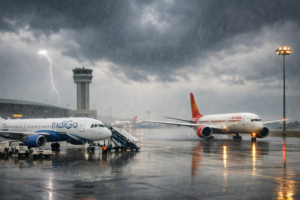
Heavy rain, thunderstorms, and gusty winds prompted IndiGo and Air India to issue travel advisories for Delhi and parts of northern India on Thursday, warning of possible flight disruptions and advising passengers to check flight status and allow extra travel time. The India Meteorological Department recorded light to moderate rainfall across the capital—with Janakpuri receiving the highest 12.5 mm—and issued a yellow alert forecasting continued showers accompanied by lightning and winds of 30–40 km/h, as the minimum temperature settled at 17.6°C, slightly above the seasonal average.
Delhi Weather Disruption: How Rain, Thunderstorms, and Gusty Winds Are Reshaping Air Travel Across Northern India
As unseasonal weather batters the national capital region, passengers face flight delays, operational challenges, and a stark reminder of aviation’s vulnerability to nature’s whims.
The skies over Delhi have turned restless. What began as a routine Thursday morning for air travelers across northern India quickly transformed into a test of patience and contingency planning as the India Meteorological Department’s yellow alert materialized into very real disruptions. IndiGo and Air India, the country’s two largest carriers, moved swiftly to issue travel advisories, warning passengers that rain, thunderstorms, and gusty winds were poised to throw flight schedules into disarray.
For the thousands of passengers who pass through Delhi’s Indira Gandhi International Airport daily—one of the busiest aviation hubs in South Asia—the advisories represented more than just routine caution. They signaled a cascading series of potential headaches: delayed departures, missed connections, stranded luggage, and the distinct possibility of spending more time navigating airport terminals than actual flight time.
The Weather System Moving In
The meteorological setup driving this disruption is worth understanding. According to IMD data, parts of Delhi received light rainfall over the preceding 24 hours, with Janakpuri recording the highest accumulation at 12.5 millimeters. Safdarjung and Lodhi Road each recorded 8.2 millimeters, while the Ridge station measured 8.6 millimeters and Palam logged 6.2 millimeters. Ayanagar recorded 7.2 millimeters, Pitampura 5.5 millimeters, and Mayur Vihar 3 millimeters—numbers that, on their own, might seem modest, but when combined with the forecast of thunderstorms accompanied by lightning and gusty winds reaching 30–40 kilometers per hour, paint a more concerning picture for aviation operations.
The temperature profile added another layer of complexity. Delhi’s minimum temperature settled at 17.6 degrees Celsius, 1.1 notches above the seasonal average, while the maximum was expected to hover around 29 degrees Celsius. This thermal instability—the gap between surface temperatures and cooler upper atmospheres—creates precisely the conditions that fuel thunderstorm development, particularly during the transitional periods between seasons.
What Airlines Are Telling Passengers
IndiGo’s advisory, posted on X (formerly Twitter), struck a characteristically direct tone while acknowledging the operational reality: “With thundershower expected to pass over #Delhi and #Bangalore, departures and arrivals may be slightly impacted. While our teams are preparing well in advance to keep things running smoothly, the weather may slow things down a touch.”
The phrasing—”slow things down a touch”—belies a more complex operational reality. For airlines, thunderstorms create a cascade of decisions that ripple across their networks. Pilots require longer separation distances between aircraft during reduced visibility conditions. Crosswinds and wind shear—sudden changes in wind speed or direction—can make landings unsafe, forcing aircraft to circle, divert to alternate airports, or delay departures until conditions improve.
Air India’s advisory was similarly cautious, citing “persistent rain and gusty winds forecast in Delhi and parts of northern India” that could disrupt flight operations to and from the capital and several other cities. Both airlines emphasized the same practical advice: check flight status before heading to the airport, and plan for possible delays not just in the air, but on the ground as well, with road traffic expected to be affected.
The Human Impact Behind the Operational Alerts
Behind the advisories and weather bulletins lie thousands of individual travel plans hanging in the balance. The businessman who scheduled back-to-back meetings in Mumbai, arriving late Thursday evening to close a quarter-end deal. The family heading to their first international vacation in years, navigating connecting flights with young children in tow. The medical traveler rushing to consult a specialist, whose appointment schedule leaves no room for weather-induced delays.
For these passengers, the airline advisories are a double-edged notification. They provide necessary warning and the opportunity to proactively adjust plans—but they also introduce a layer of uncertainty that no traveler welcomes. The advice to “allow extra time for travel” translates to earlier wake-up calls, longer waits at security checkpoints, and the creeping anxiety that even the most carefully planned itinerary may unravel.
What makes this particular weather event significant is not its severity in absolute terms—Delhi has weathered far more intense storms—but its timing. March typically represents a transitional month in Delhi’s meteorological calendar, when winter’s chill gives way to spring warmth. Thunderstorms during this period, while not unusual, can catch travelers off guard who have become accustomed to the relatively predictable flying conditions of the winter months.
The Aviation Industry’s Weather Management Challenge
For airlines operating in India, weather-related disruptions have become an increasingly critical operational consideration. The country’s diverse climate zones—from the fog-prone northern plains in winter to the monsoon-soaked western coast and the storm-prone eastern regions—create year-round challenges that require sophisticated planning and real-time decision-making.
Delhi’s IGI Airport, as the country’s primary aviation gateway, faces particular pressure during weather events. With a single runway configuration that has historically created bottlenecks during peak hours, any disruption to arrival or departure rates quickly compounds. When thunderstorms reduce runway capacity, the effects radiate outward: flights scheduled to land in Delhi are held at their origins, connecting passengers miss their onward journeys, and the intricate choreography of aircraft, crew, and ground staff realignments must be recalibrated on the fly.
IndiGo’s mention that “our teams are preparing well in advance to keep things running smoothly” hints at this behind-the-scenes effort. Airlines employ dedicated meteorologists who track developing weather systems and model their potential impacts on flight operations. Ground crews preposition equipment and personnel. Operations centers begin scenario planning hours before the first raindrop falls, making decisions about which flights might be most vulnerable and where to position spare aircraft to minimize cascading delays.
Passenger Rights and Responsibilities
For travelers navigating Thursday’s disruptions, understanding the distinction between weather-related delays and those within airline control carries practical significance. In India, weather events fall under the category of “extraordinary circumstances” under aviation regulations, meaning airlines’ obligations regarding compensation differ from situations where delays stem from operational or commercial decisions.
However, the fundamental responsibility to provide care—refreshments, meals, and if necessary, overnight accommodation—remains even during weather disruptions, particularly for delays that extend beyond specified durations. Passengers holding tickets on affected flights would do well to familiarize themselves with their carriers’ specific policies, which are typically outlined in their conditions of carriage.
The practical advice from both airlines—checking flight status before departing for the airport—is not merely a procedural suggestion but a genuine time-saver. In an era of hyperconnected travel, airline mobile apps and websites provide real-time updates that can help passengers make informed decisions about when to leave home, whether to request schedule changes before arriving at the terminal, and how to plan for potential delays.
The Broader Infrastructure Question
Thursday’s weather event raises longer-term questions about aviation infrastructure resilience in the face of changing weather patterns. India’s major airports, including Delhi, have invested significantly in instrument landing systems, runway lighting, and ground radar that improve operational reliability during adverse conditions. Yet thunderstorms remain uniquely challenging because their effects extend beyond visibility to fundamental aviation safety concerns.
The wind shear phenomenon—which occurs when there are sudden, dramatic changes in wind speed or direction near the ground—has been responsible for some of aviation’s most serious accidents globally. Modern aircraft are equipped with wind shear detection systems, and pilots receive specialized training to recognize and escape these conditions, but the operational response remains conservative: when wind shear is detected or forecast, departures and arrivals are delayed until conditions stabilize.
This safety-first approach explains why what appears to passengers as “just some rain and wind” can translate to hours of delays. The thresholds for safe operations are not subjective; they are derived from rigorous aerodynamic analysis and enshrined in aircraft flight manuals, airline standard operating procedures, and regulatory requirements.
Navigating the Disruption
For passengers traveling through Delhi on Thursday and potentially into the weekend as the weather system moves through, a few practical strategies can ease the experience. Beyond checking flight status, booking seats closer to the front of the aircraft can help with more efficient deplaning if arrival delays are expected. Carrying essential medications, chargers, and a change of clothes in carry-on luggage provides peace of mind in case checked bags are delayed in connecting through disrupted hubs.
Travel insurance, often overlooked by domestic passengers, proves its worth during weather-related disruptions. Policies that cover trip interruption, missed connections, and accommodation expenses can transform a weather-induced travel headache from a financial burden into a manageable inconvenience.
Perhaps most importantly, maintaining perspective helps. The delays that frustrate passengers are rooted in safety decisions made by pilots and airlines who face no greater priority than ensuring every flight arrives safely. The thunderstorms moving through Delhi will pass, schedules will normalize, and the disruptions—inconvenient as they are—represent the aviation system functioning as designed: prioritizing safety over schedule adherence when conditions demand it.
Looking Ahead
As Thursday progresses and the weather system continues its trajectory, passengers and airlines alike will be watching closely. The yellow alert issued by IMD suggests conditions warrant caution but remain within manageable parameters for a well-prepared aviation system. For travelers whose plans have been affected, the coming hours will test patience and flexibility—qualities that, while rarely packed alongside luggage, prove essential to navigating air travel’s inherent uncertainties.
The broader lesson from this weather event is one that frequent flyers know well: in aviation, the schedule is always subject to forces beyond human control. The same clouds that bring welcome rain to Delhi’s parks and gardens also bring temporary disruption to its runways. For passengers, the art of travel increasingly involves not just planning efficient itineraries, but cultivating the resilience to adapt when the weather, in its unpredictable wisdom, decides to rewrite them.
You must be logged in to post a comment.