
Delhi Wakes to Clearer Skies: A Temporary Respite or a Turning Point in the Winter Pollution Crisis?
On December 25th, Delhi witnessed a marginal improvement in its severe air pollution crisis, with the overall Air Quality Index (AQI) moving from ‘severe’ to ‘very poor’ and ‘poor’ categories, accompanied by significantly improved visibility due to reduced fog—a temporary relief driven by favorable meteorological conditions like increased wind speed. However, much of North India remained gripped by dense fog and cold waves, severely impacting visibility and daily life in cities like Kanpur, Ayodhya, and Ambala, while the Himalayan region braced for incoming snowfall. This divergence underscores that Delhi’s slight reprieve was a weather-dependent lull in a persistent anthropogenic pollution problem, not a systemic solution, with the underlying emissions from vehicles, industry, and agriculture poised to smother the region again once the wind dies down.
Delhi Wakes to Clearer Skies: A Temporary Respite or a Turning Point in the Winter Pollution Crisis?
A Glimpse of Blue: The Morning Delhi Breathed (Slightly) Easier
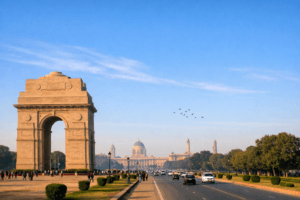
For the first time in weeks, residents of India’s capital greeted Christmas morning with a faint but precious commodity: visibility. The oppressive, grey-white shroud that had defined Delhi’s December lifted marginally, allowing the sun to break through as a discernible disc rather than a mere hazy suggestion. According to data from the Central Pollution Control Board (CPCB), the overall Air Quality Index (AQI) at 5:30 AM was 349—firmly in the ‘very poor’ category, but a notable shift from the ‘severe’ levels that had become routine. By the same hour, the Air Quality Early Warning System reported an average AQI of 221, pushing some areas into the ‘poor’ bracket. This slight reprieve, while fragile, offered a psychological boost and a literal breath of less-toxic air.
The most tangible improvement was in visibility. At the Indira Gandhi International (IGI) Airport, visibility soared from a mere 100 metres on Wednesday to 2,500 metres on Thursday morning. The India Meteorological Department (IMD) forecast no dense fog over the airport till the following day, a welcome relief for an aviation sector plagued by hundreds of delays and cancellations just 24 hours prior.
Beyond Delhi’s Borders: A Tale of Two Weather Extremes
While Delhi experienced a relative clearing, the story across much of North India remained one of intense winter hardship. The narrative split along two parallel tracks: improving air quality versus persistent, dense fog and cold waves.
- The Fog-Bound Plains:Cities across the Indo-Gangetic plain continued to grapple with near-zero visibility.
- Kanpur & Ayodhya: Wrapped in dense fog, with minimum temperatures hovering around 6-10°C. Life slowed to a crawl as commuting became hazardous.
- Ambala & Amritsar: In Haryana’s Ambala, visuals showed a world swallowed by white, while in Punjab’s Amritsar, residents clustered around smouldering fires (a poignant image that itself contributes to the particulate problem) as temperatures dipped to 8°C.
- The Silver Lining in Agra: Reflecting Delhi’s clearer skies, Agra witnessed the iconic Taj Mahal emerge from the haze, offering residents and tourists a clear view amid the biting cold—a small but significant moment for the city’s winter economy.
- The Himalayan Forecast: A Shift to Wet WeatherThe IMD’s forecast introduces a new element for the hill states. After a period of cold, dry weather, isolated to scattered light or moderaterainfall and snowfall is predicted:
- Jammu & Kashmir, Ladakh, Himachal Pradesh, Uttarakhand: Active western disturbances are expected to bring precipitation between December 27th and 30th. This could mean fresh snow for tourist resorts, improving air quality but potentially disrupting travel.
This divergence highlights a critical insight: Delhi’s pollution crisis and North India’s fog are interrelated but distinct phenomena. Fog is a meteorological event (tiny water droplets suspended in air), while Delhi’s smog is a toxic chemical cocktail (particulate matter, nitrogen oxides, etc.). Improved wind speed and slight changes in temperature and humidity helped disperse Delhi’s pollutants temporarily, but they did not eliminate the fog-forming conditions elsewhere.
The Mechanics of Marginal Improvement: Why Did Delhi’s Air Get “Better”?
This slight improvement wasn’t due to sudden policy change, but to shifting weather patterns. Dense fog often acts as a “lid,” trapping pollutants near the ground and allowing concentrations to build to hazardous levels. The reduction in fog density over Delhi allowed for:
- Increased Vertical Mixing: With the fog layer less intense, some dispersal of pollutants was possible.
- Slight Wind Movement: Even minor increases in wind speed can prevent the utter stagnation that characterizes Delhi’s worst pollution episodes.
However, labelling this an “improvement” requires heavy context. An AQI of 221 (‘Poor’) is still dangerous for sensitive groups and impacts everyone with prolonged exposure. The layer of smog, while thinner, persisted. This underscores a brutal truth: Delhi’s “better” days are still far worse than what most global cities experience on their worst days.
The Human and Systemic Toll: More Than Just a Number
Behind these AQI figures and visibility metrics lie profound human and systemic impacts:
- Health in Peril: Weeks of ‘Severe’ and ‘Very Poor’ air have led to a surge in respiratory emergencies, exacerbated asthma, and heightened long-term cardiovascular risks. A single “poor” day offers little respite for lungs already under siege.
- Economic & Logistical Disruption: The pre-Christmas fog caused over 270 flight delays and at least 10 cancellations at IGI Airport alone. Train schedules were thrown into disarray, and road accidents spiked. The economic cost of these delays, coupled with lost productivity from health impacts, is colossal.
- A Shadow on Celebrations and Preparedness: From Christmas outings to the rigorous rehearsals for the Republic Day parade—which continued at India Gate under an AQI of 354 just a day earlier—the season’s key events are being staged in an environmental danger zone.
Looking Ahead: Relief or a Recurring Nightmare?
The IMD’s forecast offers a mixed bag. The anticipated rain/snow in the Himalayas could wash away aerosols and improve air quality in the northern hills, and may eventually influence wind patterns in the plains. However, the core drivers of North India’s winter pollution—stubble burning aftermath, vehicular emissions, industrial pollution, and construction dust—remain unaddressed at scale.
The current slight improvement is almost entirely weather-dependent, not policy-driven. As soon as meteorological conditions revert (calm winds, lower mixing layer height), the smog will reconstitute with grim predictability.
Conclusion: A Clearer Day, But Not a Clear Path Forward
The clearer skies over Delhi on December 25th are a reminder of what the city can and should look like, not a sign of victory. They represent a temporary suspension of the crisis, not its resolution. The simultaneous reality of dense fog choking other North Indian cities illustrates the vast, region-wide scale of the winter weather challenge.
For policymakers, this should be a clarion call to move beyond crisis management. Long-term solutions—year-round, stringent emission controls, sustainable agricultural transitions, and robust public transport—cannot be deferred for the occasional favorable wind. For citizens, it is a day to appreciate the simple act of seeing the horizon, but also to demand that such days cease to be the exception and become the norm. The fragile blue of a winter sky in Delhi should not be a Christmas miracle, but a fundamental right.
You must be logged in to post a comment.