
Delhi Simmers: Hottest February Day in 3 Years Signals a Worrying Climate Trend
Delhi experienced its hottest February day in three years on Saturday, with temperatures soaring to 32.5°C—a significant 6.4 degrees above normal—capping a month where maximum readings remained above average on 25 out of 27 days due to a severe lack of rainfall (only 1.4mm compared to 32.5mm last year). This prolonged warmth, compounded by the absence of natural rain washout, has made February the most polluted in three years, with AQI plunging into the “poor” category at 248. The unseasonable heat has disrupted daily life for residents, particularly outdoor workers, while experts view this pattern as a worrying symptom of climate change and the urban heat island effect, foreshadowing an intensely hot March ahead.
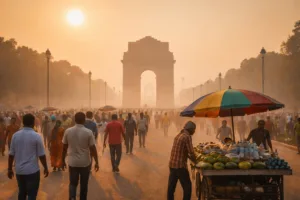
Delhi Simmers: Hottest February Day in 3 Years Signals a Worrying Climate Trend
As the calendar prepared to turn from February to March, the national capital, Delhi, wasn’t gently ushered into spring; it was thrust into an early and uncomfortable summer. On Saturday, the city recorded its hottest February day in three years, with the mercury hitting a scorching 32.5 degrees Celsius at the Safdarjung observatory, the city’s official baseline. This wasn’t just an isolated spike; it was the culmination of a month defined by unrelenting heat, scanty rainfall, and a deteriorating air quality index, painting a worrying picture of the challenges that lie ahead for the city of over 20 million people.
A Month of Unusual Warmth
The figure of 32.5°C is more than just a number on a thermometer. It represents a deviation of 6.4 degrees above the normal for this time of year, a stark anomaly that made February feel more like mid-April. To find a day hotter than this, one has to look back to February 20, 2023, when the temperature peaked at 33.6°C. While that day was marginally hotter, the consistency of the warmth throughout February 2024 is what makes the data particularly alarming.
An analysis of the month paints a clear picture: of the 27 days leading up to the report, maximum temperatures remained above normal on 25 days. The only two days that offered a semblance of respite were February 2 and 18, when brief spells of drizzle and cloud cover temporarily pulled the temperatures down. For the rest of the month, Delhiites woke up to warm mornings and endured afternoons that made light sweaters and shawls feel obsolete.
This wasn’t a phenomenon limited to one part of the city. Data from the India Meteorological Department (IMD) showed a uniform trend of above-normal temperatures across various stations. The Ridge area sizzled at 32.9°C, a staggering 6.1 degrees above normal. Lodhi Road (32.2°C, 6.2°C above normal) and Ayanagar (32.4°C, 5.8°C above normal) were not far behind. Even Palam, which often records slightly different readings due to its proximity to the airport, registered 30.8°C, a significant 4.9 degrees above normal.
The warmth wasn’t confined to the daytime. Nights offered little relief, with minimum temperatures also soaring well above the seasonal average. Safdarjung recorded a minimum of 16.4°C, which is 3.9 degrees above normal. This lack of a significant diurnal temperature variation means the human body gets little time to recover from the heat, increasing the risk of heat-related stress and illness.
The Missing Rains and a Comparative Analysis
The primary culprit behind this extended warm spell is the absence of winter rains. February is typically a month that receives beneficial western disturbances—weather systems that originate in the Mediterranean region and bring rainfall to northwest India. These rains act as a natural coolant, washing away dust and bringing down temperatures.
This year, however, the story was different. Delhi recorded a paltry 1.4mm of rainfall throughout February. To understand the impact of this deficit, one only needs to look back a year. In February 2023, the city experienced an average maximum temperature of 28.2°C, the highest in 15 years, coinciding with zero rainfall.
The contrast with February 2024 is even more stark. Last year, the city was blessed with 32.5mm of rainfall. This generous precipitation kept the average maximum temperature much lower, at a pleasant 24.4°C. The rains also played a crucial role in maintaining relatively better air quality. This year, the lack of rain has meant that pollutants have accumulated in the atmosphere without any natural washout, leading to a steady decline in air quality.
A Toxic Combination: Heat and Pollution
The absence of rain has had a compounding effect on Delhi’s perennial battle with air pollution. According to the Central Pollution Control Board (CPCB), February 2025 is on track to be the most polluted February in three years. On the day the temperature peaked, the city’s 24-hour average Air Quality Index (AQI) stood at 248, firmly in the “poor” category. This was a sharp deterioration from the previous day’s reading of 200, which fell into the “moderate” category.
An AQI between 201 and 300 is considered ‘poor’, and can cause breathing discomfort to most people on prolonged exposure. For the millions living in Delhi, particularly those with pre-existing respiratory conditions like asthma or bronchitis, this combination of unseasonal heat and toxic air creates a public health crisis. The warm air can trap pollutants closer to the ground, creating a thick, smoggy haze that reduces visibility and makes every breath a health risk.
The Human Impact: More Than Just Statistics
For the average Delhiite, these statistics translate into a tangible shift in daily life. Street vendors, construction workers, and delivery personnel—the backbone of the city’s informal economy—bear the brunt of this early heat. They have little choice but to toil for hours under the harsh sun, with their traditional period of relief in late February and March now seemingly shrinking.
“It feels like summer has arrived a full month early,” says Ramesh, a fruit seller in the Lodhi Road area. “Usually, we get some respite in the mornings till mid-March. This year, we are already seeking shade by 11 a.m. Our sales of seasonal fruits are up, but the watermelons and cucumbers are also getting more expensive. The heat makes everyone irritable, customers and shopkeepers alike.”
For parents, it means curtailing the outdoor playtime of their children. For offices, it means a higher demand for coolers and air conditioners, leading to increased energy consumption. The warm nights disrupt sleep, leading to fatigue and reduced productivity. The city’s parks, usually bustling with morning and evening walkers, are less crowded. The simple joy of a late February evening, once perfect for sitting by the India Gate lawns, has been replaced by a need to stay indoors, away from the unseasonable heat.
What Lies Ahead: A Glimpse into March
As Delhi bids farewell to February, the forecast for Sunday, March 2, offers little respite. The IMD has predicted a minimum temperature of 15°C and a maximum of 32°C, continuing the trend of above-normal warmth. To add another layer of discomfort, strong surface winds are forecast during the daytime. While winds can sometimes help disperse pollutants, they also carry dust and can make the heat feel more abrasive.
The real question on everyone’s mind is what the rest of March holds. Historically, March is a transition month where temperatures begin to climb steadily. However, with February already setting such a high baseline, there are genuine concerns that March and April could be exceptionally hot. This could have severe implications for water availability, as the city’s demand for water typically surges during the summer months. It also raises the specter of an increased number of heatwave days, which can be deadly.
The Deeper Narrative: A Symptom of a Larger Crisis
While the immediate cause of this heat spike is the lack of western disturbances, it is impossible to discuss these events without acknowledging the larger context of climate change. Cities across India, and indeed the world, are experiencing a shift in their seasonal patterns. Winters are becoming shorter and milder, while summers are arriving earlier, lasting longer, and becoming more intense.
The phenomenon of the “urban heat island effect” further exacerbates this in a metropolis like Delhi. The city’s concrete jungle, with its high-rises, paved roads, and dense population, absorbs heat during the day and releases it slowly at night. This makes urban areas significantly warmer than their surrounding rural counterparts. The lack of green cover in many parts of the city compounds the problem, as there are fewer trees to provide shade and cool the air through transpiration.
The events of February 2025 should serve as a stark warning. It is no longer just about record-breaking monsoon rains or extreme summer heat. The changing climate is now encroaching on what were once considered the comfortable “shoulder months.” The hottest February day in three years is not just a headline; it’s a lived reality for millions, a data point in a long-term trend, and a call to action for policymakers and citizens alike. It underscores the urgent need for sustainable urban planning, aggressive afforestation drives, a shift towards cleaner energy to combat the root causes of climate change, and robust public health systems ready to deal with the cascading effects of a warming planet. For now, however, Delhi can only wait, watch, and hope that the forecast for March isn’t a sign of the scorching summer to come.
You must be logged in to post a comment.