
Defying Disasters: Melbourne’s Pro-Palestine Protest Amid Bushfires and Bondi’s Shadow
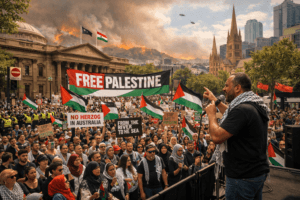
On January 10, 2026, thousands of pro-Palestinian activists held a static rally in Melbourne, defiantly proceeding despite urgent requests from police and the mayor to cancel due to catastrophic bushfires ravaging Victoria and the raw trauma still lingering from the deadly Bondi Beach terror attack less than a month earlier. The protest, which condemned a planned official visit by Israeli President Isaac Herzog and featured chants many in the Jewish community find threatening, ignited a fierce debate over civic responsibility, highlighting a deep societal divide: organizers framed their defiance as a moral imperative to keep spotlighting Palestine, while critics, including Jewish leaders, saw it as a selfish and divisive act that demonized Israel, exploited community grief, and recklessly diverted attention and resources during a state of emergency.
Defying Disasters: Melbourne’s Pro-Palestine Protest Amid Bushfires and Bondi’s Shadow
As Victoria declared a state of disaster, with bushfires consuming over 350,000 hectares, destroying hundreds of homes, and claiming at least one life, authorities issued a plea[reference:0][reference:1]. The request was simple: in a time of crisis, divert all public resources and community spirit to the emergency effort. Yet, on Sunday, January 10, 2026, a couple of thousand pro-Palestinian activists rallied in Melbourne’s city centre, defying explicit calls from the Lord Mayor, the state government, and Victoria Police to cancel their event[reference:2].
The protest, the first major gathering of its kind since the deadly Bondi Beach terror attack less than a month prior, was not just a clash over scheduling[reference:3]. It became a flashpoint, laying bare deep societal fractures over free speech, community sensitivity, security, and the very purpose of protest in a nation grappling with multiple tragedies.
A Static Rally Amid a State of Motion
Facing intense public pressure, organisers from Free Palestine Melbourne made a concession. They downgraded a planned march to a “static” protest outside the State Library of Victoria, though the gathering still brought trams on Swanston Street to a halt[reference:4]. Police estimated attendance at 500, while other observers put the figure at over 2,000 at its peak[reference:5].
The focus of the rally was a sharp condemnation of the federal government’s invitation to Israeli President Isaac Herzog for an official visit in early 2026[reference:6]. Prime Minister Anthony Albanese had extended the invitation as a gesture of solidarity with Australia’s Jewish community following the Bondi attack, a move welcomed by mainstream Jewish groups but fiercely opposed by pro-Palestinian advocates and some left-wing Labor factions[reference:7].
Speakers framed the invitation as an insult. Nasser Mashni, President of the Australia Palestine Advocacy Network, labelled it an “antisemitic gesture” that conflated Australian Jews with the Israeli state[reference:8]. The crowd’s chants of “From the river to the sea, Palestine will be free” and “Long live the intifada” echoed through the city, phrases that many in the Jewish community hear as calls for Israel’s elimination and the glorification of violence[reference:9].
Mashni’s rhetoric was defiant and combative. He dismissed figures who had linked pro-Palestine activism to the Bondi attack as peddling “racist,” “shameful,” and “disgusting” “scumbaggery”[reference:10]. He expressed deep disappointment in the Prime Minister for establishing a royal commission into antisemitism, arguing it created a “hierarchy of hate”[reference:11]. In a moment of sheer political theatre, he proclaimed the movement’s power: “We can close a city – 300,000 of us closed the [Sydney Harbour] Bridge. We can shut down a city, a bridge, a town, wherever it might be, because we are the people”[reference:12].
The Weight of Context: Bushfires, Bondi, and Iran
This display of grassroots power collided head-on with a national mood of grief and emergency. The bushfires raging across Victoria represented a tangible, immediate threat. Thousands of firefighters and over 70 aircraft were battling blazes, with authorities warning the worst was yet to come[reference:13][reference:14]. Victoria Police Deputy Commissioner Bob Hill had been unequivocal: “Now is not the right time for protests… With Australia’s Jewish community still hurting after the tragedy at Bondi, and Victoria fighting catastrophic fires, to proceed with these protests would be selfish, divisive and offensive”[reference:15].
The reference to Bondi was potent. The December 14, 2025, attack—an ISIS-inspired mass shooting at a Hanukkah celebration—was the deadliest antisemitic attack in Australian history, killing 15 and injuring 40[reference:16]. The Jewish community was, and remains, in a state of profound trauma. For many, the decision to hold a protest featuring chants like “Death to the IDF” and “All Zionists are terrorists” so soon after felt like a cruel secondary assault[reference:17].
Further complicating the picture were simultaneous events in Iran. As the Melbourne rally unfolded, Iranian security forces were engaged in a brutal crackdown on nationwide protests, with hundreds of demonstrators reported killed[reference:18]. This stark reality led critics to question the protesters’ selective focus. “If these protestors truly cared about human rights, they would instead be rallying in solidarity with the brave Iranian men and women,” said Colin Rubenstein, executive director of the Australia/Israel and Jewish Affairs Council (AIJAC)[reference:19].
The Deepening Divide: Solidarity or Demonization?
The protest and the fierce reaction to it underscored a debate that has moved far beyond the Israeli-Palestinian conflict itself, becoming a domestic Australian issue about community cohesion and the limits of protest.
For the protesters and their supporters, the cause is non-negotiable. They see Israel’s actions in Gaza as a paramount moral crisis that demands constant opposition, irrespective of other events. Postponing a rally, in this view, would be surrendering to political pressure and sidelining Palestinian suffering. As Mashni argued, attempts to silence them under the guise of other tragedies are inherently politicised and unfair.
For the Jewish community and its allies, the protest was seen as a profound failure of empathy and civic responsibility. Jeremy Leibler, president of the Zionist Federation of Australia, stated the rally made it “harder to pretend this is about helping Palestinians and not about demonizing Israel and keeping Jewish Australians on edge”[reference:20]. The decision to proceed while emergency services battled fires was framed not as an exercise in free speech, but as a selfish diversion of police resources and community goodwill during a disaster[reference:21].
The Herzog visit controversy sits at the heart of this tension. For the government and mainstream Jewish organisations, the invitation is a symbolic act of support for a grieving community[reference:22]. For pro-Palestinian activists and some dissident Jewish groups, it represents Australia’s complicity in Israeli policies and a reckless exacerbation of local tensions[reference:23]. The protest was a preview of the heated confrontations likely to surround any future visit.
Conclusion: A Nation at a Crossroads
The Melbourne protest of January 2026 will likely be remembered not for shifting the dial on Middle East politics, but for what it revealed about Australia’s social fabric. It occurred at the chaotic intersection of a natural disaster, a national trauma, a foreign humanitarian crisis, and a deeply entrenched political dispute.
The episode poses difficult questions. When does the right to protest yield to broader community safety and sentiment? How does a multicultural society navigate solidarity with one group without making others feel targeted and unsafe? Can the conversation about Israel and Palestine in Australia evolve beyond performative demonstrations that often deepen alienation?
There were no easy answers on Swanston Street that Sunday. As the protesters dispersed and firefighters continued their battle against the flames, the embers of division glowed brightly. The path forward requires a commitment to dialogue that acknowledges both the pain of the Palestinian cause and the acute vulnerability of Australian Jews, all while upholding a shared respect for the common good in times of crisis. The alternative is a future where every rally, rather than building understanding, simply burns another bridge.
You must be logged in to post a comment.