
Decoding the Digital Future: Why MNLU Nagpur’s National Conference on IP and Emerging Tech is the Must-Attend Event of 2026
The One Day National Conference on “Intellectual Property, Emerging Technology and Digital Regulation,” organized by the DPIIT-IPR Chair in collaboration with the Centre for Intellectual Property Rights and the Centre for Law, Technology & Policy at Maharashtra National Law University, Nagpur, on March 27, 2026, serves as a critical academic forum to dissect the urgent legal challenges posed by generative AI, the metaverse, deepfakes, and digital market monopolies. Bringing together students, academicians, and practitioners, the conference will feature rigorous, double-blind peer-reviewed presentations on sub-themes ranging from copyright authorship in AI-generated works and NFT trademark enforcement to competition law and Standard Essential Patents, with the best papers slated for publication in an ISBN book and awards for outstanding presentations. With a physical mode of attendance, a registration deadline of March 20, 2026, and a commitment to fostering original human insight over AI-generated content, this event promises to be an essential platform for shaping the future of India’s legal framework in the digital age.
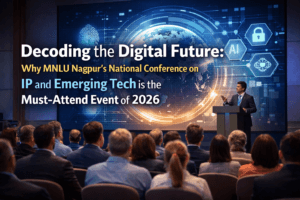
Decoding the Digital Future: Why MNLU Nagpur’s National Conference on IP and Emerging Tech is the Must-Attend Event of 2026
The legal landscape is no longer just about statutes and precedents set in stone. It is being rewritten in real-time by lines of code, neural networks, and digital assets that exist only in the ether. For law students, academicians, and practitioners in India, the challenge is no longer if they should engage with technology, but how.
This is precisely what makes the upcoming One Day National Conference on “Intellectual Property, Emerging Technology and Digital Regulation,” organized by the DPIIT-IPR Chair at Maharashtra National Law University (MNLU), Nagpur, on March 27, 2026, such a pivotal event. It arrives at a moment of profound legal and technological inflection.
Scheduled to be held in physical mode at the MNLU Nagpur campus, this conference is more than just a date on the academic calendar. It is a critical forum designed to dissect the complex interplay between our oldest legal frameworks and our newest digital realities. With a submission deadline for abstracts that has just passed (February 25, 2026), the scholarly community has already taken note. But for those whose abstracts have been selected or who are eager to participate as attendees, this deep dive into the conference’s themes reveals why it is poised to be one of the most significant legal gatherings of the year.
The Confluence of Powerhouses: Why This Conference Matters
The strength of any academic conference lies in its institutional backing, and this event boasts a trifecta of excellence.
At its heart is the DPIIT-IPR Chair, an initiative of the Ministry of Commerce and Industry, Government of India. Established under the SPRIHA (Scheme for Pedagogy and Research in IPRs for Holistic Education and Academia) scheme, this Chair is not merely an academic post; it is a policy-directed mandate to translate the National Intellectual Property Rights Policy, 2016 into tangible academic and research outcomes. Its presence at MNLU Nagpur signifies that the discussions here will have a direct line to the policymakers shaping India’s IP future.
This is powerfully complemented by two of MNLU Nagpur’s dedicated research centres:
- The Centre for Intellectual Property Rights (CIPR): This is the university’s hub for deep-dive scholarship in IP law. Its focus on bridging academia, industry, and policy ensures that the conference discussions are grounded in both theoretical rigour and real-world commercial and legal challenges.
- The Centre for Law, Technology & Policy (CLTP): In an era where technology often outpaces the law, the CLTP provides the necessary interdisciplinary lens. It focuses on the governance of technology, equipping stakeholders with the analytical skills to not just apply the law, but to meaningfully reform it.
Together, these three bodies create a perfect storm of academic credibility, policy relevance, and technological foresight. This isn’t just a conference about reading the law; it’s a conference about writing its next chapter.
Beyond the Buzzwords: A Deep Dive into the Sub-Themes
The conference’s suggested sub-themes are not merely a list of trendy topics. They are carefully chosen battlegrounds where the future of law is being contested. Let’s move beyond the headlines and explore the real, nuanced debates that will be unpacked on March 27th.
Sub-Theme I: Generative AI and the Transformation of India’s Intellectual Property Regime
Generative AI has democratised creativity, but it has also thrown copyright law into its biggest crisis since the arrival of the internet. The questions are profound and urgent:
- The Training Data Problem: Is scraping the internet to train massive AI models a violation of copyright, or does it fall under “fair dealing” in India? This session will grapple with the pending litigations in the US and Europe and ask how Indian courts might interpret Section 52 of the Copyright Act. Is the current framework of “fair dealing” flexible enough to accommodate machine learning?
- The Question of Authorship: The Copyright Act, 1957, vests authorship in a “person.” When an AI generates a stunning piece of art or a complex patent application, who owns it? The user who prompted it? The developer who coded it? Or does it fall into the public domain? This sub-theme will explore the concept of “human authorship” and whether India needs a sui generis (a unique) system to protect AI-generated creations.
- The International Ripple Effect: With the EU’s AI Act and various national approaches emerging, this theme will provide a comparative analysis, helping participants understand where India stands in the global AI governance landscape.
Sub-Theme II: Metaverse, Web3 and Virtual Asset Protection Ecosystem
The metaverse promises a parallel digital economy. But how do you enforce a trademark when a virtual Gucci bag is being counterfeited in a virtual world run by a decentralised autonomous organisation (DAO)?
- NFTs and the Illusion of Ownership: The session will cut through the hype around Non-Fungible Tokens (NFTs). It will examine the legal architecture of smart contracts – what are you really buying when you mint or purchase an NFT? Is it the art, a licence to view it, or just a metadata pointer?
- Trademark Enforcement in a Borderless World: This is a jurisdictional nightmare. If an Indian company’s trademark is infringed upon by a user in a US-based metaverse platform, what law applies? This theme will explore the concept of “virtual situs” and the liability of the platforms hosting these virtual environments.
- The Section 3(k) Conundrum: India’s Patents Act famously excludes computer programs per se from patentability. How does this apply to the complex software and protocols underlying Web3 and the metaverse? Can blockchain technology be patented, or does it fall under the “mathematical method” exclusion? This promises to be a fiery debate for IP practitioners.
Sub-Theme III: Deepfakes, Synthetic Media and Content Authenticity Framework
We are entering an era where seeing is no longer believing. Deepfakes pose a direct threat to individual reputation, democratic discourse, and national security.
- Personality Rights vs. Free Speech: Indian celebrities are increasingly leveraging personality rights to protect their likeness from being misappropriated by deepfakes. This session will examine the balance between an individual’s right to control their own image and the fundamental right to freedom of expression. Where does parody end and harmful impersonation begin?
- Intermediary Liability 2.0: The IT Rules, 2021, place significant responsibility on social media intermediaries to police content. But are they equipped to detect and remove sophisticated deepfakes in a timely manner? This sub-theme will critically analyse the due diligence requirements for platforms and the legal recourse available to victims of synthetic media.
- The Privacy of Thought: As technology moves towards brain-computer interfaces, a new frontier of “neural data” emerges. Is your private thought the next piece of proprietary data to be owned by a Big Tech company? This forward-looking topic will touch upon the intersection of privacy, IP, and emerging neurotechnology, a discussion well ahead of the curve.
Sub-Theme IV: Competition Law, Strategic IP Protection and Digital Market Regulation
This theme tackles the elephant in the room: the immense power of Big Tech. It moves beyond individual IP rights to examine the monopolistic structures of the digital economy.
- Data as a Barrier to Entry: How does the accumulation of user data by a few dominant players create an unassailable moat, stifling competition? This session will explore whether India’s Competition Act, 2002, needs an ex-ante (preventative) regulatory framework, similar to the EU’s Digital Markets Act, to govern “gatekeeper” platforms.
- The SEP/FRAND Battleground: Standard Essential Patents (SEPs) are the bedrock of the Internet of Things (IoT). The battle between SEP holders and implementers over Fair, Reasonable, and Non-Discriminatory (FRAND) licensing terms is a multi-billion dollar war. This conference will dissect the latest Indian and international jurisprudence on SEPs and the concept of a “willing licensee.”
- Semiconductor IP and National Security: With the Indian government pushing its semiconductor mission, protecting chip design and layout designs under the Semiconductor Integrated Circuits Layout-Design Act (SICLD Act) is of strategic national importance. This sub-theme will discuss how robust IP protection can foster domestic manufacturing and innovation in this critical sector.
Who Should Attend and Why?
The conference is meticulously designed for a diverse audience, ensuring a rich cross-pollination of ideas.
- For Students (UG and PG): This is an unparalleled opportunity to witness cutting-edge legal debates, network with leading professionals, and present research in a highly competitive environment. The reduced registration fee of ₹2000 and the dedicated Best Presentation Award of ₹3000 make it an attractive and accessible platform to build an academic profile. The chance to have your paper published in an ISBN-tagged book is a significant addition to any CV.
- For Academicians and Research Scholars: The conference offers a platform to present rigorous, long-form research (up to 6000 words) to a knowledgeable audience of peers and practitioners. The ₹5000 award for the Best Presentation in this category acknowledges the depth of scholarly work expected. It is a vital space for receiving constructive feedback before submitting work to top-tier journals.
- For Professionals and Practitioners: The dual focus on doctrinal challenges and commercially viable solutions ensures that the takeaways are immediately applicable. Whether you are a corporate lawyer grappling with an AI copyright issue or a policy advisor working on digital market regulation, the insights from this conference will be invaluable. The networking opportunities with the DPIIT-IPR Chair and the research centres can also open doors for future collaboration.
A Call for Rigour, Not Fluff
The submission guidelines underscore the organisers’ commitment to quality. The double-blind peer review process, the strict 10% plagiarism limit, and the explicit ban on AI-generated content signal that this conference values original, critical human thinking. In a world flooded with AI-generated text, the ability to produce authentic, well-researched legal analysis is more valuable than ever. The selection of only the “best 30 abstracts” guarantees that the quality of discussion on the day will be exceptionally high.
Conclusion: Be Part of the Conversation
The legal challenges posed by generative AI, the metaverse, and deepfakes are not coming in the distant future; they are here, disrupting industries and challenging courts today. The National Conference on “Intellectual Property, Emerging Technology and Digital Regulation” at MNLU Nagpur on March 27, 2026, represents a crucial opportunity to step back from the daily deluge of news and engage in the deep, structured thinking required to build a robust and forward-looking legal framework.
While the deadline for abstracts has passed, the opportunity to participate is still very much alive. For those whose work has been selected, the call is clear: refine your papers, engage with the themes, and prepare for a day of rigorous intellectual exchange. For everyone else, mark your calendars, register by March 20, 2026, and secure your place as an attendee at what promises to be the defining legal conference of the season.
The future of law is being written in code, but its grammar will be decided in forums like this. Be there to help shape it.
You must be logged in to post a comment.