
Cyclone Montha: A Late-Season Tempest Reshapes India’s Weather Narrative
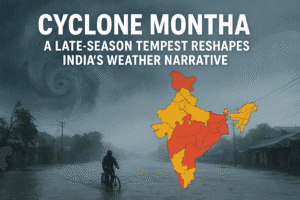
Cyclone Montha, after making landfall near Kakinada, Andhra Pradesh with severe winds, has significantly weakened into a deep depression, yet its extensive moisture field continues to trigger widespread and heavy rainfall across eastern and central India, leading the IMD to issue red and orange alerts for Telangana and Andhra Pradesh and warnings for Jharkhand, Bihar, and West Bengal, resulting in reported fatalities, widespread disruption, and a cooling trend across the affected regions, in an unusual late-October weather event that underscores the prolonged impact of such cyclonic systems even after their core dissipates.
Cyclone Montha: A Late-Season Tempest Reshapes India’s Weather Narrative
In an unusual twist for the end of October, Cyclone Montha has carved a path of disruption and drenching rains across eastern and southern India. More than just a weather event, its lingering presence has become a test of resilience for states from the coastal belts of Andhra Pradesh to the inland plains of Bihar. This storm is not merely a statistic on a meteorological chart; it is a complex narrative of climate patterns, human preparedness, and the widespread impact of a slowing cyclone.
The Eye of the Storm: Landfall and Immediate Aftermath
Cyclone Montha began its definitive encounter with the Indian mainland near Kakinada, Andhra Pradesh, packing sustained winds of 90-100 kmph and gusts reaching up to 110 kmph. The India Meteorological Department (IMD), which had been tracking its genesis in the Bay of Bengal with precision, confirmed the landfall process commenced around 7 pm, with the storm crossing the coast between Machilipatnam and Kalingapatnam.
The human cost of such events is always the most poignant. Andhra Pradesh’s Chief Minister, Chandrababu Naidu, somberly confirmed two fatalities linked to the cyclone, even as he rallied state machinery, stating, “If we work in the same way for another two days, we can give much relief to the people.” This statement underscores the critical 48-72 hour window following a cyclone’s landfall, where emergency response and relief operations are most vital to mitigate further suffering.
The Unraveling Fury: Why the Rains Didn’t Stop
A common misconception is that the danger passes once a cyclone’s core moves inland. However, Cyclone Montha presents a classic case of a system whose impact is most profound as it weakens. By Thursday, October 30, the cyclone had been downgraded to a deep depression over coastal Andhra Pradesh and neighbouring Telangana. Yet, this “weakening” is deceptive.
As the tight, organized wind structure of the cyclone breaks down, its immense moisture field is cast over a vast area. Think of it not as a concentrated fist, but as an open hand spreading water across multiple states. This residual cyclonic circulation continues to interact with regional weather patterns, pulling in moisture from the Bay of Bengal and triggering widespread and persistent rainfall. The IMD has been clear: the threat is far from over, issuing a cascade of color-coded alerts that paint a picture of a nation still in the grip of the storm’s aftermath.
A Tapestry of Alerts: Decoding the IMD’s Color-Coded Warnings
The IMD’s alert system is a crucial public communication tool, and for Cyclone Montha, it has been deployed extensively across central and eastern India.
- Red Alert (Take Action) in Telangana: This highest-level warning signifies expectations of “extremely heavy rainfall” (typically over 20 cm in 24 hours). Districts like Karimnagar, Warangal, and Mahabubabad are on high alert for severe weather, including thunderstorms, lightning, and gusty winds. This alert calls for maximum precaution, with authorities likely advising people to stay indoors and avoid travel.
- Orange Alert (Be Prepared) in Andhra Pradesh and Parts of Telangana: A step down from red, but still indicating very heavy rainfall (6 cm to 20 cm). For coastal Andhra, this also includes warnings of potential tidal surges and waterlogging in low-lying areas, a persistent danger even after the cyclone’s winds have diminished.
- Yellow Alert (Be Aware) for a Wider Swath: States like Jharkhand, Bihar, Chhattisgarh, and interior Karnataka have been under yellow alerts, signaling light to moderate rainfall at many places with isolated heavy spells. While less severe, this can still lead to significant agricultural disruption and localized flooding.
Beyond the Coast: The Cascading Effects on India’s Weather
The influence of a system like Montha extends far beyond the states under immediate alert. It acts as a major disruptor of the subcontinent’s prevailing weather regime.
- Cooling Trend for the East: The extensive cloud cover and precipitation have led to a noticeable drop in temperatures across Eastern India. Cities that would typically be experiencing warm, humid days in late October are now seeing cooler, overcast conditions, a respite that is likely to last through the weekend.
- Unexpected Showers in the West: In a ripple effect, the IMD has forecast light to moderate rainfall in Gujarat, with isolated heavy falls in the Kutch and Saurashtra regions. This is a stark reminder of how interconnected India’s weather systems are, with a cyclone in the Bay of Bengal influencing conditions over a thousand kilometers away.
- A Failed Experiment in Delhi: The article’s mention of Delhi’s failed cloud seeding effort provides a stark contrast. While the eastern seaboard grapples with an overabundance of rain, the capital continues to battle its annual smog crisis, with the Air Quality Index (AQI) plunging into the ‘severe’ category. This juxtaposition highlights the diverse and extreme weather challenges facing different parts of the country simultaneously.
Human Insight: The Real-World Impact of a Named Storm
Behind the meteorological data and government advisories lie tangible human stories. For farmers in Andhra Pradesh and Telangana, these rains are a double-edged sword. While they recharge groundwater, they can also devastate ready-to-harvest crops, ruining a season’s worth of labor. For urban residents in cities like Visakhapatnam and Hyderabad, the threat shifts to waterlogged streets, disrupted power supply, and the perennial risk of lightning strikes during thunderstorms.
The authorities’ advice to “refrain from unnecessary travel” is not merely a suggestion. It is a critical safety measure to prevent accidents on slick, visibility-poor roads and to allow emergency services unimpeded access to the hardest-hit areas.
A Sign of Changing Times?
The formation of a cyclone of this intensity in late October raises questions for climate scientists. While the North Indian Ocean cyclone season officially runs from April to December, with twin peaks in May and November, a severe storm at the end of October is less common. Researchers are increasingly studying whether a warming Indian Ocean is leading to longer cyclone seasons and more intense, moisture-laden systems that decay slower, much like Montha, leading to higher rainfall totals over land.
Looking Ahead: The Path to Normalcy
The IMD predicts that this active rainfall phase will finally cease over most of the country by Saturday, November 1. As the remnants of Montha dissipate, weather conditions are expected to gradually improve, allowing for a mammoth cleanup and damage assessment operation.
Cyclone Montha serves as a potent annual reminder of nature’s force. It underscores the life-saving value of accurate forecasting and proactive communication by agencies like the IMD. For the millions affected, the journey from weathering the storm to rebuilding in its wake has just begun.
You must be logged in to post a comment.