
Cultivating Tomorrow: Why India’s 2026 Budget Must Sow the Seeds of a Tech-Driven, Climate-Smart Agri Revolution
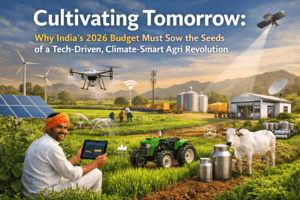
Cultivating Tomorrow: Why India’s 2026 Budget Must Sow the Seeds of a Tech-Driven, Climate-Smart Agri Revolution
The annual Union Budget is more than a ledger of income and expenditure; it is a statement of intent, a blueprint of a nation’s priorities. As India prepares for the 2026-27 fiscal plan, perhaps no sector presents a more compelling case for transformative focus than agriculture. Employing nearly half the country’s workforce yet contributing under 20% to the Gross Value Added (GVA), Indian agriculture stands at a historic crossroads. The persistent chorus from farmers, agri-tech entrepreneurs, and industry leaders is clear: the era of piecemeal welfare subsidies must evolve into a strategic investment in technology, climate resilience, and structural reform. Budget 2026 isn’t just another financial statement—it’s a potential catalyst to reimagine the very foundations of our food systems.
From Green Revolution to Green Resilience: The Unfinished Journey
India’s agricultural narrative has long been dominated by the successes and subsequent shortcomings of the Green Revolution. While it averted famine and achieved food grain self-sufficiency, it also led to groundwater depletion, soil degradation, and regional disparity. The current demand for a policy pivot recognizes that the challenges of the 21st century—climate volatility, shrinking landholdings, and a demanding global market—cannot be solved with 20th-century tools. As Amit Vatsyayan of EY India aptly notes, agriculture is now seen as a “credible engine of economic growth.” This reframing is crucial. It moves the discourse from protecting a vulnerable population to empowering a dynamic economic sector capable of driving productivity, sustainable employment, and robust rural demand.
The Digital Plough: Scaling Precision Agriculture
At the heart of the modernisation agenda is digital infrastructure. The vision extends beyond simple mobile advisory services to a fully integrated, data-driven ecosystem. Imagine a scenario where a farmer in Marathwada accesses a unified digital profile (part of the proposed AGRI-STACK) that informs her of optimal sowing dates based on AI-analysed weather patterns, recommends precise quantities of moisture-sensitive nano-fertilizers, and alerts her smartphone about a pest outbreak in a neighbouring field via IoT sensors.
CEO of MapMyCrop, Swapnil Jadhav, hits the nail on the head: scaling this precision farming vision depends on two pillars—robust digital infrastructure and accessible credit. Budget 2026 must therefore allocate funds not just for rural broadband (a continuation of the BharatNet vision), but for specific “precision agriculture grants” that subsidise the adoption of agri-drones for pesticide application, soil sensors for nutrient management, and satellite imagery for yield estimation. Furthermore, R&D tax incentives for startups developing AI-driven analytics in Indian languages can democratise access. Integrating these technologies with existing platforms like e-NAM and AGMARK-NET can create a seamless loop from farm to fork, ensuring quality-based pricing and reducing information asymmetry.
Building Backbones: Climate-Resilient Infrastructure as a Non-Negotiable
If technology is the nervous system, climate-resilient infrastructure is the skeleton of a future-proof agricultural sector. The increasing frequency of unseasonal rains, droughts, and heatwaves makes investment in green infrastructure a matter of survival, not just growth.
Vatsyayan’s call for scaling micro-irrigation, watershed development, and aquifer recharge is urgent. Budget 2026 should introduce a ‘Climate-Resilient Infrastructure Fund’ with significant outlay, designed to crowd in private investment through blended finance models. This fund could finance community-level solar-powered irrigation projects, modernise village ponds into systematic water harvesting structures, and promote bio-drainage to combat waterlogging.
Perhaps the most critical link is post-harvest logistics. India’s staggering post-harvest losses, estimated at billions of dollars annually, are a national shame exacerbated by inadequate storage and cold chains. The budget must incentivise deeper public-private partnerships (PPPs) to build a modern, integrated warehousing and logistics network. This includes not just large cold storage facilities, but also promoting smaller, decentralised pre-cooling units and pack-houses at the block level, powered by renewable energy. Adapting models like Japan’s farmer schools, where best practices in storage and processing are demonstrated hands-on, could accelerate adoption at the grassroots.
The White Revolution 2.0: Nourishing the Dairy Sector
The organized dairy segment, a lifeline for millions of rural households, seeks targeted maturation. Brahmani Nara of Heritage Foods Ltd. observes a post-GST rationalisation shift towards high-protein products like curd and paneer. To harness this demand, the budget must look beyond production and strengthen the backbone of the dairy value chain.
Her suggestions are pragmatic: subsidised quality animal feed is essential to improve milk yield and quality, reducing the economic burden on smallholders. Concurrently, expanding veterinary education and telehealth services can address the critical shortage of animal healthcare. Most strategically, increased capital subsidies for mini-dairy processing units can promote local value addition, create rural jobs, and reduce the pressure on large cooperative unions. This aligns with the broader goal of diversifying rural incomes and building local agri-entrepreneurship.
Root and Branch Reform: Addressing Structural Fault Lines
Technology and infrastructure will flounder without addressing agriculture’s deep-seated structural issues. Soumyak Biswas of BDO India highlights the triad of fragmented landholdings, under-investment in allied sectors, and anaemic research funding.
Budget 2026 can initiate change by:
- Boosting Research & Development: Doubling the allocation to the Indian Council of Agricultural Research (ICAR) and creating grants for public-private research consortia focused on drought-resistant varieties, bio-fortified crops, and sustainable farming practices.
- Empowering Farmer Producer Organizations (FPOs): Enhancing budget support for FPOs to act as consolidated entities for input procurement, tech adoption, and market access. This is a viable model to overcome the challenge of smallholdings.
- Incentivising Diversification: Providing direct benefit transfers or enhanced MSP-like mechanisms for farmers shifting from water-intensive staples to horticulture, millets, and oilseeds. This is critical for nutritional security and ecological sustainability.
- Fast-Tracking AGRI-STACK: Allocating dedicated resources for the secure and transparent rollout of the national agri-stack. This digital foundation, integrating land records, farmer data, credit, and insurance, can unlock hyper-personalised services and attract massive private sector innovation.
The Human Element: Beyond Hardware and Software
Ultimately, the success of any budgetary measure hinges on the farmer. The transition must be just and inclusive. Budgetary provisions must be coupled with massive investment in digital literacy and skill development. Krishi Vigyan Kendras need to be transformed into “Climate-Smart Agri-Tech Hubs,” showcasing live demonstrations of integrated farming systems, drone operations, and data interpretation.
Furthermore, climate-risk insurance products, subsidised by the government but delivered via tech platforms, should become ubiquitous, providing farmers with a psychological safety net to experiment with new methods.
Conclusion: A Budget for the Future of Bharat
The demands placed before Budget 2026 are not a mere wish list; they are a collective roadmap for securing India’s food sovereignty, farmer prosperity, and ecological balance in a turbulent century. By strategically directing funds towards digital enablement, climate-hardened infrastructure, dairy value-chain strengthening, and structural reforms, the government can do more than stimulate a sector—it can catalyze a renaissance.
This is an opportunity to move from a paradigm of subsidy-driven survival to one of investment-led growth. It is a chance to ensure that the hands that feed the nation are empowered by the finest tools, protected by the strongest infrastructures, and rewarded by the fairest markets. The seeds of India’s next economic surge lie in its soil. Budget 2026 must choose to water them wisely.
You must be logged in to post a comment.