
Consumption First, Innovation Next: Decoding India’s Startup Decade and the Road Beyond
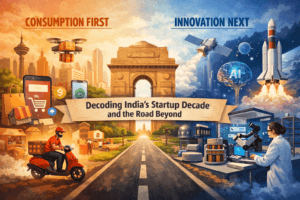
Consumption First, Innovation Next: Decoding India’s Startup Decade and the Road Beyond
As India commemorates a decade of its formalized Startup India journey, the landscape that unfolds is both spectacular and subtly instructive. The headline figures—over 100 unicorns, a thriving ecosystem ranked third globally—tell a story of explosive growth. Yet, a closer look at the sectoral distribution of these success stories reveals a more nuanced narrative. The dominance of consumer-facing platforms in retail, fintech, and services underscores a powerful truth: India’s startup boom has been fundamentally powered by its massive consumption story, not by breakthrough technology creation. This is not necessarily a failure, but a strategic, market-driven phase with critical implications for the nation’s innovative future.
The Unicorn Map: A Mirror to India’s Demand-Side Economy
The data is telling. Over half of India’s unicorns reside in consumer & retail and financial services. From e-commerce giants and food delivery apps to digital payment gateways and neo-banking platforms, their core innovation has been in business model adaptation, logistics mastery, and leveraging the Jio-led digital infrastructure to tap into an unprecedented wave of new internet users.
This consumer-tech boom is a rational response to a once-in-a-generation opportunity. A young, aspirational population, rising disposable incomes, and the digitization of hundreds of millions created a fertile ground for platforms that cater to convenience, access, and financial inclusion. These startups solved real, immediate problems for a massive market: how to shop, how to pay, how to book a ride, how to order a meal. Their “technology” was often in brilliant execution and scale management, rather than in developing proprietary frontier tech.
The Glaring Omission: Enterprise Tech and Deep Tech’s Shallow Roots
Contrast this with the figures from the Department for Promotion of Industry and Internal Trade (DPIIT): a mere 1.5% of recognized startups operate in the Artificial Intelligence space. When you expand this to encompass other frontier technologies like advanced semiconductors, robotics, quantum computing, or even deep enterprise SaaS solving complex global business problems, the footprint shrinks further.
This highlights the “limited depth” observers note. The Indian startup ecosystem, in its first decade, has been a **master of “Last Mile Innovation”**—spectacularly connecting technology to the end-consumer. However, the “First Mile Innovation”—creating the core, patentable, high-technology building blocks—remains underrepresented. Enterprise-grade technologies require long R&D cycles, deep academic-industry linkages, patient capital, and a focus on global markets from day one. The Indian venture capital landscape, tuned to the quick scaling and unit economics of B2C models, has been historically cautious here.
Why the Tilt? The Structural Calculus of Indian Startups
Several interconnected factors have shaped this consumption-first trajectory:
- The Siren Call of a Billion Consumers: The domestic market is so vast and underserved that capturing even a single vertical can build a billion-dollar company. The immediate opportunity cost of pivoting to harder, global-facing tech is high.
- Capital Incentives: Venture capital, especially in the early years, flowed towards models proven in the West and China—consumer internet. Exit horizons seemed clearer, and growth metrics (GMV, users, transactions) were easier to measure than the progress of a nascent AI algorithm.
- Ecosystem Maturity: Deep tech thrives in clusters with dense talent from top research institutions, experienced mentors, and a culture of risk-taking on fundamental problems. While India produces world-class engineering talent, much of it has been optimized for execution and services, not necessarily for foundational R&D in startups.
- Regulatory Sandbox vs. Hard Tech Labs: The government’s supportive policies, like the Startup India initiative and UPI’s public infrastructure, brilliantly enabled consumer tech innovation. Creating similar catalytic frameworks for deep tech—in terms of funding R&D, easing IP commercialization from labs, and providing targeted procurement—is a more recent, evolving focus.
Beyond the Dichotomy: Consumption as a Foundation, Not a Ceiling
To view this as merely a technological shortfall is to miss a crucial point. India’s consumption-tech boom has laid an indispensable foundation for its next act:
- Digital Financial Infrastructure: The UPI and India Stack revolution, propelled by fintech startups, has created a public good that future deep-tech enterprises can build upon.
- Talent Pipeline: The first decade has trained a generation of product managers, data engineers, and operators who understand scale. This talent is now beginning to look for harder problems to solve.
- Capital Confidence: The success of consumer unicorns has globalized Indian venture capital, attracting sophisticated investors who are now increasingly eyeing enterprise SaaS and deeptech bets, as seen in the rise of firms like Zoho, Postman, and ambitious AI startups.
- Data Advantage: The scale of digital consumption generates unique, non-linear datasets—in payments, commerce, health—which can be the bedrock for training globally competitive AI models in specific domains.
The Path to 2030: Building the “Technology Creation” Muscle
For India’s startup story to achieve balanced depth and sustainable global leadership, the next decade must see a conscious parallel building of the technology-creation muscle. This requires a concerted shift:
- For Policymakers: Beyond “ease of doing business,” focus on “ease of innovating.” This means significantly increasing R&D funding, reforming university tech transfer offices, creating sovereign funds for strategic tech, and acting as a first buyer for indigenous deep-tech solutions in defense, space, and energy.
- For Investors: Cultivate patient capital. Funds need to develop the expertise to evaluate long-term tech bets and build portfolios that balance quick-commerce with quantum computing. The recent surge in AI and space-tech funding is an encouraging sign.
- For Entrepreneurs: The playbook must evolve. Leverage the scale, talent, and data generated by the domestic consumption economy to build “Made in India” tech that can go global. The model is not China or Silicon Valley alone, but a hybrid: using domestic strength as a launchpad for global innovation.
- For the Ecosystem: Strengthen the connective tissue between IITs/ISRO/DRDO labs and startup garages. Celebrate not just valuation milestones but patent filings, research publications, and breakthroughs in material science or algorithms.
Conclusion: A Phase, Not a Fate
India’s first startup decade was about digitizing the nation’s consumption. It was a necessary, hugely successful phase that addressed immediate needs and built colossal companies. The relative lack of depth in frontier technology is a characteristic of this phase, not a permanent trait.
The challenge and opportunity for Startup India 2.0 is to channel the capital, confidence, and talent from this consumption boom into the harder, longer-term work of technology creation. The goal is not to abandon the consumer golden goose, but to feed it a new, more resilient diet of homegrown innovation. The true test will be if, a decade from now, we are discussing not just how India uses technology to serve its market, but how the world adopts technology that was invented and built in India. The consumption wave was the launchpad; the innovation orbit is the next destination.
You must be logged in to post a comment.