
Constitutional Morality vs. State Control: An Ambedkarite Analysis of Anti-Conversion Laws in India
From an Ambedkarite perspective, anti-conversion laws in India function not as protections for the vulnerable but as instruments of social control that preserve caste hierarchy by restricting the ability of Dalits and Adivasis to exercise their constitutional right to religious freedom as a path toward dignity and emancipation. These laws impose administrative scrutiny, criminalize material support from missionary institutions that have historically filled gaps in state welfare, and create a public record of conversion that invites social retaliation, while simultaneously creating an impossible dilemma for Dalit converts who lose access to affirmative action protections under the Scheduled Castes Order. By framing conversion itself as suspect and requiring state verification of religious choice, these statutes fundamentally contradict Ambedkar’s vision of constitutional morality, which recognized that for oppressed communities, the freedom to change religion represents not merely a spiritual decision but a collective assertion of equality against a social order that has historically used religious ideology to sanctify untouchability and degradation.
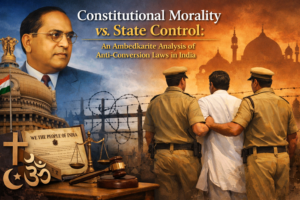
Constitutional Morality vs. State Control: An Ambedkarite Analysis of Anti-Conversion Laws in India
The relationship between religion and state power in India has always been complex, but nowhere does this complexity manifest more acutely than in the debate over anti-conversion laws. For upper-caste Hindus who have never experienced the daily humiliation of untouchability, conversion may appear as a purely theological matter—a change of beliefs without social consequence. But for Dalits and Adivasis, communities that have endured centuries of systematic degradation under the caste order, the question of religious identity carries existential weight.
When I examine anti-conversion legislation through the lens of Ambedkarite philosophy, I am forced to confront an uncomfortable truth: these laws, ostensibly designed to protect the vulnerable, often function as instruments that preserve the hierarchical structures from which the vulnerable seek emancipation.
The Ambedkarite Understanding of Conversion
To grasp why conversion matters so profoundly to Dalit communities, we must first understand what religion has meant in the context of caste. Babasaheb Ambedkar did not view Hinduism merely as a faith tradition; he saw it as a comprehensive social order that sanctified inequality. The Manusmriti, which he famously burned in a public ceremony in 1927, was not simply a religious text but a legal code that prescribed differential punishments, rights, and dignities based on birth.
Ambedkar’s study of history led him to a devastating conclusion: the caste system was not incidental to Hinduism but integral to it. In his 1936 work “Annihilation of Caste,” he argued that “the caste system is not merely a division of labour. It is a division of labourers.” This distinction is crucial. While all societies have some form of division of labour, the Indian system fixed occupational roles by birth and enforced them through religious sanctions, making social mobility virtually impossible.
When Ambedkar announced his intention to leave Hinduism in 1935 at the Yeola Conversion Conference, he was making a political statement as much as a religious one. “I was born a Hindu, but I will not die a Hindu,” he declared. This was not a rejection of spirituality but a rejection of a social order that had degraded millions. His eventual conversion to Buddhism in 1956, followed by half a million Dalits, demonstrated that for oppressed communities, religious change could be a collective act of liberation rather than individual spiritual seeking.
The Architecture of Anti-Conversion Laws
India’s first anti-conversion laws emerged in the mid-20th century, but their proliferation has accelerated in recent decades. Currently, states including Uttar Pradesh, Madhya Pradesh, Himachal Pradesh, Gujarat, Odisha, Jharkhand, Chhattisgarh, Uttarakhand, and Haryana have enacted “Freedom of Religion” legislation. While the specifics vary, common features include:
- Prior notification requirements: Individuals seeking to convert must notify district magistrates or other authorities
- Prohibition of “inducement”: Conversions achieved through material benefits are criminalized
- Verification procedures: Officials may investigate the “genuineness” of conversions
- Penal provisions: Violations can result in imprisonment and fines
The terminology itself deserves scrutiny. These laws are named “Freedom of Religion Acts,” yet they restrict one of the most fundamental expressions of religious freedom—the right to change one’s faith. This rhetorical framing positions the state as protector of the vulnerable against predatory conversion attempts, a narrative that resonates with certain constituencies but obscures the lived realities of Dalits and Adivasis.
The Material Context of Conversion
Critics of conversion often argue that Dalits and Adivasis are “lured” by material benefits offered by missionary organizations. This framing assumes that spiritual choices should be made in a vacuum, untouched by material considerations. But such an assumption reveals a profound disconnect from the conditions in which marginalized communities live.
When a Dalit family in rural Uttar Pradesh sends their children to a missionary school, they are not being “lured”—they are accessing education that government schools have failed to provide. When a tribal woman in Jharkhand seeks treatment at a Christian hospital, she is not being “induced”—she is receiving healthcare that state institutions have denied her community for generations. The material and the spiritual cannot be neatly separated when survival itself is at stake.
Ambedkar understood this intimately. His own educational journey was made possible by the support of progressive individuals and institutions. He recognized that for communities denied access to resources for millennia, material support and spiritual transformation were interconnected aspects of the same struggle for dignity.
The anti-conversion laws’ prohibition of “inducement” thus creates a perverse situation: the very institutions that have historically filled gaps in state welfare provision become suspect. Missionary schools and hospitals, which have educated and healed millions of Dalits and Adivasis, operate under the shadow of potential criminal prosecution. This does not protect vulnerable communities; it isolates them from sources of support.
The Administrative Gaze
One aspect of anti-conversion laws that receives insufficient attention is the administrative machinery they activate. When a Dalit individual must appear before a district magistrate to declare their intention to convert, they enter a space historically associated with upper-caste authority. The police officer who may investigate the “genuineness” of conversion, the local officials who scrutinize motives—these are not neutral actors but products of the same social order that produced caste hierarchy.
In my decades of service in the Indian Police Service, I observed how administrative discretion operates in practice. A Dalit seeking conversion faces questions that an upper-caste Hindu never encounters: Is this conversion voluntary? Have you been offered money? Are you aware of the consequences? The very fact of questioning implies suspicion—the assumption that a Dalit cannot make autonomous religious choices without external manipulation.
This administrative scrutiny also makes conversion publicly visible in ways that can invite social retaliation. In villages where caste panchayats still wield influence, the knowledge that a Dalit family has formally notified authorities of their conversion can trigger boycotts, violence, or worse. The legal requirement of publicity, ostensibly meant to ensure transparency, becomes a mechanism of social control.
The Tribal Question
For Adivasi communities, the conversion issue takes on additional dimensions. Many tribal groups practiced indigenous religions that were neither Hindu nor part of the mainstream religious traditions. The process of Hinduization—often called “sanskritization”—has historically sought to absorb tribal populations into the lower rungs of the caste hierarchy, assigning them a subordinate position while claiming to integrate them.
When Adivasis have converted to Christianity or Islam, they have often done so to preserve elements of their cultural autonomy while accessing education and healthcare. Missionary anthropologists and linguists have documented and preserved tribal languages and traditions that state institutions ignored. Christian missionaries were often the first to establish schools in remote tribal areas, to document oral traditions, and to provide healthcare in regions where government doctors refused to serve.
Anti-conversion laws disrupt this dynamic by creating legal uncertainty around missionary activity. In states with significant tribal populations like Odisha, Jharkhand, and Madhya Pradesh, these laws have been used to target Christian institutions and workers. The violence in Kandhamal district of Odisha in 2008, where dozens of Christians were killed and thousands displaced, occurred against the backdrop of anti-conversion legislation and the political rhetoric surrounding it.
The Reservation Paradox
Perhaps the cruelest irony facing Dalit converts concerns affirmative action. The Constitution (Scheduled Castes) Order 1950 specifies that only those belonging to Hindu, Sikh, or Buddhist religions can be recognized as Scheduled Castes. Dalits who convert to Christianity or Islam lose eligibility for reservations in education, employment, and political representation.
This creates an impossible choice. Conversion may offer freedom from the ritual humiliation of untouchability and access to religious communities that practice equality. But it also means forfeiting the constitutional protections designed to remedy historical discrimination. A Christian Dalit faces the same caste prejudice in everyday life but cannot access the benefits meant to address that prejudice.
Ambedkar, who drafted the constitutional provisions for reservations, understood that affirmative action was necessary precisely because caste discrimination persisted regardless of religious affiliation. He argued for extending reservations to all Dalits regardless of religion, recognizing that conversion did not erase the social reality of untouchability. Yet successive governments have refused to amend the 1950 Order, effectively penalizing those who exercise their constitutional right to freedom of conscience.
The Question of Coercion
Defenders of anti-conversion laws raise legitimate concerns about coercive practices. No one—certainly not an Ambedkarite—can support conversions achieved through force, fraud, or deception. The principle of informed consent applies to religious change as to any other significant life decision.
But we must ask: where does coercion actually operate in Indian society? Is it primarily in missionary activities, or is it in the daily enforcement of caste discipline? When a Dalit is denied access to a village well, barred from temples, forced to eat separately, or subjected to violence for perceived transgressions of caste norms—is this not coercion? When entire communities are pushed to the margins of economic life, denied dignity, and treated as polluting—is this not a form of structural coercion far more pervasive than anything missionaries practice?
The focus on conversion-induced coercion distracts from the coercion inherent in the caste system itself. By framing religious change as the problem requiring state intervention, anti-conversion laws implicitly legitimize the caste order as the natural state of affairs from which no one should need to escape.
Constitutional Morality and Religious Freedom
Ambedkar’s vision of constitutional morality went beyond mere adherence to legal provisions. He argued that constitutional morality required a transformation of social attitudes—a willingness to treat fellow citizens as equals regardless of birth. The right to freedom of conscience under Article 25 was not an abstract liberty but a fundamental protection against the tyranny of majoritarian social norms.
When the state places obstacles in the path of those seeking religious change, it violates the spirit of this constitutional promise. The freedom to profess, practice, and propagate religion must include the freedom to leave one religion and adopt another. To argue otherwise is to treat certain religious identities as permanent, hereditary conditions from which exit is illegitimate—precisely the logic of caste.
Anti-conversion laws also raise questions about secularism. A genuinely secular state neither favors nor disadvantages any religion and neither encourages nor discourages religious change. By making conversion administratively burdensome and legally risky, the state tilts the playing field in favor of the religious status quo. This is not secularism but its opposite.
Toward a Genuinely Liberating Framework
What would an Ambedkarite approach to religious freedom look like? It would begin by recognizing that for historically oppressed communities, religious identity is inseparable from the struggle for dignity. It would acknowledge that conversion has served as a path to education, social mobility, and self-respect for millions of Dalits and Adivasis.
Such an approach would:
- Repeal anti-conversion laws that restrict fundamental freedoms and subject marginalized communities to administrative scrutiny
- Amend the Scheduled Castes Order to extend reservation benefits to all Dalits regardless of religion, recognizing that caste discrimination persists across religious boundaries
- Address structural inequalities that make conversion attractive—inequalities in education, healthcare, and economic opportunity that push marginalized communities toward institutions that serve them
- Strengthen protections against coercion in all forms, including the coercion of caste discipline that operates daily in villages and towns across India
Conclusion
The debate over anti-conversion laws is ultimately a debate about whether India will move toward genuine equality or remain tethered to hierarchical social arrangements. For Ambedkar, the test of any policy was whether it advanced the liberation of the oppressed. By this measure, anti-conversion laws fail spectacularly. They restrict the freedom of those with the least freedom, protect a social order built on inequality, and punish those who seek dignity outside the caste framework.
As we mark another year of constitutional governance, we must ask ourselves: does our commitment to freedom extend to those whose freedom threatens established hierarchies? Can we claim to honor Ambedkar’s legacy while denying Dalits and Adivasis the right to choose their religious identity?
The answers to these questions will determine not merely the fate of anti-conversion laws but the character of Indian democracy itself. For a society that claims to have abolished untouchability while preserving the religious framework that sanctified it, the path to genuine liberation remains long. But it begins with a simple recognition: the freedom to change one’s religion is not a threat to social harmony but a testament to human dignity.
You must be logged in to post a comment.