
Chugging into a Greener Future: Inside Indian Railways’ Ambitious LNG Trial to Slash Diesel Use by 40%
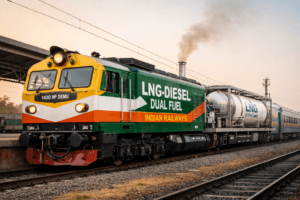
Indian Railways is taking a significant step toward decarbonization by partnering with industrial gas firm INOX India to pilot the country’s first operational LNG-diesel dual-fuel train, which has successfully demonstrated a 40% reduction in diesel consumption. The initiative involves retrofitting DEMU trains with advanced 2,200-litre cryogenic storage and regasification systems, allowing them to run on a cleaner and more economical blend of LNG and diesel. Beyond immediate fuel savings and emissions reductions, this pilot is viewed as a strategic move to decarbonize non-electrified routes and existing diesel fleets, while also building the critical cryogenic expertise and infrastructure needed for next-generation technologies like liquid hydrogen-powered locomotives.
Chugging into a Greener Future: Inside Indian Railways’ Ambitious LNG Trial to Slash Diesel Use by 40%
The rhythmic clatter of a train on the tracks is the heartbeat of India. For over 170 years, this sound has signified connection, commerce, and the daily commute for millions. But beneath that familiar rhythm lies a less romantic reality: the deep, throaty growl of a diesel engine and the plume of exhaust it leaves behind. Indian Railways (IR), the nation’s lifeline and one of the world’s largest railway networks, is also one of its largest consumers of diesel. Its fleet of thousands of diesel locomotives guzzles billions of litres of fuel annually, contributing significantly to the country’s carbon footprint and straining operational budgets.
However, a quiet revolution is underway, not in the sleek, electrified corridors of the bullet train project, but in the humbler, hard-working Diesel Electric Multiple Unit (DEMU) that serves short- and medium-distance routes. A recent announcement by industrial gas giant INOX India marks a pivotal moment in this journey. By supplying onboard liquefied natural gas (LNG) storage systems for Indian Railways’ first operational LNG-diesel dual-fuel train, they have unlocked the potential to replace up to 40% of diesel consumption with a cleaner, more economical alternative.
This isn’t just a story about a technological upgrade; it’s a narrative about pragmatism, innovation, and a massive, bureaucratic entity making a decisive pivot toward sustainability. It’s a story about the tracks of tomorrow being laid today, one converted engine at a time.
Beyond Electrification: The Case for a Transition Fuel
When we think of green railways, electrification is often the first—and seemingly only—solution that springs to mind. Indian Railways has set an ambitious target to become a “Net Zero Carbon Emitter” by 2030, and electrification is the cornerstone of this plan. The goal is to electrify the entire Broad Gauge network, a Herculean task that is already well underway. So, why invest time and resources in a dual-fuel LNG engine?
The answer lies in the nuance of a complex system. Electrifying every single kilometre of track is not only a monumental financial and logistical challenge but also a time-consuming one. There will always be routes—remote, low-traffic, or strategically sensitive—where electrification is not immediately feasible or economically viable. Moreover, the existing fleet of diesel locomotives represents a massive capital investment that cannot be simply discarded overnight.
This is where LNG emerges as a powerful and pragmatic “transition fuel.” It offers a way to decarbonize the non-electrified segments of the network and the existing diesel fleet right now. Unlike electrification, which requires a complete overhaul of the track infrastructure, retrofitting a locomotive with a dual-fuel system is a comparatively quicker and more cost-effective intervention.
Deepak Acharya, CEO of INOX India, captured this strategic importance perfectly: “The ability to substitute up to 40% of diesel with LNG is not just a technological milestone – it marks a decisive shift in how large-scale rail mobility can be decarbonised while enhancing operational efficiency and long-term sustainability.” The keyword here is “operational efficiency.” By reducing diesel consumption, Indian Railways can significantly lower its fuel bill, protect itself from volatile global oil prices, and improve its bottom line, all while shrinking its environmental footprint.
The INOX Innovation: A Cryogenic Heart on Wheels
At the core of this pilot project is a feat of precision engineering. The humble 1,400 HP DEMU, a workhorse of Indian suburban and intercity networks, is being given a futuristic upgrade. INOX India, a company with decades of experience in cryogenic storage, has developed and supplied a 2,200-litre onboard LNG receiving, storage, and regasification system.
Imagine the engineering challenges involved. LNG is not your average fuel. It is natural gas cooled to a staggering -162 degrees Celsius, transforming it into a liquid and reducing its volume by 600 times. This makes it energy-dense enough for transportation, but it requires storage tanks that are essentially high-performance thermoses. The INOX system, integrated into the DEMU’s driving power unit, must maintain this ultra-low temperature while the train rattles, vibrates, and lurches along the tracks.
The process is a marvel of thermodynamics. The stored LNG is not burned as a liquid. It must first be converted back into a gas. The system does this by carefully warming the cryogenic liquid, allowing it to regasify. This natural gas is then precisely metered and mixed with diesel in the engine’s combustion chambers. The result is a seamless dual-fuel operation where the driver likely notices little difference in performance, but the engine is sipping significantly less diesel.
The fact that INOX is currently the only Indian supplier to have delivered, tested, and validated such a system for rail applications is a testament to the specialized nature of this technology. The successful trials and certification at the Sabarmati Division in Ahmedabad were crucial steps, proving that the system could withstand the rigors of the Indian rail network and deliver on its promise.
From Ahmedabad to the Nation: Scaling the Pilot
The successful trials in Ahmedabad have given Indian Railways the confidence to move to the next phase. The plan is to induct an initial batch of 10 Driving Power Units for conversion. This small-scale rollout is a critical phase. It’s one thing to prove a concept works in a controlled trial; it’s another to prove it can work reliably across different routes, weather conditions, and operational demands.
This phase will generate invaluable real-world data. How does the system perform in the scorching heat of North India compared to the humidity of the coast? What is the long-term wear and tear on the engine when running on a dual-fuel mix? How do the economics hold up with fluctuating LNG prices? The answers to these questions will determine the pace and scale of the entire program.
The human element here is crucial. It’s not just about the engineers at INOX or the bureaucrats at the Railway Board. The success of this project hinges on the loco pilots, the maintenance crews, and the ground-level staff. Loco pilots will need training to understand the new system, its gauges, and its nuances. Maintenance staff will need to become adept at handling cryogenic equipment, a skill set far removed from traditional diesel engine repair.
One can imagine a veteran loco pilot, who has spent decades mastering the art of coaxing power from a pure diesel engine, now sitting in a cab with a new set of parameters. The transition will require a significant cultural and educational shift within the sprawling organization that is Indian Railways. It requires trust—trust that this new technology is safe, reliable, and will make their jobs easier, not harder.
A 40% Cut: What Does It Really Mean?
The headline figure—a 40% reduction in diesel consumption—is striking. But let’s unpack what that means in tangible terms. For a single DEMU running on a busy route, that translates to thousands of litres of diesel saved per month. For an initial batch of 10 units, the savings are substantial. If, and when, this technology is scaled to hundreds of units, the numbers become staggering.
- Environmental Impact: A 40% diesel substitution directly correlates to a significant drop in emissions. This includes not only carbon dioxide (CO2), a primary greenhouse gas, but also local pollutants like particulate matter (PM), nitrogen oxides (NOx), and sulphur oxides (SOx), which have a direct impact on air quality in the cities and towns the trains pass through. For communities living near railway stations and tracks, this could mean cleaner air and better public health.
- Economic Impact: India imports over 80% of its crude oil requirements. Every litre of diesel saved is a litre of foreign exchange preserved. For Indian Railways, which spends a massive portion of its revenue on fuel, a 40% reduction on converted locomotives provides immediate financial relief. This money can be reinvested into safety, infrastructure, and passenger amenities.
- Operational Impact: LNG burns cleaner than diesel. This can lead to reduced engine maintenance, longer oil change intervals, and less wear and tear on engine components. Over the lifecycle of a locomotive, these “soft” savings could be as valuable as the fuel savings themselves.
The Road Ahead: From LNG to Liquid Hydrogen
INOX India’s CEO, Deepak Acharya, didn’t stop at LNG in his comments. He looked further down the track, stating that the company sees “LNG as a powerful transition fuel and liquid hydrogen as the next frontier for zero-emission rail locomotives.”
This forward-looking statement provides a crucial piece of the puzzle. The infrastructure, cryogenic expertise, and safety protocols being developed for LNG today are laying the groundwork for the hydrogen-powered trains of tomorrow. Hydrogen, when used in a fuel cell, produces only water vapour as a byproduct. It is the holy grail of zero-emission transport. However, storing enough hydrogen on a train to give it a practical range is a monumental challenge. To be energy-dense enough, hydrogen must either be compressed to extreme pressures or cooled to -253 degrees Celsius to become a liquid.
The skills INOX is honing right now—building safe, efficient, and robust cryogenic storage tanks for a moving vehicle—are directly transferable to the liquid hydrogen economy. The 2,200-litre LNG tank on today’s DEMU is a prototype for the much more complex liquid hydrogen tanks that could power the trains of 2040. The trials in Ahmedabad are not just about cutting diesel by 40%; they are about building the institutional knowledge and supply chain for a completely emissions-free future.
Challenges on the Tracks
While the outlook is promising, the path is not without its hurdles. The successful rollout of LNG in railways faces several key challenges:
- Fuel Supply Chain: A train is only as useful as its range. Indian Railways and its partners will need to develop a robust LNG bunkering infrastructure. This means setting up LNG dispensing stations at strategic points along the routes where these dual-fuel trains will operate. Creating this “LNG highway” is a massive undertaking in itself.
- Safety and Public Perception: Transporting a highly flammable, cryogenic fuel on a train that passes through densely populated areas is a sensitive issue. While the technology is mature and safe, public perception can be a powerful force. Indian Railways and INOX will need to maintain impeccable safety records and engage in transparent communication to build public trust.
- Scaling the Technology: Moving from 10 units to 100 or 1,000 is a massive industrial challenge. It requires a reliable supply chain for the cryogenic kits, a skilled workforce for installation, and a nationwide maintenance network. INOX will need to ramp up its manufacturing capacity significantly to meet potential demand.
Conclusion: A Decisive Shift in Motion
The news of INOX India’s successful LNG trial is more than just a corporate press release. It is a tangible symbol of change within one of India’s most iconic institutions. It represents a pragmatic, multi-pronged approach to a complex problem. Indian Railways is not putting all its eggs in the electrification basket. Instead, it is pursuing a hybrid strategy—aggressively electrifying its mainlines while simultaneously decarbonizing its existing fleet with a transition fuel.
The 40% diesel cut is the headline, but the real story is the creation of a technological and industrial ecosystem. It’s about Vadodara-headquartered INOX proving that high-tech, critical components for the energy transition can be designed, built, and validated in India. It’s about the engineers who figured out how to keep a liquid at -162°C stable on a moving train. It’s about the loco pilots who will learn to master a new kind of engine. And it’s about the millions of passengers who, one day soon, might just breathe a little easier as they watch the countryside roll by.
The Indian train, an enduring symbol of the nation’s journey, is getting a cleaner, more efficient engine. And as it chugs into the future, it’s leaving behind a trail of not just smoke, but of innovation and a blueprint for sustainable mobility that the entire world can learn from.
You must be logged in to post a comment.