
Christmas in the Holy Land: Celebration and Survival Under Occupation
The article describes a bittersweet Christmas in Bethlehem, where celebrations resumed after a two-year hiatus due to the war in Gaza, highlighting the profound challenges faced by Palestinian Christians living under Israeli occupation. Once constituting 12% of the population, their numbers have dwindled to fewer than 50,000, or about 1%, due to economic hardship, movement restrictions, settler violence, and direct attacks. The community endures daily life constrained by checkpoints and the separation wall, while their churches and holy sites, including Gaza’s oldest churches which have been bombed, face vandalism and violence. Despite this environment, which many describe as a deliberate effort to force them out, the return of Christmas festivities is portrayed as an act of quiet resilience and a determined effort to maintain their ancient presence in the land of Christianity’s birth.
Christmas in the Holy Land: Celebration and Survival Under Occupation
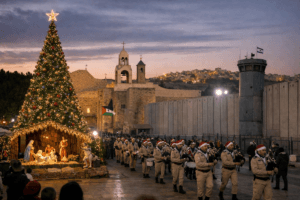
Christmas returned to Bethlehem after a two-year hiatus, but the celebrations in Christianity’s birthplace were marked more by quiet resilience than festive exuberance. For Palestinian Christians, one of the world’s oldest Christian communities, the season highlights a painful contradiction: living as a shrinking minority in the land of Christianity’s birth, under an occupation that many say is systematically dismantling their future.
The lighting of the tree in Manger Square and the sounds of bagpipes from marching bands provided a veneer of normalcy. Yet for shopkeepers like Jack Issa Giacaman, whose family has run the “Christmas House” store for generations, the doors remained closed. “You don’t see anybody around,” he lamented. “Unfortunately during the last years Israel converted Bethlehem to be a big prison”. This reality frames a Christmas season where symbols of hope coexist with an existential threat to a community that has called this land home for two millennia.
A Community in Steep Decline: The Shrinking Christian Presence
Palestinian Christians represent one of the most dramatic demographic declines of any religious community in the Middle East. In the early 20th century, they constituted approximately 12 percent of Palestine’s population. Today, fewer than 50,000 Christians remain in the occupied West Bank, East Jerusalem, and Gaza, making up just 1 percent of the population.
Table: The Shrinking Christian Presence in Key Areas
| Location | Christian Population (Estimate) | Key Trends |
| Bethlehem Governorate | 22,000–25,000 | Once 85% Christian in 1948, now ~10% Christian. |
| Ramallah & el-Bireh | ~10,000 | Administrative hub; includes historic Christian villages like Taybeh. |
| East Jerusalem | 8,000–10,000 | Centered in the Old City’s Christian Quarter. |
| Gaza Strip | ~1,000 (pre-war) | Severely impacted by war; 75% of Christian homes damaged/destroyed. |
This exodus is not voluntary emigration but a response to what community leaders and residents describe as a “deliberately made coercive environment”. The factors are multifaceted: economic strangulation, particularly due to the collapse of pilgrimage tourism; daily restrictions on movement; lack of political prospects; and direct threats of violence. As Bethlehem’s Mayor, Maher Nicola Canawati, notes, 4,000 people—10 percent of the city’s population—have left since the Gaza war began, largely because “tourism stopped and all the hotels and the industry was shut down completely”.
Daily Life Behind Walls and Checkpoints
For residents, the geography of occupation defines daily life. Bethlehem is encircled by Israel’s separation wall, checkpoints, and a ring of Israeli settlements. The journey from Nazareth to Bethlehem, which Mary and Joseph made, would today be fragmented by barriers, making the biblical narrative a practical impossibility for modern Palestinians.
- Movement and Economy: The main entrance to Bethlehem, Checkpoint 300, has been closed for much of December, traditionally the busiest economic month. This not only deters international pilgrims but also Palestinians from nearby villages, who risk being stranded if military gates are closed. The result is a ghost town atmosphere in Manger Square, where shuttered shops are the norm.
- Settler Expansion and Land Loss: The threat is not static but expanding. In November 2025, the Israeli cabinet approved the legalization of 19 settlement outposts. One, named “Yatziv” (Hebrew for “stable”), is slated for Beit Sahour, the biblical Shepherds’ Field near Bethlehem. For locals, the arrival of bulldozers triggers a familiar pattern of fear: “The destruction of an ancient way of life… Farmers – and shepherds – driven off their land”. In Taybeh, the West Bank’s only entirely Christian village, settlers have burned farmland and set cars ablaze.
- A Broader West Bank Crisis: The Christian experience is part of a wider humanitarian crisis. In 2025 alone, over 30,000 Palestinians in the West Bank were forcibly displaced—the largest such crisis since 1967. Human rights groups label the demolition of homes and structures a “deliberate policy of dispossession” to clear land for settlements.
Targeted for Faith: Violence and Vandalism
Beyond the systemic pressures, Christian communities face direct attacks on their persons, property, and places of worship. Monitoring groups report a significant surge in such incidents.
- Harassment and Hate Crimes: The Religious Freedom Data Center documented at least 201 incidents of violence against Christians between January 2024 and September 2025, primarily in Jerusalem’s Old City. These range from spitting and verbal abuse to physical assaults, often targeting clergy or those wearing visible crosses. In Jerusalem’s Armenian Quarter, a community present for 1,700 years, settlers have vandalized the area with graffiti reading, “Death to Arabs and their Armenian Friends”.
- Attacks on Holy Sites: Churches have been repeatedly violated. In July 2025, the ancient St. George Church in Taybeh was targeted by arsonists. In Jerusalem, a statue of Jesus at the Church of the Flagellation was attacked with a hammer. Even a Christmas tree and nativity scene at the Holy Redeemer Church in Jenin were set on fire, though Palestinian authorities quickly arrested suspects and local Muslim and Christian leaders united to condemn the act.
- War in Gaza: The conflict has been catastrophic for Gaza’s tiny Christian community. Israeli strikes hit the Church of Saint Porphyrius in October 2023, killing at least 18 displaced people sheltering inside. The Holy Family Church has been struck multiple times. An Open Doors report estimates 75 percent of Christian-owned homes in Gaza have been damaged or destroyed.
“We Will Resist Peacefully”: Between Celebration and Resistance
Faced with this reality, the resumption of Christmas celebrations in 2025 was a profound, if bittersweet, act of defiance. Mayor Canawati described canceling the previous years’ festivities with a “broken heart and a broken soul,” and reigniting them as a symbol of “resilience” and “hope”.
This resilience takes a specific form. In Taybeh, community leaders explicitly teach non-violent resistance. “We will resist peacefully,” stated Father Jack Nobel. This philosophy was echoed in Bethlehem, where celebrations proceeded despite the pain. “Our joy doesn’t mean people are not suffering,” explained Safaa Thalgieh at a Christmas market. “But we can only pray that things get better”.
The celebrations themselves also revealed the complex political landscape. While Palestinian Christians feel abandoned by Western Christian nations, the Israeli government hosts delegations of evangelical Christian leaders, promoting a narrative of itself as the “guardian of Christianity” in the region. This claim is met with stark rebuttals on the ground. “What drove the Christians out from Bethlehem is the occupation,” insists Mayor Canawati.
The future of Christianity in its birthplace hangs in a precarious balance. The community’s decline is a bellwether for the possibilities of coexistence and peace in the region. As families leave one by one, they take with them a living, ancient heritage. The Christmas story, born in Bethlehem, is now also a story of a community’s struggle to remain in its homeland—a struggle marked by quiet perseverance amidst checkpoints, shrinking numbers, and the longing for a peace that still seems far away.
You must be logged in to post a comment.