
Chip Wars and Strategic Shifts: Why India’s Entry into ‘Pax Silica’ Redraws the Global Tech Map
India has officially joined the U.S.-led Pax Silica initiative, a strategic move that aligns New Delhi with Washington’s efforts to build secure, trusted technology supply chains for semiconductors and critical technologies as a counterweight to China’s manufacturing dominance. The agreement, signed in New Delhi, marks a significant reset in U.S.-India relations after recent friction over India’s purchases of discounted Russian oil, which have now been scaled back in exchange for U.S. trade concessions and tariff reductions. By joining founding members like Japan, South Korea, and Israel, India brings its massive engineering talent pool and internal market to the alliance, though the initiative faces considerable challenges in matching China’s scale of production and navigating the complex trust required for deep technology sharing among sovereign democracies.
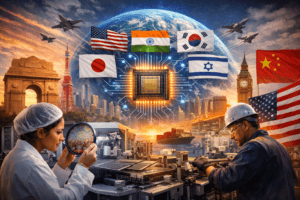
Chip Wars and Strategic Shifts: Why India’s Entry into ‘Pax Silica’ Redraws the Global Tech Map
New Delhi – In the gilded halls of a New Delhi hotel, a photograph was taken on Friday that, in the grand sweep of history, might look less like a diplomatic formality and more like the drawing of a new line on the map of the world.
The image captures India’s IT Minister, Ashwini Vaishnaw, pen in hand, surrounded by a cadre of U.S. officials. The occasion was the formal signing of an agreement bringing India into the fold of “Pax Silica,” a U.S.-led initiative to build secure and trusted technology supply chains. On the surface, it was a bureaucratic milestone. Beneath it, the tectonic plates of the global economy shifted again.
For the casual observer, “Pax Silica” sounds like a term from a political science textbook, an abstract concept of nations agreeing to play nice with microchips. But for the engineers in Bengaluru, the factory workers in Ohio, the startup founders in Tel Aviv, and the geopolitical strategists in Beijing, this is the sound of a new era crystallizing—an era where technology is no longer just a commodity to be traded, but the very bedrock of national security and economic sovereignty.
This isn’t just a story about India joining a club. It’s a story about the end of a unipolar tech world, the high-stakes gamble of diversification, and the intricate dance of a nation trying to balance its past dependencies with its future ambitions.
Beyond the Buzzword: What is Pax Silica?
The name itself, a modern twist on the concept of a “Pax Romana” (a Roman peace), hints at the ambition. Pax Silica, a reference to the silicon valley that powers the digital age, aims to create a zone of technological stability and trust among like-minded nations. It is a direct response to the vulnerabilities exposed in recent years: a global pandemic that choked supply chains, a war in Ukraine that weaponized energy flows, and a simmering superpower rivalry that has made the world’s reliance on a single manufacturing hub—China—feel less like efficiency and more like an existential risk.
The founding members—Japan, South Korea, the U.K., and Israel—are not random selections. They are the pillars of the global tech ecosystem. Japan and South Korea dominate materials and memory chips; the U.K. contributes cutting-edge IP and research from institutions like ARM; Israel is a startup nation powerhouse of innovation.
India’s entry, therefore, is not symbolic. It is a massive infusion of scale and talent into this fledgling alliance. With its world-class pool of chip designers, its massive internal market, and its aggressive push to become a semiconductor manufacturing hub, India provides the “lab” and the “factory floor” that Pax Silica desperately needs to become a viable alternative to the status quo.
The Delicate Dance: From Russian Oil to American Silicon
To understand the weight of Friday’s announcement, one must rewind to the days following Russia’s invasion of Ukraine in 2022. As Western nations scrambled to impose crippling sanctions, India saw an opportunity born of necessity. It began snapping up discounted Russian crude, a move that insulated its economy from global price spikes but drew sharp, public criticism from its Western partners, including the United States.
For a time, it seemed the much-hyped “Quad” partnership and the deepening U.S.-India ties might be cooling under the pressure of realpolitik. How could the U.S. trust India as a strategic partner in the Indo-Pacific if New Delhi was underwriting Moscow’s war machine?
The signing of the Pax Silica agreement, coupled with recent trade concessions, provides a clear answer: pragmatism wins. The friction over oil was a temporary squall, navigated by skilled diplomacy. The United States, under President Donald Trump, leveraged its economic might, linking tariff relief to a change in India’s energy posture. Prime Minister Narendra Modi’s government, in turn, signaled its strategic alignment by agreeing to wind down those Russian purchases.
This is the human insight at the heart of geopolitics. It’s not a binary choice between good and evil, but a constant, high-stakes negotiation. For the Indian consumer, this dance has a direct impact. The reduction of U.S. tariffs from 25% to 18% on Indian goods means that the intricate bracelet you buy from a Jaipur artisan, or the engineering component made in Pune, becomes slightly more competitive in the American market. It means jobs. For the U.S. taxpayer, it means a crucial partner in the Pacific is now more closely tethered to a supply chain that doesn’t run through Beijing.
The Bengaluru Engineer and the Ohio Fabricator
The high-level talk of “supply chain resilience” can feel distant. But its implications are intensely local.
Consider Kavya, a 29-year-old chip design engineer in Bengaluru. For years, her skills have been applied to designing cutting-edge semiconductors for global giants, but the actual manufacturing—the “fab” process—happened almost exclusively in Taiwan, South Korea, or China. Under the Pax Silica framework, her blueprints could soon be routed to a new fabrication plant in Ohio or a dedicated facility in Gujarat, built with investment from a Japanese conglomerate and technology from an Israeli startup.
Her work is no longer just a service export; it’s a thread in a global security blanket.
Or consider a small auto parts manufacturer in the American Midwest. Two years ago, a sudden lockdown in Shanghai halted his supply of a critical sensor, forcing his assembly line to a standstill. With Pax Silica, that sensor might now be sourced from a trusted partner in India, a nation with a shared democratic ethos and a reliable legal framework. The risk of disruption doesn’t vanish, but it is diversified. It is the difference between putting all your eggs in one basket and spreading them across a fortified network of baskets.
The Unspoken Challenge: Trust, Investment, and Sovereignty
Yet, the path of Pax Silica is not paved with silicon and good intentions alone. The initiative faces profound challenges.
First, the scale gap. China’s manufacturing dominance is not an accident; it is the result of decades of massive, state-directed investment. Replicating that ecosystem across multiple democracies, each with its own regulatory hurdles and market pressures, is a Herculean task. Can Japan, the U.S., and India coordinate their industrial policies quickly enough to compete with the sheer velocity of China’s output?
Second, the trust paradox. The initiative is built on “trusted” networks. But trust is fragile. Will the U.S. share its most advanced chip design software with Indian firms? Will Israel allow its cutting-edge security tech to be manufactured in a factory with Indian partners? The agreement is a framework, but the actual flow of sensitive technology will require a level of transparency and legal comfort that takes years to build.
Third, India’s own balancing act. India has masterfully cultivated a “multi-aligned” foreign policy, maintaining deep ties with Russia for defense, with the Gulf for energy, and now with the U.S. for technology. But Pax Silica demands a deeper commitment. It is an explicitly anti-China framework in its intent, if not its charter. For India, which shares a long and tense border with China, this alignment is strategically logical, but it also closes doors. It makes future economic normalization with Beijing far more complicated.
A New World, Etched in Silicon
Standing at the signing ceremony, U.S. Ambassador Sergio Gor spoke of a future where technology empowers “free people and free markets.” It was a resonant line, but the true meaning of Friday will be written not in speeches, but in the factories, research labs, and trade routes of the coming decades.
India joining Pax Silica is a recognition that in the 21st century, a nation’s sovereignty is defined by its technological independence. It is a bet that democracies can innovate and manufacture as efficiently as autocracies. It is a signal that the era of globalization-for-cheapness-alone is over, replaced by an era of globalization-for-security.
For the citizens of these partner nations, this means a world where the phones in their pockets, the cars they drive, and the power grids that light their homes are built on a foundation of strategic trust. It promises a future less prone to the whiplash of geopolitical blackmail.
But it also demands patience. The chips that will power the AI revolution in 2030 are being designed today. The factories that will build them are still on drawing boards. The trust networks that will govern them are being forged in rooms like the one in New Delhi on a Friday afternoon.
India has signed its name. Now the real work—of building, innovating, and trusting—begins.
You must be logged in to post a comment.