
Chilled Winds and Human Resilience: What Delhi’s January 2026 Is Teaching Us About Urban Life
Chilled Winds and Human Resilience: What Delhi’s January 2026 Is Teaching Us About Urban Life
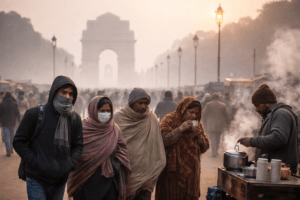
As the new year dawns, Delhi finds itself in the grip of a familiar yet profound seasonal shift. The meteorological headlines tell a straightforward story: cold northwesterly winds are gaining pace, capping maximum temperatures at a crisp 16-18°C, with a sharp drop in minimums expected. The India Meteorological Department (IMD) has issued alerts; the Air Quality Index (AQI), while still in the “very poor” zone, shows a slight reprieve. But to stop at the weather report is to miss the deeper narrative of a metropolis responding, adapting, and revealing its multifaceted character under the weight of a winter that is more than just a drop in mercury. This is a story of interconnected systems—environmental, social, physical, and geopolitical—playing out on the streets of the capital.
The Biting Wind: More Than Just a Chill
The arrival of persistent northwesterly winds, unimpeded by western disturbances until mid-January, is not merely a weather event. It is a climatic reset button for North India. For Delhi’s residents, this signals the start of “pure winter”—days of piercing sunshine and nights of intense cold. Weatherman Navdeep Dahiya’s prediction of temperatures potentially dipping below 5°C in the second week is a call to prepare for a sustained period of cold that tests infrastructure and personal resilience.
This consistent cold has layered implications. Public health systems brace for a rise in respiratory and cardiovascular complaints, exacerbated by the lingering poor air quality. The “shallow fog” reported, while less dramatic than dense fog, still disrupts circadian rhythms and daily logistics, affecting everything from flight schedules at IGI Airport to the morning routines of millions. The slight improvement in AQI to 311 (from 380) is a fragile victory, a reminder that winter in Delhi is a constant tug-of-war between meteorological dispersal and human-made pollution. The forecast of “very poor” air until January 11 means schools, offices, and families must continue their delicate dance of mitigation—air purifiers, masks, and altered outdoor schedules.
A City’s Pulse Amidst the Cold: The Social Fabric Under Strain
Strikingly, the cold snap coincides with reports of a starkly different nature: a spate of violent crimes on New Year’s Day. Four lives lost in separate incidents within hours paints a picture of a city grappling with tensions that the chill cannot freeze. A property dealer found slain, a teenager killed—these stories unfold in parallel to the weather report, reminding us that a city’s climate is also its social climate.
There is no direct causal link between the temperature and crime, but the timing invites reflection. The end of the year and the long, cold nights can amplify feelings of desperation, financial strain, and social isolation for some. While police report swift solutions in three of the four cases, the incidents underscore the relentless demand on civic safety and justice systems, which operate 24/7, regardless of the weather. It’s a reminder that urban resilience isn’t just about weathering physical cold, but also about maintaining the warmth of social order and security for every citizen.
When the Body Speaks the Mind’s Language: The Somatoform Disorder Case
In a seemingly unrelated piece of news, a neurologist’s account of a young woman suffering from unexplained physical sensations—tingling, numbness, and ‘jhanjhanahat’—offers a profound metaphor for the city’s own state. Diagnosed with a somatoform disorder, her body was manifesting psychological stress as tangible physical symptoms, despite “normal” test results.
This case holds a mirror to our collective urban experience. How often does the unquantifiable stress of city life—the anxiety of pollution, the pressure of daily commutes in difficult weather, the underlying fear of uncertainty—manifest in ways we can’t easily diagnose? The doctor’s insight that “the source of the pain is not damage in any organ, but in how the brain processes signals” is eerily analogous to urban malaise. The city, like the patient, might have all its functional “reports”—traffic lights working, metro running, markets open—yet its inhabitants can feel a deep-seated unease. The lesson here is one of holistic attention. Just as effective treatment required listening to the patient beyond the scans, effective urban management requires listening to the citizenry beyond just infrastructure metrics. Mental health, often neglected in public discourse, is as critical to a city’s well-being as its air quality index.
The Global Echo in Local Winters: India’s Voice on Venezuela
Finally, the external world intrudes, even into Delhi’s winter narrative. India’s measured statement of “deep concern” over the US military action in Venezuela and the capture of President Maduro is a geopolitical event with local resonance. It’s a reminder that the citizens bundled up in Delhi’s cold are part of a global community. Energy markets, which influence everyday prices, can be shaken by such events. The principles of dialogue and stability that India advocates abroad are the same ones required for harmony at home.
This connection globalizes the local. The same northwesterly wind shaping Delhi’s weather is part of planetary circulation patterns. The stability sought in international relations is the bedrock upon which local economic and social plans are built, including preparations for a long winter.
Weaving the Threads: January as a Metaphor for Urban Resilience
So, what does Delhi’s early January 2026 truly tell us?
It reveals a city of layers. The physical layer of atmosphere, with its winds and pollutants. The social layer of human activity, with its celebrations and tragedies. The psychological layer of its inhabitants’ well-being. And the interconnected layer of global citizenship.
The real human insight is this: navigating an urban winter is a multidisciplinary challenge. It requires:
- Environmental Vigilance: Heeding IMD alerts and AQI forecasts, not as passive information, but as a guide for personal and collective action.
- Social Compassion: Recognizing that periods of environmental stress can exacerbate social vulnerabilities, demanding greater community awareness and institutional responsiveness.
- Holistic Health Awareness: Validating and addressing the mental and physical health impacts of urban living, understanding they are deeply intertwined.
- Informed Citizenship: Acknowledging that local life is touched by global currents, and an engaged, informed populace is crucial.
The cold northwesterly wind, in its relentless flow, is more than a weather phenomenon. It is the backdrop against which the complex, resilient, and ever-evolving drama of Delhi continues to unfold. This January, the city isn’t just getting colder; it’s presenting a masterclass in the multifaceted art of urban survival and adaptation. The true measure of its winter won’t be in degrees Celsius alone, but in how its systems—and its people—respond to the chill, the challenges, and the quiet lessons embedded in the season’s breath.
You must be logged in to post a comment.